
We are not sinners because we sin. We sin because we are sinners.
R.C. Sproul
Original Sin
Total Depravity is the Reformed/Calvinist viewpoint on original sin. It all started in the garden with Adam and Eve committing the first sin. However, original sin mostly concerns the consequences to the human race because of that first sin. Many people mistake original sin to be all about how we as individuals have repeated that first sin over the years. While that is true, it isn’t the main point of Total Depravity. Virtually every church has, at some point, recognized or adopted the effect of original sin to some degree – also known as the Fall of mankind. We see the very nature of man changed after the first sin, affecting the entire human race. God created Adam and Eve with an inclination to a good and holy nature. But we know Adam was led astray by Satan and fell into sin by disobeying God’s Word. So, the Fall of mankind leads us to Total Depravity, which would have many effects on the human soul. Below, we will dive in and discuss the consequences and changes that have taken place since the Fall/original sin.
The Wretched Fall of Mankind
“As by one man sin entered into the world, and death by sin; and so death passed upon all men, for that all have sinned.” Rom 5:12
The Doctrine of the fall starts with Adam being that he was first created human and that he represented the Human race. He was our Federal Head. He was our first Earthly father. He was our ambassador. We are told sin entered through one man and that it has been passed down through every human born of the flesh. There is no escaping it and there are no exceptions for man(Rom 3:23). The sin of Adam was a compound of unbelief, pride, ingratitude, and rebellion. Of which we have now inherited these traits through sin resulting in Total Depravity.
Total Depravity could be said to be the inclination to choose sin and evil over righteousness as a result of the Fall. Total Depravity could also be the lack of ability to do good and profess faith.
“But of the tree of the knowledge of good and evil you shall not eat, for in the day that you eat of it you shall surely die.” Gen 2:17
Now when God gave the command that man shall not eat of the tree He told them what would happen. He said “for in the day that you eat of it you shall surely die” now I believe He was talking about it in the spiritual way since they didn’t physically die on that day. Now that’s not to say that physical death wasn’t brought about by sin, I believe it was but that was not the death that God was warning them about. That day man’s nature and ability to choose Righteousness and Holiness over evil died along with his Soul. Man’s ability to choose anything spiritual died the day he fell into sin. No longer does he have the free will in spiritual matters anymore, for how can a dead man choose life and he is no longer drawn to the inclination to choose righteousness. He no longer seeks God and in doing so he no longer seeks righteousness. He seeks to do that which is evil only putting more enmity between Himself and God.
Human beings were originally created in the image of God and were furnished in mind with a true and sound knowledge of the Creator and things spiritual, in will and heart with righteousness, and in all emotions with purity; indeed, the whole human being was holy. However, rebelling against God at the devil’s instigation and by their own free will, they deprived themselves of these outstanding gifts. Rather, in their place they brought upon themselves blindness, terrible darkness, futility, and distortion of judgment in their minds; perversity, defiance, and hardness in their hearts and wills; and finally impurity in all their emotions. – Article 3.1 of The Canons of Dort
Total Depravity equals a corrupt nature
“Behold, I was brought forth in iniquity, and in sin did my mother conceive me.” Psalm 51:5
The idea that we are born into sin due to the sin of Adam comes from many places in the Bible, like Psalm 51 or Romans 3. This is not a new doctrine. David cries out that he was born into sin and Paul says in Ephesians that all people without Christ are “sons of disobedience.” So if we are thus “by nature children of wrath,” it is because we are sinful and for this we are guilty. For no one is free from the sinful nature that is passed down through generations; it affects everyone. We are guilty from birth because we have inherited this fallen nature from Adam. We are under condemnation, and consequently we will be found guilty apart from Christ.
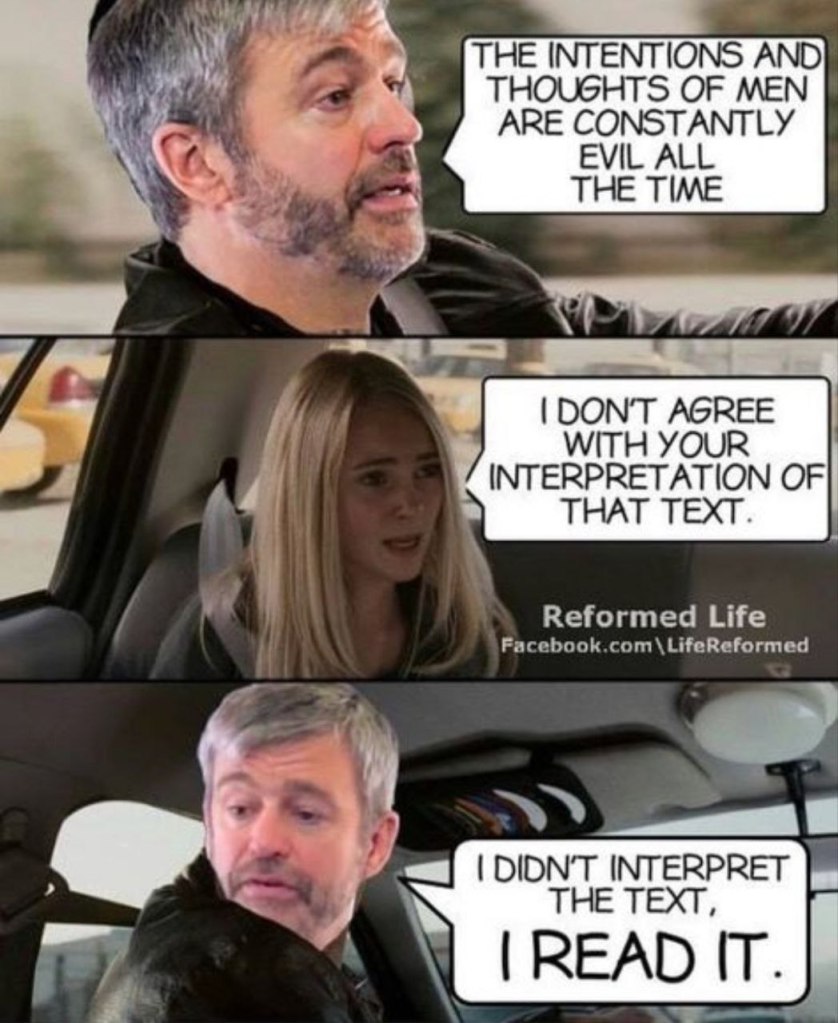
“for the intention of man’s heart is evil from his youth.” Gen 8:21
“The word translated youth, signifies the whole of the former part of the age of man, which commences from the beginning of life. The word in its derivation, has reference to the birth or beginning of existence . . . so that the word here translated youth, comprehends not only what we in English most commonly call the time of youth, but also childhood and infancy.”
Jonathan Edwards
Every intention of man before being reborn is evil, why is that? Because he seeks everything for his own selfishness rather than seeking God, and he is unable to seek God. We were created to worship God, and when we fail to do so, it is because of our sinful nature. It is because we choose to worship ourselves or something created rather than the Creator. Man can do nothing good in his fallen state of being, which is a very big problem for us. For we were designed to do good, and yet we lack the ability to carry this out on our own. This is a very big conundrum for mankind, one which only God Himself can fix through the death of His Son on the Cross.
Human beings brought forth children of the same nature as themselves after the fall. That is to say, being corrupt they brought forth corrupt children. The corruption spread, by God’s just judgment, from Adam and Eve to all their descendants—except for Christ alone—not by way of imitation (as in former times the Pelagians would have it) but by way of the propagation of their perverted nature. – Article 3.2 of The Canons of Dort
Total depravity equals Inability
“For I know that nothing good dwells in me, that is, in my flesh. For I have the desire to do what is right, but not the ability to carry it out.” Rom 7:18
We act like our free will and ability to choose is sovereign over all, without realizing that we lack the “Ability to carry it out” because we are spiritually dead. Apart from God we can do nothing and as long as we remain in the state of original sin, we will remain separated from God. We are found as slaves but not as slaves to God rather we are found to be bound by sin to our flesh(corrupt nature). A slave cannot free himself rightly until such debt is fully paid back. This debt can only be paid via God since it is against Him that we have committed such sins and we are found dead, unable to pay Him back. The dead not only lack the ability to do so but they also lack the ability to hear God’s call. More so, they lack the ability to see God. This inability includes not being able to understand God’s word nor even to see it for what it is. This understanding elevates what God has done on our behalf and leads to a worship and praise of Him. This view gives God all the glory rather than placing it on the responsibility of man’s choice in the matter of his salvation.
Once we understand Total Depravity, we begin to understand what good truly is. God is good and all good things come from Him. There are many different types of good things, such as deeds, heart posture, and nature/being. Goodness in a moral sense involves living according to God’s commandments and teachings. This is also the way the Spirit brings about the fruit of goodness, of which only Christians can truly have. Christians are called to imitate Jesus Christ, who is the ultimate example of goodness. Only those with the Spirit are able to do this. Even the “good” that non-believers do is not actually good. For those in the flesh only serve themselves, even if they are found doing “good deeds”; they lack the posture and nature for it to be truly good. For all that they do is hostile towards God, for all that they do is found in the flesh and cannot please God. This isn’t saying that we shouldn’t encourage those outside of Christ to do “good deeds”; rather, it just enforces the thought that what is truly good is found in Christ alone, not in the outward appearance of deeds. By understanding this, might they look towards the goodness of the Spirit and marvel at it.
‘For the mind that is set on the flesh is hostile to God, for it does not submit to God’s law; indeed, it cannot. Those who are in the flesh cannot please God. – Romans 8:7-8
Psalm 16:2; Proverbs 3:12; 3 John 1:11
Therefore, all people are conceived in sin and are born children of wrath, unfit for any saving good, inclined to evil, dead in their sins, and slaves to sin. Without the grace of the regenerating Holy Spirit they are neither willing nor able to return to God, to reform their distorted nature, or even to dispose themselves to such reform. – Article 3.3 of The Canons of Dort
Man, by his fall into a state of sin, hath wholly lost all ability of will to any spiritual good accompanying salvation: so as, a natural man, being altogether averse from that good, and dead in sin, is not able, by his own strength, to convert himself, or to prepare himself thereunto. – Chapter 9.3 of Westminster Confession of Faith.
Total Depravity extends to all Mankind
“For all have sinned and fall short of the glory of God.” Romans 3:23
All have fallen, All have sinned, All have failed to seek God. Paul makes it very clear that there is not even one who is righteous nor anyone who seeks after God. This is clear to be inclusive of all ages and all people with no exception being that we all come from Adam spiritually & physically. God expects us to be holy and perfect, why is that, because He is Holy and perfect. Failing to meet this status of holiness & blamelessness, would mean that we have missed the mark. Paul also makes this clear in his letter to the Corinthians “that one has died for all, therefore all have died”. Death is an awful thing, one that man likes to push off and not give any thought to. When we come to think about death and our true nature let us not insert what we wish to be true over the true reality. So long as man does not serve God with body, soul, strength, and spirit, he is not really alive. Our first question should always be “What saith the Lord?”, we should always find ourselves seeking out the truth in God’s Word. Even when such truth leads us to seeing ourselves as dead in our sins, for it is only then that we will see our need for Christ.
Also they teach that since the fall of Adam all men begotten in the natural way are born with sin, that is, without the fear of God, without trust in God, and with 2 concupiscence; and that this disease, or vice of origin, is truly sin, even now condemning and bringing eternal death upon those not born again through Baptism and the Holy Ghost. – Article 2 of Augsburg Confession
If Jesus was fully human, did He have a Sinful Nature?
The question then arises; What of Jesus? How is He fully human, yet doesn’t have a Sinful Nature? While there are a plethora of different theories that make an attempt at understanding this issue, I believe that this is the most consistent way of understanding it, as follows; That the Curse given to Adam spreads not by Physical means, but Spiritual. It is best put by Paul in his letter to the Corinthians.
For as in Adam all die, so also in Christ shall all be made alive. – 1st Corinthians 15:22
Adam, who was cursed, has passed on this spiritual curse to all of Humanity as all of Humanity is by nature in Adam, that Adam is our Federal Head. Jesus, while being born into Humanity, is not in Adam, rather He is in the Father, as the Father is His Federal Head. We must remember that Jesus, while fully Human, is also Fully God. His Natures can’t conflict with each other, as He can’t have one Holy Nature and one Sinful Nature. God can’t be in the presence of Sin, much less possess a Nature completely inclined towards it.
Common Objections
- Jesus, in order to be tempted must have had a Sinful Nature. This is not true. If we remember the Garden, Adam and Eve, prior to the Fall, didn’t have a Sinful Nature, and yet they were tempted. We could also look to the Angels, who were made Holy. They also were tempted. One doesn’t need to have a Sinful Nature to be tempted.
- Jesus, in order to be fully Human must have had a Sinful Nature. It is important to note that a Sinful Nature is not a necessary quality to be Human. Again, as we see in the Garden, prior to the Fall, Adam & Eve did not have a Sinful Nature and were still Human.
Another point to consider, is that the fall did not immediately affect the biology of Adam. The fall was primarily a spiritual reality, as is Regeneration, Salvation, Heaven, etc. If the fall brought Spiritual death, it is consistent to see it being passed down spiritually rather than physically.
While this is just a theory on how Christ did not inherit Original Sin, I do find it to be the most consistent one. We must remember that this specific point is a secondary issue, as it doesn’t impact or change the Gospel. We must be gracious to those who have different lines of thought and stand arm in arm with them in our declaration; All those who are found in Christ shall be saved, that it is by Grace Alone through Faith Alone in the finished work of Christ Alone!
Does this Doctrine include Mary and go against the Roman Church?
Throughout the Bible, we see time and time again that all of Humanity is Sinful, with the only exception being Jesus Christ, our Lord. The Roman Church affirms and binds to the hearts of man the Dogma of Mary’s Sinlessness, Immaculate Conception. This teaching must be denied as it is clearly a novelty, a development over time, and unbiblical. I will make a brief case in defense of the Biblical and Historical teaching that Mary was a sinner, in need of a Savior.
In dealing with the novelty, we have no Early Church Fathers writings asserting that Mary was sinless, and the earliest writing we have potentially supporting this claim is Ephraim the Syrian in his book Nisibene Hymns.
“You alone and your Mother are more beautiful than any others, for there is no blemish in you nor any stains upon your Mother. Who of my children can compare in beauty to these?” (Nisibene Hymns 27:8 [A.D. 361]).
It was more clearly defined by Augustine in his book Nature and Grace.
“Having excepted the holy Virgin Mary, concerning whom, on account of the honor of the Lord, I wish to have absolutely no question when treating of sins—for how do we know what abundance of grace for the total overcoming of sin was conferred upon her, who merited to conceive and bear him in whom there was no sin?—so, I say, with the exception of the Virgin, if we could have gathered together all those holy men and women, when they were living here, and had asked them whether they were without sin, what do we suppose would have been their answer?” (Nature and Grace 36:42 [A.D. 415]).
We find little reason to believe the assertions made that it was a Tradition passed on by the Apostles, because it is entirely absent from any early source with direct connection to the Apostles. That being said, we do have numerous earlier quotes teaching that all of mankind is sinful.
“Mankind by Adam fell under death, and the deception of the serpent; that ‘we are born sinners;’ and that we are entirely flesh, and no good thing dwells in us; he asserts the weakness and disability of men either to understand or perform spiritual things, and denies that man, by the natural sharpness of his wit, can attain to the knowledge of divine things, or by any innate power in him save himself, and procure eternal life,” (Epist. ad Zenam, p. 506.). – Justin A.D 150
Satan is “the angel of wickedness, the artificer of every error, the interpolator of every age; by whom man from the beginning being circumvented, so as to transgress the commands of God, was therefore delivered unto death, hence he has also made the whole kind, or all mankind, which springs from his seed, infected, partaker of his damnation,” (Tertullian. de Testimon. Animae, c. 3, p. 82.). – Tertullian A.D 200
“In Adam,56 as saith the word, all die, and are condemned in the likeness of Adam’s transgression, which the divine word says not so much of some one, as of all mankind—for the curse of Adam is common to all,” (Contr. Cels. 1. 4, p. 191.). – Origenus Alexandrinus. A.D. 230.
In keeping the quotes from Ephraim and Augustine in mind, we can also trace through History the development of the Marian Dogma’s. It can be sourced in having started with the Gnostic writing; The Gospel of James which was written mid-late 2nd Century. In this ‘Gospel’ we are given a fictitious history of Mary’s early childhood, the birth of Jesus; namely that she remained a perpetual virgin and Jesus’ early life, which was later Dogmatized by Pope Martin I in 640 A.D. Then later the concept of the Sinlessness of Mary was taught; Earliest being 361-415 A.D, which was later Dogmatized by Pope Pius IX in 1854. This further developed into the Ascension of Mary, which was first written about by Epiphanius 350 A.D in his book Panarion, which was later Dogmatized by Pope Pius XII in 1950. We now have many Romanists pushing for the Dogmatization of Mary to be the Co-Mediatrix, and Co-Redemptrix. This being a further abandonment of the Gospel by the Romanist.
God has made clear statements on the condition of Humanity; Namely that all are Sinful, and in need of a Savior, that being Jesus Christ! In this Section I will list some of the text’s that show the Biblical Doctrine that all of Humanity is Sinful.
- Romans 5:12,19 – sin came into the world through one man, and death through sin, and so death spread to all men because all sinned… by the one man’s disobedience the many were made sinners
- Romans 11:32 – For God has consigned all to disobedience, that he may have mercy on all.
- Romans 3:23 – for all have sinned and fall short of the glory of God
- 1 John 1:8,10 – If we say we have no sin, we deceive ourselves, and the truth is not in us. If we say we have not sinned, we make [God] a liar, and his word is not in us.
- Mark 10:18/Luke 18:19 – And Jesus said to him, “Why do you call me good? No one is good except God alone.”
- Mark 7:21-23 – “For from within, out of the heart of man, come evil thoughts, sexual immorality, theft, murder, adultery, coveting, wickedness, deceit, sensuality, envy, slander, pride, foolishness. All these evil things come from within, and they defile a person.”
- Genesis 8:21 – the Lord said in his heart, “I will never again curse the ground because of man, for the intention of man’s heart is evil from his youth.”
- John 3:6 – “That which is born of the flesh is flesh”
- Romans 8:7-8 – For the mind that is set on the flesh is hostile to God
- Ephesians 2:3 – among whom we all once lived in the passions of our flesh, carrying out the desires of the body and the mind, and were by nature children of wrath, like the rest of mankind.
- Romans 8:7-8 – Those who are in the flesh cannot please God.
As seen, the Marian Dogma, the Immaculate Conception, is a-historical, a development over time, and unbiblical. We find no reason to believe or trust the Roman Church when they compel men to affirm this Doctrine. It is our duty as Christians to stand firm in Sola Scriptura and to not bow to the idolatrous whims of apostate Rome.

“There is no way to avoid the obvious teaching of Scripture that Adam’s sin had dreadful consequences for his descendants. It is precisely because of the abundance of such biblical statements that virtually every Christian body has composed some doctrine of original sin linked to the fall of Adam.”
R. C. Sproul

Leave a comment