
While the Church has diligently preached the Gospel and been courageously confronting modern culture, a wicked disease has stealthily infiltrated through the back door. This deceptive disease has been quietly festering within our community, hidden from the eyes of many. Recently, it has begun to rear its ugly head, revealing its true nature. It has distorted the sacred words of God, much like Satan deceived Eve in the garden. Yet this time, it springs forth from our supposed “brothers” in Christ, leading us into the despicable trap of battling evil with even more evil and setting brother against brother. This disease is known as “Kinism,” a modern disguise for the long-standing affliction of racism, while falsely claiming a biblical foundation. I am vigorously committed to guiding us through the depths of this disease, exposing what it truly is, illustrating why it stands in stark opposition to the Gospel, and revealing how it is a condemned heresy within the Church.
One question you might ask yourself when coming across Kinism is, how did Kinism gain such a following? It came about through the advancement of an extreme “Christian Nationalism” that typically originates from a far-right group within the Reformed Christian camp. Like many twisted heresies, it comes with a truth and then proceeds to distort it. This truth being “Ordo Amoris,” which is the order of love; we will discuss this more in depth below. But just know that they have abused this theological idea to the extent of turning truth into heresy.
What is Kinism
“Kinism is the belief that the ordained social order for man is tribal and ethnic rather than imperial and universal. Mankind was designed by God to live in extended family groups…. Blood ties are the only natural and workable basis for a healthy society not subject to the ideologies of fallen man. We believe this is the normative system for our people. We believe that our White people have a God-given right and duty to seek their own prosperity and existence as a distinct nation.” definition by a Kinist
However, we will be using this definition below to describe kinism because this one is a bit more simple.
Kinism is a modern idea that racial segregation and ethnic homogeneity are biblically ordained and should be practiced within Christian communities. This ideology promotes the belief that people should live, marry, and worship within their own racial or ethnic group, and that mixing races or ethnicities is against God’s design.

Right from the start, it’s clear why this topic is sensitive as it deals with race. The issue is worsened by claims that God intended for us to be divided by skin color and ethnicity. This belief not only implies that such divisions are ideal for them, but also suggests that it’s a biblical truth, which misrepresents God’s true intentions for His creation and gospel. Now this definition above and these accusations below will not be true for all Kinists per se. Some are partial to the idea of Kinism and its ideology, while others might be in full support of it. You also have those who might support a section of the particular beliefs of Kinism, and yet this might push them more into a defensive nature because they too are on the line. They might get swept up in the overall term of being defined as a Kinist; this is unfortunately collateral damage in the honorable quest of rooting out such a disease. One should seek to take a page from the Kinist book of separation and separate themselves from such horrible ideology.
Racial Segregation
Kinists believe that “extended blood ties are the only natural and workable basis for a healthy society.” They prioritize their own race or ethnic group and believe that mixing races will harm their unique heritage. They see other races as a hindrance to them in aspects of crime and poverty, while also believing that their race, in some way or another, is superior, whether that be because of their health, cultural achievements, or “moral righteousness.” They derive this idea from biblical texts such as Genesis 1:25, Genesis 11:1-9, and Genesis 9:20-27. Because of their interpretation of these texts, Kinists hold to the belief that each race should have its own distinct nation and culture by God’s design, and that races should remain within the borders of their “kind.” This means no mixed marriages, communities, nor worship among different races, depending on how serious the Kinist belief is. To be found in violation of said views would be, at best, unwise, and at worst, a sin against God.

Ethnic Homogeneity
Kinists believe that each race has its own unique culture, heritage, and traditions that must be preserved at all costs. They also believe their culture is “irreplaceable and vital to our survival as a people.” They fear the loss of their identity of their own unique kind. Usually, their aim is at a complete Monoethnicity, which is the existence of a single ethnic group in a given region or country. Without that, their uniqueness of culture might cease to be, and, worse, they might be found guilty of sinning against God’s design. Ultimately, they desire ethnic homogeneity because they believe it is divinely ordained, essential for social stability, and necessary to preserve their racial and cultural identity.

Within Christian communities
This last phrase is the disguise in which they have been hiding all along. This idea of it being “within Christian communities” that nothing changes for those in Christ, that they are free to behave as such. This is what really gets at me, that so-called “Christians” would seek to divide the body of believers and show contempt for their own brothers. The only way this happens is if someone is misled and/or they never really were a part of us to begin with (1 John 2:19). Kinists reject the concept of a unified, multi-ethnic church, preferring to maintain separated churches based on race. This is no different from the early division between Jews and Gentiles in the New Testament. They emphasize racial ties as a means of societal sanctification, which denies the power of the gospel to overcome divisions and transform individuals. They look toward the color of their skin and the superiority of their culture for a righteousness of their own. While they claim to be Christian, their interpretations of the Bible are more often seen as heretical and contradictory to core Christian beliefs.
“it’s almost as if the Gentiles got tired of being hated by the Jews and so now they are going to hate back” – D.J.Y
Kinism Vs the Word of God
When kinship means more to oneself than common faith in Christ, we have lost sight of the Gospel. No longer is it good news if it means that we might have to leave our identity in our kin behind. No longer do we see our brothers and sisters in Christ as closer to ourselves than that of our kin. Sadly, this is what kinism leads to at its fullest degree.
It dienes the Biblical view of Imago Dei
The biblical idea of “Imago Dei” comes from Gen 1:27, where He creates man in His own image. In the image of God, He created mankind; this gives us all equal value and a rooted identity back to our creator. This equal value is what makes Christians the best people for equal rights, freedoms, and the value of life extended to all people. All life, at the bare minimum, is deserving of general respect and love because our Creator has instilled such a uniqueness in man that sets him apart from the animals and even the angels. To deny such truths puts us at odds with God’s own word. Kinism seeks to destroy or belittle this idea of value and limits it to only a select few groups of people that just so happen to be ‘divinely’ white. This view leads to an idea of racial superiority that divides humans based on the worth of their outward appearance. This is contrary to the Scriptures, where we see the same worth given to the Gentiles as was given to the Jews as well. Nowhere in God’s word do we see Him treating people differently because of their outward appearance. Instead, we see the exact opposite—that Christ was drawn to those who have been rejected and despised by the world. He had compassion for them because He too knew what it was like to be rejected by those who see themselves as superior to others. We see numerous times how Christ condemned the actions of the Jews and Pharisees based on how they belittle others that they viewed as lesser than themselves.
It hinders the great commission
When blood is more important than faith, it becomes a hindrance to the spread of the Gospel. All throughout the Scriptures, the priority has always been about one’s faith, not their race. Someone’s skin color plays no factor in one’s faith nor how well off they will be by worldly standards. Note just how unbiblical these assertions are—“extended blood ties are the only workable basis for a healthy society.” In other words, the gospel of Jesus Christ and the power of the Holy Spirit that flows from His perfect work are not enough to restrain sin, hatred, and crime. No, according to the Kinist, racial blood ties are what are needed. This once again is a denial of the gospel and the sufficiency of Scripture. Christ’s death upon the cross was for the purpose of bringing all His people from all nations to form one body in Him, united in all things. Kinism seeks to hinder the spread of the Gospel by drawing back and separating themselves in the same way Peter did in Antioch from those of different backgrounds.
“That besides treating all men in accordance to God’s Law, our only universal responsibility to others is to share the Gospel with them. That this responsibility is not borne by every individual, but collectively by the Church. That the social gospel is not the Gospel, and that relief efforts, as well as educational and medical missions, are often destructive of the spread of Christianity to foreign cultures. That our responsibility consists only of sharing the Good News of Jesus Christ. That the most effective missionaries are native missionaries, and that foreign missionaries should only be considered if no natives are available.” Mickey Henry (Kinist)
“Note also the blatant racism in the Kinist idea that the difference among men is
endogenous. This word means they are intrinsic to different racial groups. They flow
from internal causes and thus cannot be overcome by the gospel. This is totally contrary
to the gospel message. The gospel brings Jew and Gentile, slave and free, together in
Christ. All believing races are part of the same church and partake of the sacraments
together. To have separate tables of fellowship, Paul says in Galatians, is an implicit
denial of the gospel. If different races can be brought together in the church,
then they can in a Christian society also.” – theonomy resources
The Gospel’s emphasis on spiritual kinship over earthly, ethnic kinship highlights a profound shift in how relationships are defined within the faith. We see this clearly in Jesus’ radical inclusion of the marginalized, such as the Samaritan woman at the well and the Gentiles who were often viewed with suspicion and disdain by the Jewish community. His interactions with these individuals were not mere acts of kindness but powerful statements about the expansive and inclusive nature of God’s love. By actively seeking out those who would be seen as contrary to the ideal people group by Kinist ideology, Jesus challenged societal norms and demonstrated that spiritual family transcends ethnic boundaries, emphasizing that true kinship is found in shared faith and love, rather than lineage or cultural identity. This radical approach invites all people into a community based on grace and acceptance, fostering a deeper understanding of what it means to be united as children of God.
It divides the Body
Another way Kinism strays away from the Word of God is through the ideas that lead to a division of the body among believers. This ignores the New Testament teaching of becoming one in Christ. We are no longer divided by race nor by cultural differences. The vision of the Church in the New Testament is of one that is multiethnic. One that prioritizes faith rather than culture. One that values its brothers and sisters in Christ more than those of his or her own family members who are not of the faith. Those who are spiritually united, not united by blood ties. Kinism is nothing more than another form of modern-day Pharisees that despise those of Gentile roots. They hold themselves as more righteous than those of other cultures and races. Kinists fall guilty to the misinterpretation of scripture to justify segregation.
Jews and Gentiles share equal status in local churches. They worship, eat, and fellowship together as one body. No believer in Christ should be excluded from the church community due to race or ethnicity. Saying otherwise is heresy. We all partake in the same baptism and the same Lord’s Supper.
‘that there may be no division in the body, but that the members may have the same care for one another. ‘ 1 Corinthians 12:25
This important theological discussion leads Paul to conclude that “there should be no division in the body” (1 Cor 12:25). The various ethnic groups and social classes in the local congregation should show their Christian love and care for one another by avoiding conflict and separation.
‘For he himself is our peace, who has made us both one and has broken down in his flesh the dividing wall of hostility and might reconcile us both to God in one body through the cross, thereby killing the hostility. So then you are no longer strangers and aliens, but you are fellow citizens with the saints and members of the household of God, ‘ Ephesians 2:14,16,19
The hostility between all races finds its peace in our Lord. For the Christian, no matter our race nor our culture, we all have the same Father. We have all been adopted into the same family. We are citizens in the same Kingdom of God. We are a part of the same Body of Christ. We are all one in Christ Jesus, our Lord and Savior.
“The argument is not that those who aren’t White Anglo-Germanic Americans are going to hell. They can receive salvation, however I’m not letting them marry my daughter or invade my homeland. I don’t like black (*n word), I don’t find them pleasant. They’re not even good fighters. I don’t need a token black. I want them to be saved and then get the #$@! away from me” – words from a so called “Christian” Kinist
Misinterpretations that lead to a false view
According to their kinds
‘And God made the beasts of the earth according to their kinds and the livestock according to their kinds, and everything that creeps on the ground according to its kind. And God saw that it was good. ‘ -Genesis 1:25
In the Kinist/racist paradigm, there is a misguided sense of equality when it comes to salvation, and there may even be a superficial kind of equality recognized between churches of different ethnic groups; however, in their view, this does not negate the belief that God intended for all races to worship separately in their own Black, Mexican, or Asian churches. This perspective reinforces a troubling segregation that not only diminishes the beauty of diversity within the Christian faith but also promotes an unquestioning adherence to ethnic boundaries that they see as divinely mandated. They transform ethnic and cultural differences into existential absolutes that must be maintained at all costs, viewing any challenge to this division as a direct threat to their interpretation of God’s design. (This skewed understanding stems from their perverted interpretation of the phrase “according to one’s kind” in Genesis 1:21, 24, 25, which they read as a directive for racial separation, which they misappropriate to justify division rather than unity among God’s creation.) While God did create kinds, which could be the explanation of the animal classification that we see, yet this in no way changes the human race. The human race is all made up of one kind; we are all descendants of Adam. We all share the same DNA; there is no difference besides the varying amount of melanin that we share.
The Tower of Babel
‘Therefore its name was called Babel, because there the Lord confused the language of all the earth. And from there the Lord dispersed them over the face of all the earth. ‘ – Genesis 11:9
Another Kinist says, “When nations cease to be based on blood heritage rooted in common knowledge, culture, and language, they will inherently lose their common faith.” He then refers to the Tower of Babel incident. Once again, the Kinist has it precisely backwards. The only way to have a common, lasting heritage and culture is to have a common faith. One’s faith determines culture, not the other way around. Culture, to a large degree, is an external manifestation of faith. If we took some real Christian families from Greece, Africa, Spain, and China and put them on an island, there would be no oppression, murder, or suffering. Nazi Germany demonstrates what happens to a nation or culture that abandons the Christian faith. Soviet Russia is another good example. These nations (Russia and Germany) did not have a race problem but a faith problem. Culture is an expression of faith; indifferent elements of a culture, like eating rice and fish instead of wheat and beef, are adiaphora and irrelevant.
Sin divides while the Gospel unites. The Gospel is reversing the work of Babel in that it will bring about restoration regarding relationships among diverse peoples and nations. Unlike the confusion of languages that led to separation and misunderstanding, the message of Christ fosters a spirit of reconciliation that transcends cultural barriers. It will find its end goal in heaven when all tribes, tongues, and nations will be gathered together in perfect harmony, worshiping God in a collective act of praise and adoration, reflecting the beauty of our diverse backgrounds as one family in Christ. This ultimate gathering signifies not only the fulfillment of God’s promises but also represents the profound impact of the Gospel in healing and uniting what was once fractured and divided.
Q: How do Kinists use the Tower of Babel narrative in Genesis 11 to justify racial separation?
A: Kinists use this passage to argue that God’s scattering of people by language at Babel shows that He intends for people to remain in separate nations based on shared blood, culture, and language.
Verses they seems to ignore
‘But when Cephas came to Antioch, I opposed him to his face, because he stood condemned. For before certain men came from James, he was eating with the Gentiles; but when they came he drew back and separated himself, fearing the circumcision party. And the rest of the Jews acted hypocritically along with him, so that even Barnabas was led astray by their hypocrisy. But when I saw that their conduct was not in step with the truth of the gospel, I said to Cephas before them all, “If you, though a Jew, live like a Gentile and not like a Jew, how can you force the Gentiles to live like Jews?” ‘ Galatians 2:11-14
Here we have an incident between Paul and Peter that explicitly contradicts the whole Kinist way of thinking. In that, Peter was rebuked by Paul for withdrawing from the Gentiles in a form of segregation. He was worried about being seen eating with the “lower class/un-pure” when the Jews arrived, revealing a deep-seated prejudice that went against the inclusive message of the Gospel. Paul’s confrontation was not just a personal grievance; it was a necessary intervention aimed at preserving the sanctity of the early Christian community, reminding Peter and others that their true identity was rooted in Christ, not in societal divisions. To make things worse, his actions influenced others to follow him, and by following him in this manner, it led them to sin and stray away from the Gospel in which they were preaching; this made them hypocrites. This story highlights the dangers of allowing cultural biases to infiltrate the church, as it ultimately undermines the unity and love that believers are called to embody. The fallout from this incident serves as a cautionary tale, urging modern Christians to examine their own behaviors and attitudes towards others, and to actively engage in fostering an environment where all are welcome in Christ and His body, regardless of their background.
‘ A wife is bound to her husband as long as he lives. But if her husband dies, she is free to be married to whom she wishes, only in the Lord. ‘ 1 Corinthians 7:39
Here we see Paul give only one rule in seeking the pursuit of marriage based on external conditions. The main issue is whether or not they share the same Lord, emphasizing the spiritual unity that should underlie such a significant union. Notice how Paul nor any other writer in the Bible warns against marrying those of different races and cultural backgrounds; this absence of admonition suggests that God values the heart and faith of individuals far more than their ethnic origins. Instead, we see a clear directive that focuses solely on faith and shared beliefs rather than societal norms or preconceived notions of compatibility. The only factor at play that God is concerned with is whether or not they are among His children, as this divine connection ultimately determines the strength and sanctity of the marital bond. By prioritizing faith, we are reminded that spiritual alignment can lead to a more profound and lasting partnership, rooted in mutual devotion to the Lord.
“the righteousness of God through faith in Jesus Christ for all who believe. For there is no distinction” Romans 3:22
“There is neither Jew nor Greek, there is neither slave nor free, there is no male and female, for you are all one in Christ Jesus.” Gal 3:28
We are united in Christ as a new creation in spirit. Paul highlights the conflict between Jews and Greeks, as they were not on good terms in the ancient world. Jews wouldn’t let Gentiles into their homes or eat with them, seeing themselves as superior and Gentiles as inferior. Paul emphasizes that unity in diversity should be practiced in local churches, making the Kinist idea of “equal but separate” clearly unbiblical.
“Live in harmony with one another. Do not be haughty, but associate with the lowly. Never be wise in your own sight.” Romans 12:16
The Christian life is to be defined by the peace that we have in Christ, and this leads us to live in harmony with those who share the same peace as we do. This sense of tranquility not only fosters a spirit of unity among believers but also inspires us to reach out to others and provide support in times of need. We are not called to be puffed up in our own eyes, basking in our own achievements or status, but rather to be known for our humility and compassion towards the lowly. Our faith encourages us to bear the burdens of one another, including those who do not look like our kin or share our backgrounds, for in doing so, we reflect the grace that has been extended to us. The Kinist cannot say the same, for they wish everyone who isn’t their blood to keep to their own, advocating for division rather than understanding, and in doing this, they isolate themselves from the beauty of Christ’s inclusive love, along with keeping all their burdens and problems away from them, missing the opportunity for growth and community that comes from authentic relationships built on mutual support and empathy.
‘Miriam and Aaron spoke against Moses because of the Cushite woman whom he had married, for he had married a Cushite woman……. And the anger of the Lord was kindled against them, and he departed. And Aaron said to Moses, “Oh, my lord, do not punish us because we have done foolishly and have sinned. When the cloud removed from over the tent, behold, Miriam was leprous, like snow. And Aaron turned toward Miriam, and behold, she was leprous. ‘ Numbers 12:1,9-11
I guess they ignore passages like this that show the displeasure of the Lord towards those who would mock God’s design of marriage, a sacred institution meant to reflect the divine relationship between Christ and His church. The scriptures emphasize the importance of honoring this covenant, and when individuals choose to undermine it through hate, they not only disrespect the divine intent but also risk falling into a pattern of moral ambiguity that can lead to further spiritual erosion. The weight of such actions, often trivialized in contemporary discourse, carries profound implications for both personal integrity and communal values, reinforcing the need for a deeper understanding of the sanctity of marital bonds, including those of interracial marriages.
‘For though I am free from all, I have made myself a servant to all, that I might win more of them. To the Jews I became as a Jew, in order to win Jews. To those under the law I became as one under the law (though not being myself under the law) that I might win those under the law. To those outside the law I became as one outside the law (not being outside the law of God but under the law of Christ) that I might win those outside the law. To the weak I became weak, that I might win the weak. I have become all things to all people, that by all means I might save some. I do it all for the sake of the gospel, that I may share with them in its blessings. ‘ – 1 Corinthians 9:19-23
This passage is interesting in that Paul in verse 20 says, “to the Jew I became as a Jew,” meaning “I conducted myself as a Jew.” Was not Paul already a Jew of Jews, born of the tribe of Benjamin (see Phil. 3:5)? He certainly was. But the apostle was writing from the perspective of a Christian who had been made a new creation (2 Cor. 5:17) and thus was no longer defined as a Jew or a Greek, but as a Christian. When preaching among the Jewish communities, Paul followed their customs even though he was not obligated as a Christian to do so. He was so dedicated to winning over the Jews that he had Timothy circumcised (Acts 16:3) to avoid offending them, even though Scripture did not require it. Surely if Paul went through such efforts to spread the Gospel, we also are within reason to conduct ourselves likewise.
“In our study of both Testaments, we have seen that the Kinist teaching is clearly
contrary to the explicit teaching of Scripture. It is nothing more than a human tradition
rooted in racism. It is our hope and our prayer to God that Jesus Christ the King over all
nations and head of the church will root this divisive, racist heresy out of professing
Christian churches. In our day—when the church is under attack by secular humanists, a
revival of paganism and witchcraft and militant Islam—it is crucial that we maintain the
biblical antithesis with the world and not set up a racist antithesis between brothers in
Christ.” – theonomy resources
Ordo Amoris
The “Ordo Amoris” is a Latin phrase that means “rightly ordered loves”. It is a Christian concept that describes the idea that people flourish when their love is ordered in a way that is good and just. This notion emphasizes that the relationships and affections we cultivate should prioritize the greater good, aligning our emotional attachments with values that promote virtue and community well-being. For example, in this framework, love for God holds the highest position, followed by love for family, friends, and ultimately, the larger society.
Human beings were made very local creatures with a stewardship to care for real people, and usually only a few at a time. Parents want what is best for their children—and they feel this to a degree that they do not for the children of others, much less for children of whom they have no knowledge at all—and it just so happens that those same children are best served by those very parents in ways that are unique to that relationship. They can help their own child in a way that is different from how they would be able to help a child on the other side of the world.
“Grace and virtue imitate the order of nature, which is established by Divine wisdom. Now the order of nature is such that every natural agent pours forth its activity first and most of all on the things which are nearest to it: thus fire heats most what is next to it. In like manner God pours forth the gifts of His goodness first and most plentifully on the substances which are nearest to Him.” – Aquinas
Interest and proximity are key factors. They operate within limited resources, and people are constrained by time and space in using these resources. Everyone is aware of this and acts according to their own perceived best interests within these limits. Each individual tries to acquire, develop, and use their resources for the benefit of those they care about.
“Since one cannot do good to all, we ought to consider those chiefly who by reason of place, time or any other circumstance, by a kind of chance are more closely united to us.” – Augustine
What the Kinist fails to realize, though, is that we are not excused from loving those who are not in close proximity to us. We might not be able to love them the same, given the various degrees of connection and understanding, but that does not change the matter at hand. We have an obligation to love all, not merely as a suggestion but as a fundamental principle rooted in the essence of Imago Dei, which teaches us that every person is created in the image of God. Furthermore, Christ has called us to display the same love He has shown us, a love that transcends all barriers of race, nationality, and personal bias. Our love cannot and should not stop with those of our own nation nor family because genuine love knows no boundaries. It should not stop with those who look like us, share our beliefs, or have similar life experiences.
“So then, as we have opportunity, let us do good to everyone, and especially to those who are of the household of faith” – Gal. 6:10
Interracial Marriage
Another issue with the Kinist view is the idea that interracial marriage is a sin or, at best, an unwise decision. Proponents of this perspective believe that the sense of identity will be lost between father and child, primarily based on the notion that the child won’t perfectly resemble their parents. However, one must ask, who among us truly perfectly resembles their parents? We all exhibit slight variations in appearance, whether it be in hair texture, height, eye color, or skin tone, which showcase the uniqueness of each individual. This reality plays no role in diminishing our sense of belonging to our parents; in fact, such differences enrich our familial ties and highlight God’s magnificent design in the diversity of mankind. Ultimately, love and connection transcend physical appearances, affirming that the bond between parent and child is founded on deeper emotional and spiritual ties that go far beyond mere facial features or skin color.
The Bible’s teachings on marriage focus on faithfulness to God, commitment, and mutual love. Ethnic or racial differences were not a concern in terms of marriage during the time of the Old Testament. The only thing that ever mattered was not marrying one who belonged to another faith, as seen in 1 Cor 7:39 and Deuteronomy 7:3-4.
“If there’s a black Lutheran of good character and a white Lutheran of good character I’d rather my daughter marry the white one because she would receive all the benefits and none of the drawbacks, and she’ll be better off in the long run and so would my grandkids……. whether you like it or not, and racism is not a sin, noticing something that is true is not a sin.” – words from a Kinist

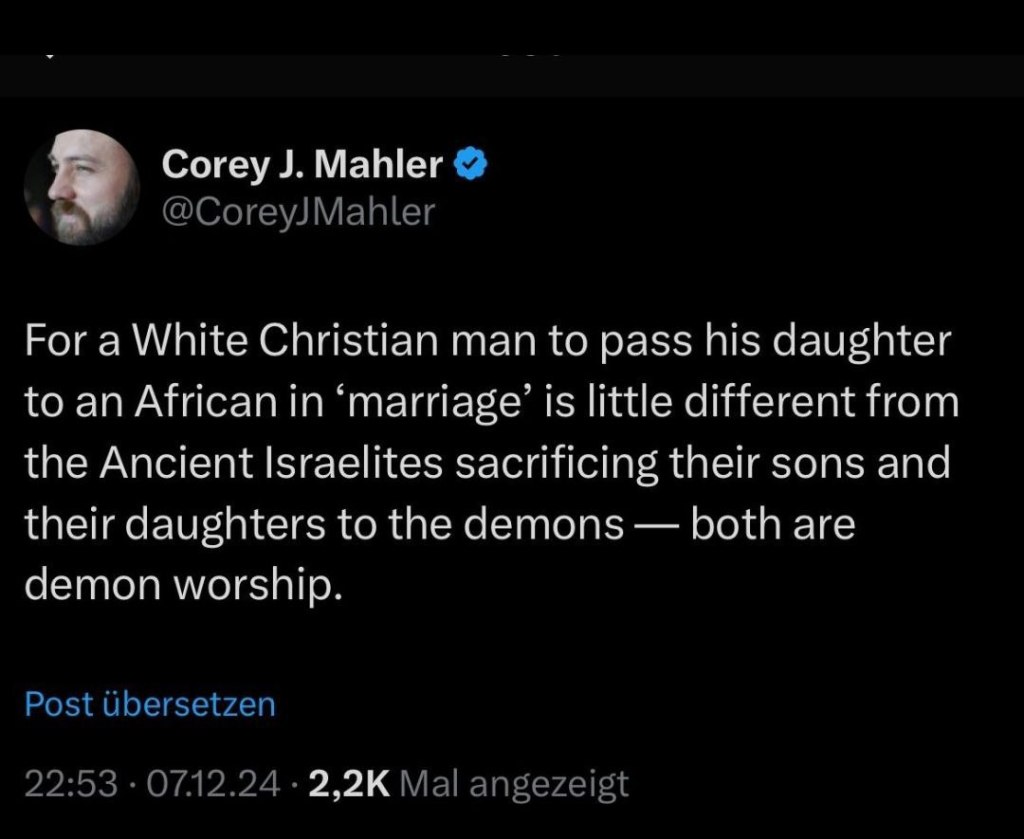
Purge the Heresy of Kinism
The Holy Spirit raises our dead hearts, imparts the gift of faith, and links all of us with Christ and thereby links us with one another. Thus, we can see that racism in any form in the church is a grievous contradiction to our profession and who we are in Christ. “For a Jew to confess himself to be a Christian, and then to refuse to eat with Christians from the Gentiles, or to regard himself as being in any way superior to them in moral worth, is an abomination to the Lord.” Likewise, the segregation of African Americans from whites or vice versa in the church is exceptionally wicked. It is an implicit denial of Christ’s work and the unity of His body. It is to say that being clothed with the perfect righteousness of Christ is not enough for fellowship.
The Kinist belief that blood ties can achieve what only Jesus Christ and His law-word can is unbiblical and shows ignorance of history, as blood ties do not influence crime rates or conflicts. The high crime rates among non-white immigrants stem from their unbiblical worldview rather than their race. True Christians from any ethnicity do not commit crimes or rely on welfare, and they reject using race to privilege one group over another. The argument that race is more important than the gospel undermines the efficacy of Christ’s death and resurrection.
Nationalities and cultures are not fixed; they have always influenced and borrowed from one another. The Romans took inspiration from Greek culture and adopted various military innovations. Europeans incorporated Chinese technology to create modern firearms. The Romans also used Celtic clothing styles to adapt to colder weather. In America, many foods we enjoy, like peanuts and watermelons, come from African culture, while coffee, tomatoes, and potatoes are from indigenous South Americans. God did not preserve the culture of the seven Canaanite nations in Palestine; instead, Israel was commanded to eliminate these nations and their idolatrous practices. Culture reflects religion, so the gospel will replace older laws and cultures with a unique Christian culture. We are not to preserve cultures but rather we are to preserve faith because that is what influences cultures, not the other way around.

Kinism can lead to a form of idolatry, placing ethnic pride above God’s will, often manifesting in a distorted worldview that prioritizes race over spiritual truth. You can usually spot a Kinist by his hatred for the Jews and his love for Hitler, whose ideologies they may naively idolize, failing to understand the profound moral implications of such adoration. Another area of concern is that they have turned into a “white lives matter” group, thereby becoming the new Woke Right. I can’t believe I have to say this because it seems so obvious: racism is a sin. Associating oneself with those of such beliefs is unwise and most certainly will lead to sin.
I revere the Scripture, like Mr. Hitler. – Another you guessed it Kinist quote

The Kinist view of peace and unity is unbiblical and unloving because it promotes segregation. They replace the idea of love as service and mutual support with a harmful mentality that separates Christians by race. This distorted theology leads them to believe that God saves people of different backgrounds only to keep them apart, as if their cultures are harmful to one another. Paul rejects this idea, stating that division, especially in churches, is sinful and causes feelings of alienation. While the Kinist claims to support love and equality, they treat other races with disdain. Paul worked with individuals like Timothy, who had a mixed heritage, and Titus, a Gentile, showing that the church must counter racism by teaching the truth and correcting those who refuse to change. We cannot let racism take root in our churches or serve communion to unrepentant bigots.
“If you are truly born again, you are far closer in Christ to a born-again foreigner whose language you don’t speak than you are your dear doting cookie-baking grandmother who you genuinely love but does not know Jesus. The first is your true family; the second, sadly, is not.” – Owen Strachan
The CRCNA has declared Kinism a heresy, specifically the teaching that interracial marriage is sinful and that God has ordained racial separation in a religio-ethnostate. The CRCNA instructs that any office bearer who teaches or promotes Kinist theology is worthy of special discipline. The church has also committed to educating church leaders and lay members to recognize and refute Kinism, because it is a deviation from sound doctrine.
“Racism is a sin that violates God’s will for humanity. Racism is a system that perpetuates injustice and dehumanizes both the oppressed and the oppressor. As followers of Christ, we must work to dismantle the systems of sin and injustice that perpetuate racism.” — PCUSA General Assembly
“Any teaching that promotes division of the people of God based on ethnicity or race is not consistent with the gospel of Jesus Christ. The gospel calls us to be reconciled to one another as one body, transcending the divisions that might separate us. Therefore, the teachings of Kinism are heretical and contrary to Scripture.”
— CRCNA
“We denounce and repudiate the racism and ethnic prejudice that have historically plagued the church and society. Racism is a sin that divides the body of Christ, and we call on all Christians to embrace the diversity that God has created within His Church.” — Southern Baptist Convention
“We believe that God creates all people equally and calls us to live in community with one another, regardless of race or ethnicity. Racism is a sin against God’s creation, and we reject all forms of racial injustice and division.” — ELCA
“In Christ, the Church transcends all distinctions of race and ethnicity, for we are all one in Christ Jesus (Gal. 3:28). Any belief or practice that creates division in the Church on the basis of race or ethnicity is contrary to the gospel.” — LCMS
“Racism is a sin. It is a denial of the equality of all people before God, and it contradicts the teachings of Scripture, which declare that all men and women are created in the image of God.” — LCMS
“Racism, whether in society or in the church, denies the unity of the human family in Christ and is an affront to God’s creation. The Church of England seeks to address and eliminate all forms of racism within the life of the church, recognizing that the gospel calls all people to reconciliation and unity, irrespective of race or ethnicity.” — Church of England
Summary
What is important is not one’s nationality but whether one is clothed with Christ and His righteousness.
Kinism cannot lead to a Christian culture because it absolutizes race at the expense of God’s law and the church’s vital unity. By placing racial identity above the teachings of Christ, it ultimately leads to a humanistic culture that divinizes the white race, promoting division instead of the inclusive love that Jesus exemplified. This worldview is anti-gospel in its full nature and is nothing less than a heresy that undermines the core message of redemption and grace. It distorts the beauty of diversity in God’s creation and elevates a singular identity to an idolatrous status. Let us shine a light on such evil and purge it from among us, recognizing that true Christian culture celebrates the unity of believers regardless of race. May we only be known by others for welcoming sinners to Christ, embracing and uplifting one another in the unity that is found in Him, and reflecting His love to the world around us.

May we be reminded to avoid such people who preach a different gospel or those who do not obey our Lord’s commands, as their influence can lead many astray from the truth we hold dear. It is our responsibility to call them out as brothers, not with condemnation or malice, but as fellow believers seeking not their destruction but their sincere repentance and return to the faith that upholds the teachings of Christ. We should approach such situations with love and compassion, encouraging a conversational atmosphere that allows for reflection and growth. But in the meantime, do not associate with them, lest others be led astray too, for our unity in truth is vital in maintaining the integrity of our community and ensuring that the message of the Gospel remains clear and undiluted in the hearts of those who seek it.
‘As for you, brothers, do not grow weary in doing good. If anyone does not obey what we say in this letter, take note of that person, and have nothing to do with him, that he may be ashamed. Do not regard him as an enemy, but warn him as a brother. ‘ – 2 Thessalonians 3:13-15

https://tribaltheocrat.com/2013/08/what-is-kinism/
https://www.reformedclassicalist.com/home/ordo-amoris
https://www.monergism.com/kinism
https://heidelblog.net/2023/04/the-crc-is-right-about-kinism-part-one/
https://reporter.lcms.org/2023/president-harrison-denounces-disturbing-ideologies

Leave a comment