Below we will dive into the reasons why Mormons are not a part of the Christian Church but rather an offshoot cult of it. This distinction is crucial for understanding the differences in doctrine and belief systems. We will briefly walk through their views on the Character of God, where Mormons believe in a distinctly different understanding of divinity compared to traditional Christianity. Next, we will examine their interpretation of The Gospel of Christ, which diverges significantly in its teachings on grace and redemption. Additionally, we will explore the practices and beliefs surrounding Baptism and Salvation, noting how their rituals and theological meanings differ from mainstream Christian thought. Furthermore, we will touch on a few other odd beliefs of the Mormon “Church,” such as the concept of eternal progression and the existence of other worlds, which set them apart from historic Christian teachings. Through this exploration, we aim to present a clearer picture of why many view Mormonism as a separate and distinct belief system rather than a branch of Christianity.
‘I am astonished that you are so quickly deserting him who called you in the grace of Christ and are turning to a different gospel— not that there is another one, but there are some who trouble you and want to distort the gospel of Christ. But even if we or an angel from heaven should preach to you a gospel contrary to the one we preached to you, let him be accursed. As we have said before, so now I say again: If anyone is preaching to you a gospel contrary to the one you received, let him be accursed. ‘ – Galatians 1:6-9
“Just a few scant days before his martyrdom, Joseph affirmed:
‘I never told you I was perfect; but there is no error in the revelations which I have taught. Must I, then, be thrown away as a thing of naught?’” – Joseph Smith
Definition of a Mormon:
“Someone who accepts Joseph Smith as a prophet and the book of Mormon (translated from the Nephi Plates) as an inspired message from God.”
“I asked the personages [God the Father and Jesus Christ] who stood above me in the light, which of all the sects was right – and which I should join. I was answered that I must join none of them, for they were all wrong; and the personage who addressed me said that all their creeds were an abomination in His sight: that those professors were all corrupt…” – Prophet Joseph Smith
If Mormons hold true to the words of Joseph Smith, the father of their faith, then they have completely separated themselves from the Christian Church and the historical view of all those of the early Church fathers, along with every Christian creed which professes what we believe in the Bible and all that is concerning salvation.
Cult is a term often applied to new religious movements and other social groups which have unusual, and often extreme, religious, spiritual, or philosophical beliefs and rituals.
‘Love never ends. As for prophecies, they will pass away; as for tongues, they will cease; as for knowledge, it will pass away. For we know in part and we prophesy in part, but when the perfect comes, the partial will pass away. ‘ – 1 Corinthians 13:8-10
In the passage above, it talks about the passing away of prophecy once the perfect has come. The Perfect that they were looking forward to and what we now look back to was none other than the Word of God being fully canonized. We now have the full Word of God that lacks nothing and is fully inspired and infallible, wrapped up in what we call the Bible. This means the time for new prophecy has passed away. For all prophecy is either one of two things: first, it has to agree and adhere to the truth of God, for it cannot go against His word, which we have in the Bible, or else the Bible would be found in error. Secondly, if the prophecy is wrong and/or does not come to pass, then it is false prophecy. Joseph Smith allegedly received 135 direct revelations between 1831 and 1844, which is a huge claim, being that, apparently according to Smith, God hadn’t spoken to anyone since the time of Jesus. Out of these revelations, Joseph Smith made roughly 70 or so prophecies (some have recorded a higher number), of which the Church of the Latter-day Saints (Mormon) has not recorded, because only about 10% came to pass. If you ask me, that’s a pretty poor prophet at best.
A Distorted god
‘God is not man, that he should lie, or a son of man, that he should change his mind. Has he said, and will he not do it? Or has he spoken, and will he not fulfill it? ‘ – Numbers 23:19
Is the God of the Bible the same God that the Mormons profess? NO! They hold to an entirely different, distorted, and warped view of God that significantly diverges from traditional Christian teachings. According to Mormon beliefs, God was once like man, possessing flesh and bones, and they assert that He has evolved into God over time through a process of progression. This perspective implies that God was not always God in the sense that classical Christianity understands Him, leading to the belief that He continues to change and adapt. In contrast, the God of the Bible is portrayed as eternal, unchanging, and the absolute sovereign of the universe, whose nature and essence remain constant throughout time.
‘from everlasting to everlasting you are God.’ – Psalm 90:2
“God our Heavenly Father is still progressing. While He knows all that is, all that has been, and possibly all things that He designs for the future and what will be in the future, yet He is constantly adding to His dominion, constantly increasing His power, constantly developing in His resources and in His glorious aspirations. This, at least, is our understanding of the condition of our Father in heaven. The thought has been expressed and accepted as a truth, that as we are now, God has been, and as God is now we may be; and if we admit this to be a truth—and I have no disposition to dispute it—then I repeat that even God our Heavenly Father has not reached the ultimatum of His greatness, His power, or His capacity, but that He is continually increasing and expanding in power, in dominion, in glory and in greatness, if I may be permitted to use such terms as these which some people who know no better would call blasphemous, in connection with the Supreme Being, the Father of us all.” – Prophet Joseph F. Smith
“for I am God and not a man,” – Hosea 11:9b
“The Father became the Father at some time before ‘the beginning’ as humans know it, by experiencing a mortality similar to that experienced on earth… Gods and humans are the same species of being, but at different stages of development in a divine continuum, and that the heavenly Father and Mother are the heavenly pattern, model, and example of what mortals can become through obedience to the gospel…. Knowing that they are the literal offspring of Heavenly Parents and that they can become like those parents through the gospel of Jesus Christ is a wellspring of religious motivation.” – Encyclopedia of Mormonism
“God himself was once as we are now, and is an exalted man, and sits enthroned in yonder heavens! That is the great secret…. It is the first principle of the Gospel to know for a certainty the Character of God, and to know… that he was once a man like us…. Here, then, is eternal life – to know the only wise and true God; and you have got to learn how to be Gods yourselves… the same as all Gods have done before you…” – “prophet” Joseph Smith, Jr
‘“For I the Lord do not change; therefore you,” – Malachi 3:6
“He is our Father – the Father of our Spirits, and was once a man in mortal flesh as we are, and is now an exalted being.” – Prophet Brigham Young
“Mormon prophets have continuously taught the sublime truth that God the Eternal Father was once a mortal man who passed through a school of earth life similar that through which we are now passing. He became God – an exalted being – through obedience to the same eternal Gospel truths that we are given opportunity to obey.” – “apostle” Milton R. Hunter
‘remember the former things of old; for I am God, and there is no other; I am God, and there is none like me,’ – Isaiah 46:9
Mormons subscribe to a view of polytheism. Polytheism is the belief in the existence of more than one god. In Mormonism, they believe all can reach godhood, making the possibility for an infinite amount of gods. However, in the historical Christian belief, there is only one God, making Christians monotheistic in their belief. This is a huge difference in how we view the character of God and how we go about worshipping Him. Being able to become gods ourselves really takes away the divine, holy nature of God, making Him no different than Joseph Smith or, say, a Mormon who passed away last year. This creates a cheap and lowly view of God, not to mention it goes against what Jesus Christ, our Lord and God, has taught us (Mark 12:29).
“I wish to declare I have always an in all congregations when I have preached on the subject of Deity, it has been the plurality of Gods.” – Joseph Smith
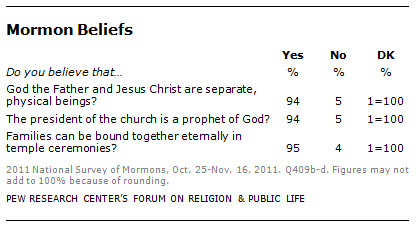
The doctrine of the Trinity is central to the Christian faith, as understanding God is key to biblical religion. God is revealed as Father, Son, and Holy Spirit, forming a divine mystery. The one true God exists in three distinct but connected persons, yet remains only one true Godhead. The church’s creeds and confessions summarize important biblical truths about God’s triunity, supporting this essential doctrine. Historic, biblical, orthodox Christian monotheism, however, states that the one divine essence belongs equally to the three distinct divine persons of the Godhead. Mormons do not believe in the Trinity. They affirm the unity of three personages, but the unity is a relational unity in purpose and mind, not a unity of essence. The three separate beings of the Godhead are three distinct Gods.
‘There is none like you, O Lord , and there is no God besides you, according to all that we have heard with our ears. ‘ – 1 Chronicles 17:20

“In the beginning, the head of the Gods called a council of the Gods; and they came together and concocted a plan to create the world and people it.” – Joseph Smith
In the words of the great preacher Charles Spurgeon, “Discernment is not a matter of simply telling the difference between right and wrong; rather it is telling the difference between right and almost right.” This profound insight is particularly relevant in today’s religious landscape, where numerous sects and belief systems often borrow terminology from foundational Christian teachings. Because Mormonism was created from a distorted view of Christianity, it should be no surprise that they utilize similar language and terms when describing their faith, often leading the unsuspecting to assume they share the same core beliefs. Yet we need to be discerning enough to see that, beneath the surface, they mean completely different things than they do for Christians. Thus, it is imperative for Christians to engage in thoughtful dialogue and study, ensuring that they clearly understand and communicate the authentic essence of their faith while recognizing the subtle nuances that may exist in other belief systems.
A False Gospel
In the Christian faith, salvation is found in Christ alone. No other savior is required, nor are any able to add to the saving power that is in Christ. However, this is not the case in Mormonism, for they require an equal faith in Joseph Smith and the prophets as they do in Christ, claiming that he [Joseph Smith] holds the keys to the Kingdom of God and that no one apart from believing in him will be saved. This is a clear distortion of the Christian faith, making the Mormon “gospel” a false gospel. Yet many Mormons might not even know about this, as it is not taught with importance in the modern LDS church, even though their beloved prophets said it was true.
“[There is] no salvation without accepting Joseph Smith. If Joseph Smith was verily a prophet, and if he told the truth…no man can reject that testimony without incurring the most dreadful consequences, for he cannot enter the kingdom of God” – Joseph Smith
“No man or woman in this dispensation will ever enter into the celestial kingdom of God without the consent of Joseph Smith...every man and woman must have the certificate of Joseph Smith, junior, as a passport to their entrance into the mansion where God and Christ are” – Prophet Brigham Young
“Christ and his prophets go together… it is not possible to believe in one without believing in the other… by rejecting the prophets we reject Christ himself.” – “apostle” Bruce R. McConkie
Only The Mormon “church” Will Be Saved
They double down in this area of the gospel message by claiming that all other Christian churches are in error, asserting that the gospel proclaimed by Protestants, Catholics, and Orthodox is a false gospel, only that of man, not God. They also claim that in the Mormon faith, and only in the Mormon faith, is there salvation. Everyone outside the Mormon “church” will perish, even if they profess and believe in Christ as their Lord and Savior.
“For hundreds of years the world was wrapped in a veil of spiritual darkness, until there was not one fundamental truth belonging to the place of salvation…. Joseph Smith declared that in the year 1820 the Lord revealed to him that all the ‘Christian’ churches were in error, teaching for commandments the doctrines of men.” – Joseph Smith
“…if any man preach any other Gospel than that which I have preached, he shall be cursed; “
– Joseph Smith, Jr., The Teachings of the Prophet Joseph Smith, p. 366, also in History of the Church, v. 6, p.365
“Q. What does the Lord require of the people of the United States?
A. He requires them to repent of all their sins and embrace the message of salvation, contained in the Book of Mormon, and be baptized into THIS church, and prepare themselves for the coming of the Lord.
Q. What will be the consequence if they do not embrace the Book of Mormon as a divine revelation?
A. They will be DESTROYED from the land and SENT DOWN TO HELL, like all other generations who have rejected a divine message!” – Apostle Orson Pratt
Historic/orthodox/traditional Christianity refers to the core beliefs and practices that have been consistently upheld by orthodox Christian traditions since the time of Jesus and the Apostles. The core beliefs can be summed up by the Apostles Creed in 180-341AD.
“It was said to Joseph Smith, the prophet, ‘according to your faith and the teachings of your Elders, nobody will be saved but you, Mormons; now Mr. Smith, will all be damned but the Mormons?’ Jos. Smith replied, ‘Yes, and most of them, unless they repent and do better.” – Prophet Brigham Young
Salvation By Works & Perfection
‘For by grace you have been saved through faith. And this is not your own doing; it is the gift of God, not a result of works, so that no one may boast. ‘ – Ephesians 2:8-9
Mormons stress that the gift of the Holy Spirit is conditional upon continued obedience to God’s commandments and teachings. They emphasize that salvation and eternal life are contingent upon adhering to the law in a perfect manner, which inherently leads them to a works-based salvation model. Although they claim that faith in Jesus Christ is essential for salvation, their teachings suggest that without a strict adherence to these laws, one cannot achieve eternal life. The conditions for salvation within the Mormon belief system are primarily rooted in one’s personal righteousness, which places the responsibility of achieving salvation on the individual rather than fully relying on the righteousness of Christ. This perspective stands in stark contrast to traditional Christian beliefs, which assert that we are saved by grace through faith alone, emphasizing that salvation is a gift from God that cannot be earned through personal merit or works. Thus, the debate over the nature of salvation highlights fundamental theological differences between these two faiths, inviting further exploration into the implications of faith, grace, and obedience.

“Conditional or individual salvation, that which comes by grace coupled with gospel obedience, consist in receiving an inheritance in the Celestial Kingdom of God. This kind of salvation follows faith, repentance, baptism, receipt of the Holy Ghost, and continued righteousness to the end of one’s mortal life. (D & C 20:29 & 2 Nephi 9:23-24). All others are damned – Even those in the celestial kingdom however, who do not go on to exaltation, will have immortality only and not eternal life – they will be ‘ministering servants, to minister for and to those who are worthy of a far more, and an exceeding and an eternal weight of glory’. They will live ‘separately and singly’ in an unmarried state ‘without exaltation, in their saved condition, to all eternity’ (D & C 132:16,17). Salvation in its true and full meaning is synonymous with exaltation or eternal life and consist in gaining an inheritance in the highest of the three heavens within the Celestial Kingdom – It is the salvation which saints seek – This full salvation is obtained in and through the continuation of the family unit in eternity, and those who obtain it are gods – If it had not been for Joseph Smith and the restoration, there would be no salvation. There is no salvation outside The Church of Jesus Christ of Latter-day Saints.” (McConkie, Mormon Doctrine, pg 669-670, 1966 Edition)
“As with all other doctrines of salvation, justification is available because of the atoning sacrifice of Christ, but it becomes operative in the life of an individual only on conditions of personal righteousness” (McConkie, Mormon Doctrine, p. 408).
“One of the most pernicious doctrines ever advocated by man, is the doctrine of ‘justification by faith alone’, which has entered into, the hearts of millions since the days of the so-called ‘reformation’” (Joseph Fielding Smith, The Restoration of All Things, p.192).
“One of the most fallacious doctrines originated by Satan and propounded by man is that man is saved alone by the grace of God; that belief in Jesus Christ alone is all that is needed for salvation.” (Kimball, The Miracle of Forgiveness, pp. 206-207).
Yet for the Protestant Christians, we adhere to Grace Alone by Faith Alone in Christ Alone for justification and the forgiveness of sins. This is a vastly different message than that of the Lord Jesus Christ and Paul the Apostle of Christ.
“Salvation comes by grace, faith and works. Unless a man will adhere to the doctrine and walk in faith, accepting the truth and observing the commandments as they have been given, it will be impossible for him to receive eternal life, no matter how much he may confess with his lips that Jesus is the Christ, or believe that his Father sent him into the world for the redemption of man… So it is necessary, not merely that we believe, but that we repent, and in faith perform good works until the end; and then shall we receive the reward of the faithful and a place in the celestial kingdom of God.” (Joseph Fielding Smith, Doctrines of Salvation: Sermons and Writings of Joseph Fielding Smith, 2:311).
“Keep my commandments continually, and a crown of righteousness thou shalt receive. And except thou do this, where I am you cannot come.” – D&C 25:15
“Complete obedience brings eternal life. But to be exalted one must keep the whole law … to receive the exaltation of the righteous, in other words eternal life, the commandments of the Lord must be kept in all things.” (Joseph Fielding Smith, Doctrines of Salvation: Sermons and Writings of Joseph Fielding Smith, 2:6).
“To enter the celestial and obtain exaltation it is necessary that the whole law be kept…Do you desire to enter the celestial Kingdom and receive eternal life? Then be willing to keep all of the commandments.” (Joseph Fielding Smith, The Way to Perfection, pg. 206).
As you can see, this has become an issue for every person that has walked on Earth besides Christ. For we are all sinful and unable to attain perfection while living in the flesh, burdened by our human nature. This is why we needed Christ as our Savior, for we were completely unable to keep the law. We needed His righteousness because we have none of our own, no matter how hard we may strive for it. In our attempts to be good, we often fall short, making it clear that we cannot rely solely on our efforts. There is no condition on eternal life besides that of believing in the Son of God, Jesus Christ, who offers us hope and redemption. Through His grace, we find the strength to overcome our shortcomings and the assurance that, despite our failures, salvation is certain for those who place their faith in Him (1 John 5:13).
Limited Forgiveness
Mormons also place a limit on the forgiveness of God. They claim that a believer cannot fall into the same sins that they once did before becoming “saved.” This belief stems from their high view of keeping the law perfectly and their pursuit of self-righteousness. If one repeats a past sin, he or she would forfeit the past forgiveness granted for that sin, leading to a complex cycle of guilt and anxiety. This situation creates a state of walking on eggshells, as individuals are continually worried about whether their sins were genuinely forgiven, and they harbor fears that past transgressions could resurface at any moment. The potential return of unforgiven sin carries dire consequences, as it would not only jeopardize their assurance of salvation but also lead them to lose their standing with God, resulting in being found in a non-perfect state. Such beliefs foster an environment of self-doubt and apprehension, where the pursuit of spiritual acceptance can become a source of immense stress rather than a path to peace and redemption. This takes away from the peace and certainty that we Christians find in the finished work of Christ.
Unto that soul who sinneth shall the former sins return, saith the Lord your God. – D&C 82: 7
“We can hardly be too forceful in reminding people that they cannot sin and be forgiven and then sin again and again and expect repeated forgiveness. The Lord anticipated the weakness of men which would return him to his transgression and he gave this warning (D&C 82:7)”. (Spencer Kimball, The Miracle of Forgiveness, p. 360).
“The forsaking of sin must be a permanent one. True repentance does not permit making the same mistake again.” (Spencer Kimball, The Miracle of Forgiveness, p. 208).
Baptism Is Necessary, Even For The Dead.
I won’t go into this because many Christians differ on this topic on the role and action of Baptism. The notion that baptism merits salvation is itself unbiblical. However, I will mention it just so we are aware of what is required of the Mormon faith for eternal life.
“Baptism by immersion in water by one having authority is the first ordinance of salvation and exaltation in the gospel of Jesus Christ. It is also necessary for an individual to become a member of The Church of Jesus Christ of Latter-day Saints and to receive eternal salvation. All who seek eternal life must follow the example of the Savior by being baptized and receiving the gift of the Holy Ghost.” – LDS church
“If the sinner will repent of his sins, and go down into the waters of baptism, and there be buried in the likeness of being put into the earth and buried, and again be delivered from the water, in the likeness of being born—if in the sincerity of his heart he will do this, his sins shall be washed away. Will the water of itself wash them away? No; but keeping the commandments of God will cleanse away the stain of sin.” – Prophet Brigham Young
“Baptism is just as essential to salvation, as Faith and Repentance. Without being immersed in water no man can enter into the fulness of Celestial glory: for baptism is instituted for the remission of sins; and if a person does not take the necessary steps to obtain pardon of sins, of course, he cannot be saved in the kingdom of God.” – Apostle Orson Pratt
“But who in this generation have authority to baptize? None but those who have received authority in the church of Jesus Christ of Latter day Saints: all other churches are entirely destitute of all authority from God; and any person who receives Baptism or the Lord’s supper from their hands will highly offend God, for he looks upon them as the most corrupt of all people. Both Catholics and Protestants are nothing less than the “whore of Babylon” whom the Lord denounces by the mouth of John the Revelator as having corrupted all the earth by their fornications and wickedness. And any person who shall be so wicked as to receive a holy ordinance of the gospel from the ministers of any of these apostate churches will be sent down to hell with them, unless they repent of the unholy and impious act.” – Apostle Orson Pratt
‘Otherwise, what do people mean by being baptized on behalf of the dead? If the dead are not raised at all, why are people baptized on their behalf? ‘ – 1 Corinthians 15:29
Another odd doctrine that separates Mormons from the historic orthodox Christian Church is the belief in baptism for the dead. Since Mormons require baptism for salvation and that it can only be performed by the LDS church properly, it creates an issue for all those who passed away prior to Joseph Smith’s cult. Therefore, they came up with the idea to baptize living beings on behalf of the dead so that the dead might be able to choose it. Amazing how even after death one has the “ability” to choose to accept or reject Christ, something that is not taught by the Bible (even for the living, cough cough reformed teaching). Yet they claim and twist that 1 Cor 15:29 teaches that the apostles were baptizing the dead. Paul here is explaining to them how it is that many are coming to faith in Christ based on the testimonies of faithful Christians who have deceased before them. This speaks to the hope and joy that people have in Christ even for those who have already perished yet believed upon the name of Christ. Most likely they were being Baptized because they wanted to share in the same faith of those loved ones who had passed.
“Jesus Christ taught that baptism is essential to the salvation of all who have lived on earth. Many people, however, have died without being baptized. Others were baptized without proper authority. Because God is merciful, He has prepared a way for all people to receive the blessings of baptism. By performing proxy baptisms on behalf of those who have died, Church members offer these blessings to deceased ancestors. Individuals can then choose to accept or reject the ordinances that have been performed on their behalf.” – LDS church
Open Canon and Error Of The Bible
‘I warn everyone who hears the words of the prophecy of this book: if anyone adds to them, God will add to him the plagues described in this book, and if anyone takes away from the words of the book of this prophecy, God will take away his share in the tree of life and in the holy city, which are described in this book. ‘ – Revelation 22:18-19
While the church has had some disagreements about which books are in the Canon, it has always agreed that the Canon was closed with the death of the last apostle. This belief is linked to the completion of the Old and New Testament canons, with Revelation being the final book written around the 1st century AD. Today, no Christian seeks to add to the Canon, but some people in the church claim to receive new, binding words from God. Mormons do not believe that the Bible to be inerrant, complete, or the final word of God contrary to orthodox Christianity.
“Latter-day Saints revere the Bible. They study it and believe it to be the word of God. However, they do not believe the Bible, as it is currently available, is without error.” – LDS church
If the Bible is not without error, then it cannot be trusted, which raises significant questions about its reliability and the foundation of faith built upon it. If it cannot be trusted, then there can be no hope nor assurance of good news, leaving believers in a state of uncertainty and doubt regarding the very core of their beliefs. The Christian faith hinges on the Word of God being true and a final authority for all things regarding eternal life, as it embodies the promises and teachings that guide the lives of all Christians.
“Latter-day Saints believe in an open scriptural canon, which means that there are other books of scripture besides the Bible (such as the Book of Mormon) and that God continues to reveal His word through living prophets. The argument is often made that to be a Christian means to assent to the principle of sola scriptura, or the self-sufficiency of the Bible. But to claim that the Bible is the final word of God—more specifically, the final written word of God—is to claim more for the Bible than it claims for itself. Nowhere does the Bible proclaim that all revelations from God would be gathered into a single volume to be forever closed and that no further scriptural revelation could be received.” – LDS church
“8 We believe the Bible to be the word of God as far as it is translated correctly; we also believe the Book of Mormon to be the word of God.” – LDS church
Christ the Brother of Satan
So what is our belief about Jesus and Satan’s relationship? Latter-Day Saints(Mormons) believe that Heavenly Father is Creator of all beings, and since we have a common father, we are all brothers and sisters. Jesus Christ, Satan, and all of us on earth, are all beings created by God who gave us freedom to choose between good and evil. Jesus chose good, and Satan chose evil. We also must choose who we will follow. Jesus and Satan could be and are considered spiritual brothers according to the theology of LDS church.
Christ and Satan: The Creator and the Created
- Two beings of the same ontological status (both created) can at least be conceived as brothers.
Brotherhood is made contingent upon ontological status by this premise. Brotherly hood in Scripture typically carries the meaning of common origin or nature:
“But you are not to be called rabbi, for you have one teacher, and you are all brothers.” (Matthew 23:8)
Here, Jesus acknowledges brotherhood among men because of their shared status of being created and God’s relationship. Similarly, when angels are referred to in plural form in the Bible, it places them at the same level of existence:
“Whenever morning stars sang together and all sons of God shouted for joy.” (Job 38:7)
The verse mentions “sons of God” as a reference to angels, marking their shared status as created heavenly beings.
- Scripture plainly marks Christ as the uncreated Creator and Satan as one of the created ones.
The Bible always and only describes Christ as the uncreated Creator:
“In the beginning was the Word, and the Word was with God, and the Word was God. He was in the beginning with God. All things were made through him, and without him was not any thing made that was made.” (John 1:1-3)
“For in him all things were created, in heaven and on earth, visible and invisible, whether thrones or dominions or rulers or authorities—all things were created through him and for him. And he is before all things, and in him all things hold together.” (Colossians 1:16-17)
These verses establish Christ as the Creator of all things and His preexistence to everything.
The Bible, on the other hand, describes Satan as a fallen created angel:
“I saw Satan fall like lightning from heaven.” (Luke 10:18)
“You were an anointed guardian cherub. you were blameless in your ways from the day you were created, till unrighteousness was found in you.” (Ezekiel 28:14-15, typically understood as speaking of Satan)
These verses establish fairly clearly Satan as a created entity, one of the angels who had revolted.
- Christ and Satan cannot, therefore, be brothers, since they belong to altogether different categories of being – Creator and created.
This is a logical conclusion from the first two premises. Scripture testifies to this difference of being:
“For to which of the angels did God at any time say, ‘You are my Son, today I have begotten you’? Or again, ‘I will be to him a father, and he shall be to me a son’?. But of the Son he says, ‘Your throne, O God, is forever and ever.'” (Hebrews 1:5,8)
This paragraph distinguishes Christ from all the angels (including Satan before he fell) by pointing to the unique relationship of Christ with the Father and Christ’s divinity.
Supported Logical Extensions:
- If Christ created all things (Colossians 1:16), and if Satan is a created thing, then Christ created Satan.
“For by him all things were created, in heaven and on earth, visible and invisible, whether thrones or dominions or rulers or authorities—all things were created through him and for him.” (Colossians 1:16)
This sweeping statement includes everything created both in heaven (angels, including Satan prior to rebellion) and on earth. The specific mention of “thrones or dominions or rulers or authorities” would include angelic hierarchies which would necessarily include Satan as a created angelic being.
- A creator cannot be the brother of his creation.
“But unto us there is but one God, the Father, of whom are all things, and we in him; and one Lord Jesus Christ, by whom are all things, and we by him.” (1 Corinthians 8:6)
It provides the fundamental difference between Maker and made. The analogy is not with brothers but maker and made. It is repeated in:
“From eternity to eternity you are God. Before the mountains were born, before you had formed the earth and the world, from everlasting to everlasting you are God.” (Psalm 90:2)
This verse brings out the distinction between eternal God (including Christ as known in the New Testament) and everything that has been created.
- Christ, then, cannot be the brother of Satan.
“And the Word became flesh and dwelt among us, and we have seen his glory, glory as of the only Son of the Father, full of grace and truth.” (John 1:14)
The use of the adjective “only Son” (μονογενοῦς, monogenous) to describe Christ emphasizes His unique relation to the Father—one that is not shared by any creature, not even the devil. This is again repeated in:
“No one has ever seen God; the only God, who is at the Father’s side, he has made him known.” (John 1:18)
Christ is here addressed as “the only God” (μονογενὴς θεὸς, monogenēs theos in most manuscripts), rendering Him His absolute uniqueness and deity—categories in which any created being is excluded from sharing brotherhood with Him.
*Written by Mr. Jones
Other Odd & False Beliefs
“You believe Adam was made of the dust of this earth. This I do not believe, though it is supposed that it is so written in the Bible; but it is not to my understanding. You can write that information to the States, if you please – that I have publicly declared that I do not believe that portion of the Bible as the Christian world do. I never did, and I never want to. What is the reason I do not? Because I have come to understanding, and banished from my mind all the baby stories my mother taught me when I was a child.” – Prophet Brigham Young
“Some have said that I was very presumptuous to say that Brother Brigham was my God and Savior. Brother Joseph was his God. The one that gave Joseph the keys of the Kingdom was his God, which was Peter. Jesus Christ was his God and the God and Father of Jesus Christ was Adam.” – Apostle Heber C. Kimball
*The two quotes above are former beliefs that are no longer up held by the LDS Church.
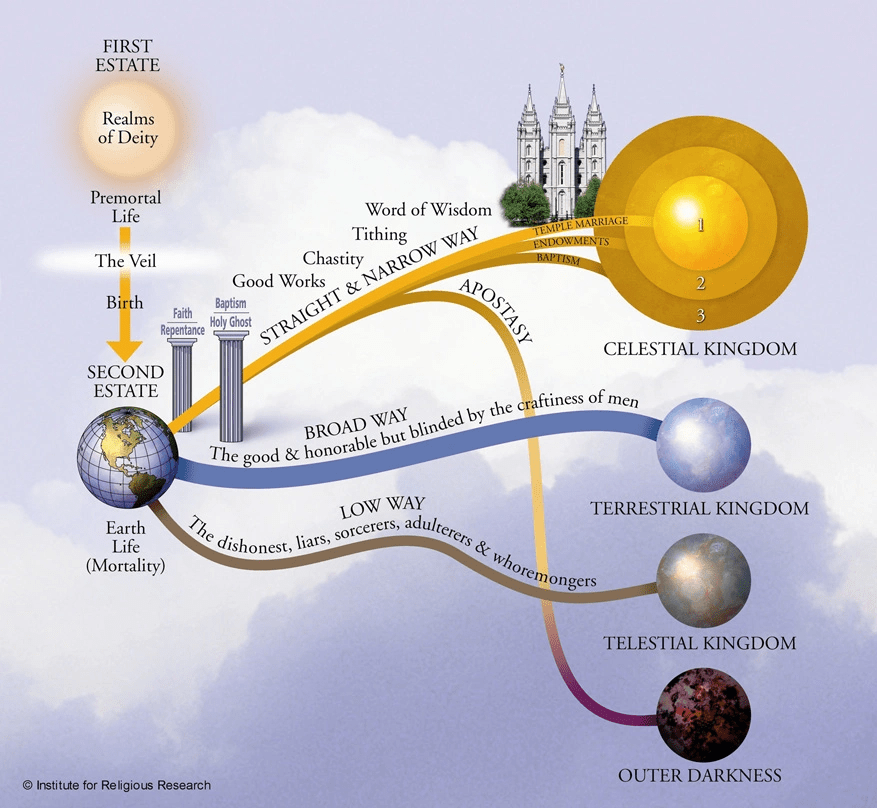
In January 1836 the Prophet Joseph Smith received a revelation that expanded his understanding of the requirements to inherit celestial glory. There are three kingdoms of glory: the celestial kingdom, the terrestrial kingdom, and the telestial kingdom. The glory we inherit will depend on the depth of our conversion, expressed by our obedience to the Lord’s commandments. It will depend on the manner in which we have “received the testimony of Jesus.” – LDS church
Telestial glory will be reserved for individuals who “received not the gospel of Christ, neither the testimony of Jesus.” These individuals will receive their glory after being redeemed from spirit prison, which is sometimes called hell. – LDS church
Burbank, California March 17, 1963
President Joseph Fielding Smith 47 East South Temple Street Salt Lake City 11, Utah
Dear President Smith:
In a discussion recently, the question arose, “Was Christ married?” The quote of Isaiah 53:10 was given, which reads,
Yet it pleased the Lord to bruise him; he hath put Him to grief: when thou shalt make his soul and offering for sin, he shall see His seed, he shall prolong His days, and the pleasure of the Lord shall prosper in his hand.
What is meant by “he shall see his seed”? Does this mean that Christ had children?
In the Temple ceremony we are told that only through Temple marriage can we receive the highest degree of exaltation and dwell in the presence of our Heavenly Father and Jesus Christ. Christ came here to set us the example and, therefore, we believe that he must have been married. Are we right?
In a written response (on the same letter), Elder Smith indicated his feelings on the matter—both in the positive. Placing an asterisk next to the words “His seed” in the letter, at the bottom of the letter Elder Smith wrote:
*Mosiah 15:10-12 Please Read Your Book of Mormon!
Placing two asterisks next to the words “he must have been married,” at the bottom of the letter Elder Smith wrote:
**Yes! But do not preach it! The Lord advised us not to cast pearls before swine!
Conclusion
Mormons are not Christians nor do they profess the same Christ and God the Father, we do. If they did they would simply not be Mormon.
‘Claiming to be wise, they became fools, and exchanged the glory of the immortal God for images resembling mortal man….. because they exchanged the truth about God for a lie and worshiped and served the creature rather than the Creator, who is blessed forever! Amen. ‘ – Romans 1:22-23,25
- The Mormon belief is extrabiblical false revelation.
- Mormons believe that the Bible is errant, incomplete, and not the final word of God.
- Mormons elevate the words of modern prophets to be the word of God and equal to scripture.
- Mormons believe that God the Father was once a man like us.
- Mormons believe that God the Father can and is continually changing and increasing in power and deity.
- Mormons believe that Christ is the “first and greatest Son.” Not the “only” son.
- Mormons believe that Jesus is the spiritual the bother of Satan.
- Mormons believe that Jesus the Son of God was created and that he didn’t eternally exists nor did He create all things (because He Himself was created, leading to maybe a partial creator theory).
- Mormons believe that Jesus had to earn his own spiritual salvation through works while in the flesh just like they have to.
- Mormons do not believe that Jesus was conceived by the Holy Spirit, but that Mary was impregnated by God the Father. Therefore denying the Virgin Birth of our Lord Jesus.
- Mormons do not believe in the trinity Godhead as Christians do.
- Mormons believe that we will become gods ourselves.
- Mormons teach a belief of Polytheism, which means they believe that there are more than one God.
- The Mormon belief roots salvation to be a result of Works and one’s own righteousness, not Faith Alone.
- Mormons require baptism in order to be saved and to receive the Holy Spirit.
- The Mormon practice of baptism for the dead is unscriptural and traces back to Marcionism, a heresy of the mid-second century AD.
*note that this might not all be currently true of the modern LDS church, however it was at one time or another all taught by it.


My goal in writing and sharing this is to highlight the errors of Mormonism and to reject the claim that they are a part of the Christian Church, which is made up of the body of believers. Hopefully, this did a fair job of displaying the multitude of differences between the two. While I could have gone into the complicated life and character of Joseph Smith, I wanted this to be more about the LDS doctrine and beliefs. Below are more resources and information on LDS/Mormonism. Continue to love and pray for those caught up in the LDS Church, always pushing them toward the truth of the Gospel that is found in Christ Alone.

https://faithwaybaptist-ypsilanti.com/wp-content/uploads/2018/05/Whats-the-Difference-series.pdf
https://clearlyreformed.org/7-reasons-why-mormonism-and-christianity-are-not-the-same/
https://www.fairlatterdaysaints.org/archive/publications/salvation-by-grace-alone
https://coldcasechristianity.com/writings/is-mormon-salvation-possible/
https://www.equip.org/articles/mormon-view-salvation-gospel-truly-impossible/
https://www.churchofjesuschrist.org/study/manual/gospel-topics?lang=eng
https://christiandefense.org/oneness/modalism-and-the-book-of-mormon/

Leave a comment