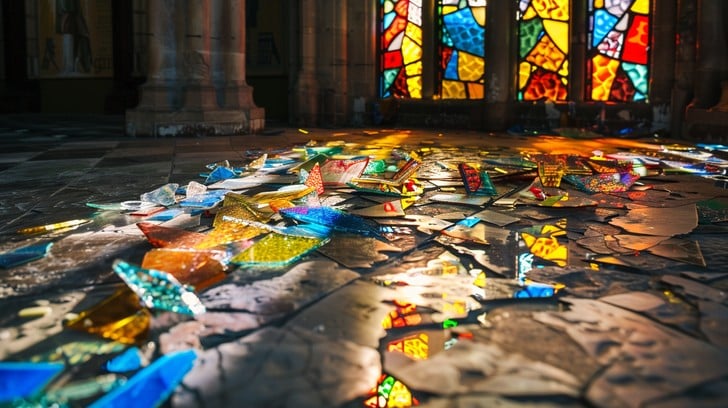
In the Reformed world, many reject images of Christ, Mary, and the Saints in all formats. Why is this, one might ask? To simply answer, “confusion and error are usually brought in with images surrounding worship.” Many Reformed Christians hold to a strict understanding of the 2nd commandment, which states that no images of God are to be created and no images of saints are to be used with regard to any form of worship. This is because images falsely represent that which they display and can lead people to view such images with a value that ends up being a distorted form of worship. Our God has designated how He is to be worshipped, and to stray away from that will ultimately lead to destruction brought upon by oneself because we think we have a better way to worship than God has designated.
‘ “You shall not make for yourself a carved image, or any likeness of anything that is in heaven above, or that is in the earth beneath, or that is in the water under the earth. You shall not bow down to them or serve them, for I the Lord your God am a jealous God, visiting the iniquity of the fathers on the children to the third and the fourth generation of those who hate me, ‘ – Exodus 20:4-5
Iconoclast is defined as someone who is a destroyer of images used in religious worship. The term literally means “image breaker”. This can also represent those who oppose and ban such images within the context of worship.
‘ “Therefore watch yourselves very carefully. Since you saw no form on the day that the Lord spoke to you at Horeb out of the midst of the fire, beware lest you act corruptly by making a carved image for yourselves, in the form of any figure, the likeness of male or female, the likeness of any animal that is on the earth, the likeness of any winged bird that flies in the air, the likeness of anything that creeps on the ground, the likeness of any fish that is in the water under the earth. And beware lest you raise your eyes to heaven, and when you see the sun and the moon and the stars, all the host of heaven, you be drawn away and bow down to them and serve them, things that the Lord your God has allotted to all the peoples under the whole heaven. ‘ – Deuteronomy 4:15-19
We must be very careful about what we allow our hearts to take in and what it is that entertains us. If we are not watchful enough, idols will soon be growing like weeds. It’s even worse when we openly advocate for such idols to exist within our churches, which are houses of worship. We have no reason to believe that these commands do not still stand even today. We have been given no new revelation that would lead us to believe that God is not only okay with such images but that he is glorified by them.
“The Human heart is an idol factory” – John Calvin
The Creator of Art & Worship
God is the creator and author of art and beauty. It seems only fair that He would be the one who is to set the guidelines in the realm of how to go about art and worship. We must fully submit to that which is taught in the Holy Scriptures and apply it to our worship. While being careful to not add anything that is of man to how God has prescribed us to worship.
‘But the hour is coming, and is now here, when the true worshipers will worship the Father in spirit and truth, for the Father is seeking such people to worship him. ‘ – John 4:23
It is important to understand worship in light of Christ’s words, teaching us that we are no longer confined to worship only taking place in a temple or through such forms limited to sacrifices. Worship is now done in the Spirit, meaning no physical location is required to worship God. This removes all restrictions, leading us to believe that worship can take place anywhere and anytime within our day-to-day lives. Now, with that being said, we can apply the view that the imagery of God is prohibited everywhere at all times. Because we know that worship can and does happen outside the local church, our talk about worship is no longer restricted to that which only takes place in a church.
“Nothing ought to be admitted in the worship of God, either as to matter or manner, but what is expressly prescribed in the Word of God, or by just consequence is deduced from it.” – John Own
It is also crucial to understand that all people were created to worship. God has designed us with the desire to worship and value Him; yet sin has entered the world and destroyed that, turning people to worship the creation rather than the Creator. This shift has profound implications on our lives and society, as we often find ourselves pursuing fleeting pleasures and shallow validations. We are always valuing and/or serving something or someone; it doesn’t matter whether you are a believer or not. In the fast-paced world we live in, this tendency is heightened, as we are bombarded by messages that entice us to seek fulfillment in material possessions or social standing. You name it, we have probably worshiped it: money, fame, health, family, sports teams, cars, people’s opinions, pets, and the list could go on for days. Each of these can easily take precedence in our hearts, often leading us to neglect the deeper and more fulfilling relationship we could have with God. And yet God intended us to worship Him alone; therefore, our hearts and motives are mostly to blame for this worship of creation. Such creation isn’t bad, but just how we are prone to overly value it to an unhealthy level can lead to dissatisfaction and a longing that cannot be quenched by anything other than a genuine connection with our Creator. This understanding urges us to reflect deeply on what we prioritize in our lives and calls us back to the original design of heartfelt worship that brings true peace and contentment.
If I find in myself a desire which no experience in this world can satisfy, most probable explanation is that I was made for another world. – C.S. Lewis
How do we go about worshipping Him rightly then? Two things are needed, first faith is required for we know that apart from faith we can do nothing pleasing to God (Heb 11:6). Without faith we would never seek to worship God nor seek His will for us. Secondly, we must have Truth. That is a correct and biblical understanding of God and the Gospel, for this is what has been revealed to us through His word. If we do not have the truth, then there is nothing stopping us from worshiping the sun and moon as former pagans have. For with the truth comes a proper understanding of all that God has called us to and how to go about worshiping Him because the truth fully reveals who He is.
“It is not lawful to have pictures of Jesus Christ … because, if it does not stir up devotion, it is in vain, if it does stir up devotion, it is a worshipping by an image or picture, and so a palpable breach of the second commandment.” – James Durham
Images Falsely Represent
Christians are meant to be known for the truth, being that we are called to the truth through the word of God. We all would agree that God and Christ are both truth; this is their nature, and they delight in that which is also true. Why, then, would we pursue images that are not true? Can you say that any image formed by man to represent God is 100% true? Because if you cannot, then you are pursuing lies and are falsely representing God through the creation of said images. However, I can say that the Word of God is 100% true, being that it is the very word of God and not a creation of man.
You might argue that such imagery doesn’t have to be perfect in every detail but, in large part, is a true depiction of Christ, reflecting some of the essential aspects of His life and ministry. You might also argue that we may create such images because God has revealed Himself in the flesh of Christ, allowing us a glimpse into His divine nature through His human experience. Therefore, we now have a reference point for what God looks like, so the commandment no longer stands against images of Christ as representations of His life on Earth. And yet, one cannot still truthfully depict God because one cannot fully capture His human and divine nature together in a single representation. Great, you now have an image of Christ (imperfectly) as the man (His human nature) while neglecting His Godhood (divine nature), which is essential to understanding the fullness of who He is. You can now label yourself as Nestorian, which is an old condemned heresy that arises from a misunderstanding of Christ’s dual nature. For we cannot split the union of the two natures within Christ, for if we do so, we will no longer be serving the true Jesus Christ, a union that is mysterious yet fundamental to our faith. By depicting Christ’s human nature alone, we are defaulting to a false view of Jesus, potentially leading others astray from the truth of His divine essence and the full reality of the Gospel message, which is a display of His humanity and divinity together.

“All religious worship invented by man, besides or contrary to the Word of God, is superstition and idolatry.” “To make an image of God is utterly unlawful… because God hath forbidden it in his law, and because no image can represent him as he is.” – William Perkins
Pagans were known for serving other gods during the time of Israel, bowing down and serving images and idols that represented their deities. This behavior was not just a casual religious practice; it was deeply ingrained in their culture and rituals, which often led them away from the true worship of the Almighty. It only makes sense that after God provided clear instructions on who it is that Christians were to serve—being God alone—He would take great care in describing how to go about it. He clearly does not want to be worshiped in the same way as the pagans, who often relied on physical representations and images to express their devotion. Worship for Israel was a holy and very detailed act mandated by the people of God that involved sincerity, reverence, and a deep understanding of their relationship with the God. God did not leave His glory, praise, and worship up to chance; rather, He set strict details regarding how they were to approach Him in worship. In no way, shape, or form were graven images to be used as objects or mediators in the act of worship, as they detract from the true essence of honoring the living God in spirit and truth. If God was not pleased by Uzzah touching the ark—a sacred emblem of His presence—why would He be pleased by someone dressing up and pretending to be His Son in a television series or by someone kneeling before a distorted image of Christ crafted by human hands? Such actions could lead to a misunderstanding of the nature of God and dilute the sanctity of worship that He established, emphasizing that genuine reverence cannot be simulated through mere physical representations. God desires a heartfelt connection with His people, one that honors His instructions and acknowledges His supremacy above all created things.
“We declare, on the contrary, that the making of images of the Trinity is absolutely forbidden. We neither know the spiritual nature of the angels nor the true physical appearance of Christ and the apostles. Thus, the images made of them are without resemblance, and it is vanity to make an image and say: That is Christ, that is Mary, that is Peter, etc. … In the first place, one may make no images of God whatsoever; that is, of the Father, of the Son, and of the Holy Spirit.” – Wilhelmus a Brakel

Replacement Idols
Now let’s talk about what imagery we currently have that is condemnable, as it violates the 2nd commandment. Once you have been made aware of this and are convicted of it, you will notice it is very common in our culture, even among churches. We find images of Christ everywhere from TV to books, from theater to paintings, from crosses to statues, often glorifying His figure in ways that may not align with the truth and His divine nature that were exemplified during His time on earth. The church at large is guilty of this and has gone wild with imagery in the house of the Lord, creating environments that are visually overwhelming and distracting from true worship. Rather than fostering a genuine relationship with God, these representations can distort our understanding and reverence, leading us to focus on the art instead of the faith it symbolizes. We must be careful and proactively purge such images among us that we might not be led to a false form of worship nor lead those less mature to such error, encouraging instead a spirituality grounded in authenticity and simplicity, where our hearts can truly connect with the divine.
“The brazen serpent was also a figure of Christ, and yet Moses broke it at God’s command because the people misused it for idolatry. So it is with images; if they are not misused, they may remain.” – Martin Luther
“The heart must not hang on the picture, but on the Word.” – Martin Luther
‘Jesus said to him, “Have you believed because you have seen me? Blessed are those who have not seen and yet have believed.” ‘ – John 20:29
The most popular imagery of Christ in today’s world is the TV series “The Chosen.” Many might support it because it has led them to a deeper spiritual feeling and has strengthened their faith. While it is wonderful to see individuals inspired by storytelling and visual representation, we must also consider the implications of relying on such portrayals. We have been taught to live by faith, not by sight. We know the words of our Lord in (John 20:29) to be an understanding statement that the majority of all Christendom will have never physically seen Christ until his return. Why then do we need to make such false examples when the essence of faith invites us to seek in spirit and truth the living God through prayer and Scripture? If your response is to spread the gospel and lead others to Christ, then my question to you is: do you not think the Word of God is enough and sufficient for the advancement of the gospel message? The Scripture itself has stood the test of time, revealing truth and sparking transformations in countless lives. If your answer is that it is enough, then no other images or TV shows are needed and therefore should not be made to take away from that of the Word of God, which is living and active, sharper than any two-edged sword. If you happen to say it is not enough, my reply to you would be that God have mercy on your soul for adding something to the Word of God and not believing it to be enough for all teaching (2 Tim 3:16). Instead, let us turn back to the Scriptures and embrace its teachings, allowing it alone to guide us in our faith.
‘All Scripture is breathed out by God and profitable for teaching, for reproof, for correction, and for training in righteousness, that the man of God may be complete, equipped for every good work.’ – 2 Timothy 3:16-17
If we are not permitted the use of such images, why do we think it is okay if our children have storybook Jesus in every book?
If we do not have such images and or do not allow them in churches, why would we watch a show with hours of it? It does not change anything with it coming through a digital screen.
In order for images to be used by Christians and the Church, God would have had to instruct us to do so or have given us freedom to perhaps allow us such things. However, it’s crucial to remember that regardless of our interpretations or desires, the second commandment still stands firm, reminding us that we are without excuse to create such images in the name of worship. This commandment not only serves as a guideline but also as a warning against the potential pitfalls of idolatry. It compels us to reflect deeply on the intentions behind our practices and creations, ensuring that they align with our faith and reverence for the divine. And remember that if it is not done for the purpose of worship, then it is of no use for us, as our acts of creativity should aspire to honor God, enriching our spiritual lives in a way that truly reflects our devotion and dedication to Him. In doing so, we are encouraged to seek ways that deepen our relationship with God rather than distract from it.
“To represent the infinite God by a finite image, is to vilify his glory, and to debase his nature.” – Stephen Charnock

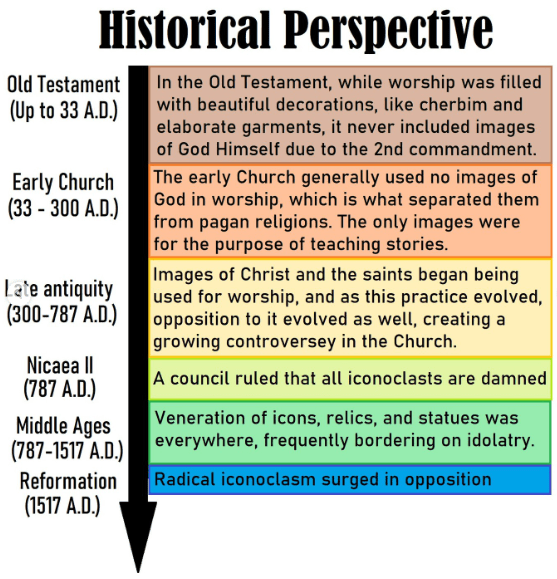
We anathematize the introduced novelty of the revilers of Christians. We salute the venerable images. We place under anathema those who do not do this. Anathema to them who presume to apply to the venerable images the things said in Holy Scripture about idols. Anathema to those who do not salute the holy and venerable images. Anathema to those who call the sacred images idols. Anathema to those who say that Christians resort to the sacred images as to gods. Anathema to those who say that any other delivered us from idols except Christ our God. Anathema to those who dare to say that at any time the Catholic Church received idols. – roman catholic church at the second council of Nicaea 787AD
Now anathema is nothing less than complete separation from God. – roman catholic church at the second council of Nicaea 787AD
The Reformed Confessions
Heidelberg Catechism
95. What is idolatry?
Idolatry is to conceive or have something else on which to place our trust instead of, or besides the one true God who has revealed Himself in His Word1. 1Eph 5:5. Phil 3:19. Eph 2:12. John 2:23. 2 John 9. John 5:23. * Ps 81:8,9. * Matt 6:24. * Ps 62:5-7. * Ps 73:25, 26. – Heidelberg Catechism
96. What does God require in the second Commandment?
That we in no wise make any image of God,1 nor worship Him in any other way than He has commanded us in His Word.2 1 Deut 4:15-19. Isa 40:18, 25. Rom 1:22-24. Acts 17:29. 2 1 Sam 15:23. Deut 12:30-32. Matt 15:9. * Deut 4:23, 24. * John 4:24.
97. May we not make any image at all?
God may not and cannot be imaged in any way; as for creatures, though they may indeed be imaged, yet God forbids the making or keeping any likeness of them, either to worship them, or to serve God by them.1 1 Exod 23:24, 25. Exod 34:13,14. Deut 7:5. Deut 12:3. Deut 16:22. 2 Kgs 18:4. * John 1:18.
98. But may not pictures be tolerated in churches as books for the people?
No, for we should not be wiser than God, who will not have His people taught by dumb idols,1 but by the lively preaching of His word.2 1 Jer 10:8. Hab 2:18,19. 2 2 Pet 1:19. 2 Tim 3:16,17. * Rom 10:17.
Westminster confession of Faith
Chapter 21
Of Religious Worship and the Sabbath Day
1. The light of nature showeth that there is a God, who hath lordship and sovereignty over all, is good, and doth good unto all, and is therefore to be feared, loved, praised, called upon, trusted in, and served, with all the heart, and with all the soul, and with all the might. But the acceptable way of worshiping the true God is instituted by himself, and so limited by his own revealed will, that he may not be worshiped according to the imaginations and devices of men, or the suggestions of Satan, under any visible representation, or any other way not prescribed in the Holy Scripture.
2. Religious worship is to be given to God, the Father, Son, and Holy Ghost; and to him alone; not to angels, saints, or any other creature: and, since the fall, not without a Mediator; nor in the mediation of any other but of Christ alone.
The Second Helvetic Confession
CHAPTER IV
Of Idols or Images of God, Christ and The Saints
IMAGES OF GOD. Since God as Spirit is in essence invisible and immense, he cannot really be expressed by any art or image. For this reason we have no fear pronouncing with Scripture that images of God are mere lies. Therefore we reject not only the idols of the Gentiles, but also the images of Christians.
IMAGES OF CHRIST. Although Christ assumed human nature, yet he did not on that account assume it in order to provide a model for carvers and painters. He denied that he had come “to abolish the law and the prophets” (Matt. 5:17). But images are forbidden by the law and the prophets” (Deut. 4:15; Isa. 44:9). He denied that his bodily presence would be profitable for the Church, and promised that he would be near us by his Spirit forever (John 16:7). Who, therefore, would believe that a shadow or likeness of his body would contribute any benefit to the pious? (II Cor. 5:5). Since he abides in us by his Spirit, we are therefore the temple of God (I Cor. 3:16). But “what agreement has the temple of God with idols?” (II Cor. 6:16).
IMAGES OF SAINTS. And since the blessed spirits and saints in heaven, while they lived here on earth, rejected all worship of themselves (Acts 3:12 f.; 14:11 ff.; Rev. 14:7; 22:9) and condemned images, shall anyone find it likely that the heavenly saints and angels are pleased with their own images before which men kneel. uncover their heads, and bestow other honors?
CHAPTER V
Of The Adoration, Worship and Invocation of God Through The Only Mediator Jesus Christ
GOD ALONE IS TO BE ADORED AND WORSHIPPED. We teach that the true God alone is to be adored and worshipped. This honor we impart to none other, according to the commandment of the Lord, “You shall worship the Lord your God and him only shall you serve” (Math. 4:10). Indeed, all the prophets severely inveighed against the people of Israel whenever they adored and worshipped strange gods, and not the only true God. But we teach that God is to be adored and worshipped as he himself has taught us to worship, namely, “in spirit and in truth” (John 4:23 f.), not with any superstition, but with sincerity, according to his Word; lest at anytime he should say to us: “Who has required these things from your hands?” (Isa. 1:12; Jer. 6:20). For Paul also says: “God is not served by human hands, as though he needed anything,” etc. (Acts 17:25).
GOD ALONE IS TO BE INVOKED THROUGH THE MEDIATION OF CHRIST ALONE. In all crises and trials of our life we call upon him alone, and that by the mediation of our only mediator and intercessor, Jesus Christ. For we have been explicitly commanded: “Call upon me in the day of trouble; I will deliver you, and you shall glorify me” (Ps. 1:15). Moreover, we have a most generous promise from the Lord Who said: “If you ask anything of the Father, he will give it to you” (John 16:23), and: “Come to me, all who labor and are heavy laden and I will give you rest: (Matt 11:28). And since it is written: “How are men to call upon him in whom they have not believed?” (Rom. 10:14), and since we do believe in God alone, we assuredly call upon him alone, and we do so through Christ. For as the apostle says, “There is one God and there is one mediator between God and men, the man Christ Jesus? (I Tim. 2:5), and, “If any one does sin, we have an advocate with the Father, Jesus Christ the righteous,” etc. (I John 2:1).
THE SAINTS ARE NOT TO BE ADORED, WORSHIPPED OR INVOKED. For this reason we do not adore, worship, or pray to the saints in heaven, or to other gods, and we do not acknowledge them as our intercessors or mediators before the Father in heaven. For God and Christ the Mediator are sufficient for us; neither do we give to others the honor that is due to God alone and to his Son, because he has expressly said: “My glory I give to no other: (Isa. 42:8), and because Peter has said: “There is no other name under heaven given among men by which we must be saved,” except the name of Christ (Acts 4:12). In him, those who give their assent by faith do not seek anything outside Christ.
THE DUE HONOR TO BE RENDERED TO THE SAINTS. At the same time we do not despise the saints or think basely of them. For we acknowledge them to be living members of Christ and friends of God who have gloriously overcome the flesh and the world. Hence we love them as brothers, and also honor them; yet not with any kind of worship but by an honorable opinion of them and just praises of them. We also imitate them. For with ardent longings and supplications we earnestly desire to be imitators of their faith and virtues, to share eternal salvation with them, to dwell eternally with them in the presence of God, and to rejoice with them in Christ. And in this respect we approve of the opinion of St. Augustine in De Vera Religione: “Let not our religion be the cult of men who have died. For if they have lived holy lives, they are not to be thought of as seeking such honors; on the contrary, they want us to worship him by whose illumination they rejoice that we are fellow-servants of his merits. They are therefore to be honored by the way of imitation, but not to be adored in a religious manner,” etc.
Thirty Nine Articles
22. Of Purgatory.
The Romish Doctrine concerning Purgatory, Pardons, Worshipping and Adoration, as well of Images as of Relics, and also Invocation of Saints, is a fond thing, vainly invented, and grounded upon no warranty of Scripture, but rather repugnant to the Word of God.
1689 Baptist Confession of Faith
The light of nature shows that there is a God, who has lordship and sovereignty over all; is just, good and does good to all; and is therefore to be feared, loved, praised, called upon, trusted in, and served, with all the heart and all the soul, and with all the might.1 But the acceptable way of worshipping the true God, is instituted by himself,2 and so limited by his own revealed will, that he may not be worshipped according to the imagination and devices of men, nor the suggestions of Satan, under any visible representations, or any other way not prescribed in the Holy Scriptures.3 1 Jer. 10:7; Mark 12:33 2 Deut. 12:32 3 Exod. 20:4–6

“Nor the likeness of any thing” means, “All ideas, portraits, shapes, images of God, whether by effigies or pictures, is hereby forbidden to be made.” God is to be adored in the heart, not painted to the eye. To set up an image to represent God is to debase him. Idolatry is devil worship.” – Thomas Watson regarding the Second Commandment
Conclusion
God is the Creator of art and worship. God has given us His thoughts regarding imagery and worship through His Word. We would be wise to avoid creating such distorted images and idols, as this is a strict violation of the Second Commandment. Our Reform confessions have remained steadfast on this issue. There is nothing to gain with regard to images of Christ, but everything to lose. Hopefully, this article has brought you to a deeper understanding and conviction regarding the act of worshiping our Heavenly Father, the one true God. May God forgive us for thinking we know better than Him.
‘The God who made the world and everything in it, being Lord of heaven and earth, does not live in temples made by man, nor is he served by human hands, as though he needed anything, since he himself gives to all mankind life and breath and everything. Being then God’s offspring, we ought not to think that the divine being is like gold or silver or stone, an image formed by the art and imagination of man. ‘ – Acts 17:24-25,29
“We are not to make use of visual or pictorial representations of the Triune God, or of any person of the Trinity, for the purposes of Christian worship.” – J.I. Packer

Would love to hear thoughts below on why we should have such images or why such images are wrong? maybe i missed something that you could add.
