
The view of Limited Atonement (also known as “particular atonement”) stems from the understanding of the death of Christ and how it applies to the Elect. It is crucial to understand what is not meant by the word limited; we are not speaking of a lesser atonement, nor are we saying that Christ could not have atoned for all. Limited simply implies that the benefits of atonement are applied only to those whom Christ was sent to redeem, that none of His sheep will be lost, nor will any outside His flock be redeemed. That Christ had a particular people in mind regarding whom He died for.
Limit Atonement: teaches that Christ effectively redeems from every people “only those who were chosen from eternity to salvation”. In other words, the death of Christ was intended for all those who would believe and only effectively applied to the elect. (also known as Particular Redemption/Atonement)
‘I am the good shepherd. I know my own and my own know me, just as the Father knows me and I know the Father; and I lay down my life for the sheep.‘ – John 10:14-15
“Christ died for the elect, and for them only, with the intention of procuring their salvation, and not merely making it possible.” – William Ames
The English word atonement was coined by William Tyndale to signify how estranged parties are brought together (at-one-ment). The atonement is a work of redemption. Redemption is an economic term, meaning to purchase, to buy back, or to set free. This means that in order for us to be brought back into the presence of God, there had to be a form of payment to buy back and set free those who were purchased. The most important issue by far in regard to the atonement is that we vigorously affirm Christ’s death as a vicarious, penal substitutionary atonement to make satisfaction for our sin before God. If we lack this understanding, we simply will falter in our view of the gospel. If the atonement is not done vicariously on our behalf, then we simply do not have right standing with God, making Christ’s sacrifice on the cross void of all sufficiency. Our entire faith hinges on what took place in the atonement. Correctly understanding it is crucial, for it is what distinguishes the differences between universalism and a Particularism “The Elect” belief.
It all boils down to what the cross has accomplished. Does the death of Jesus Christ make us save-able or does it make us saved? We can better answer this question by answering who it is that is saved.
“Fear not, for I have redeemed you; I have called you by name, you are mine” – Isa. 43:1
There is no inconsistency or incoherence in the teaching of the New Testament about, on
the one hand, the offer of Christ in the gospel, which Christians are told to make known
everywhere, and, on the other hand, the fact that Christ achieved a totally efficacious
redemption for God’s elect on the cross. – J. I. Packer
A Biblical Case for Limited Atonement
‘I am praying for them. I am not praying for the world but for those whom you have given me, for they are yours.’ – John 17:9
‘I pray not for the world, but for them that thou hast given me.’ Many things may be inferred out of this limitation. First, universal redemption is disproved; for those for whom Christ prayed not, for them he died not. – Thomas Manton
The “limited” of limited atonement has to do with its “extent” — that is, how many people benefit from Christ’s atoning death. This theme is not new to the New Testament or Christ’s atonement only, in regard to God having in mind a set group of people to redeem. Since the beginning, God has been working on a plan of salvation through a particular group of people who have been chosen and set aside for the glory of God. We know this because of the Bible, for we see that Abel’s sacrifice was acceptable and Cain’s was not. We see that Noah found favor in the eyes of God, while all others perished in the flood. We see that God chose to make a great nation out of Abraham while cursing those who cursed him. We see that God chose Jacob over Esau. Do you not see the particular calling in God’s plan of redemption? While the death of Christ extends that very same calling to both Jews and Gentiles, it still is limited to those whom God has called. For we know from Scripture that God does not call all people in the same manner regarding redemption. The Gospel is for all people, meaning it is to be preached to everyone without distinction but ultimately is only going to be applied to a certain particular group which happens to be those who will believe.
“Pay careful attention to yourselves and to all the flock, in which the Holy Spirit has made you overseers, to care for the church of God, which he obtained with his own blood.” – Acts 20:28
“The love of God, the Father, which led to the sending of Christ, and the love of Christ, the Son, in undergoing death, are not to be extended to all and every one in the same manner, but in a peculiar way to the elect, for whom salvation was secured.” – Herman Witsius
Throughout scripture, there are many words associated with this notation of a particular group, emphasizing the unique relationship between God and His followers. We see such words as the flock, called, chosen, my people, sheep, elect, Israel, many, and holy nation, each carrying profound theological significance. This has been the case ever since the fall; God has been seeking out His people, yearning for a deep and abiding connection with them. For if we believe that Jesus is the way, and the only way to the Father, then salvation has already been limited only to those who are found abiding in Christ. This crucial belief forms the foundation of Christian doctrine, emphasizing the exclusivity of salvation through Jesus alone. Consequently, this perspective excludes all those of Hinduism, Buddhism, Islam, Judaism, and atheism, for they are all claiming to be outside of Christ, therefore unable to come to God the Father. This exclusive calling is part of the limited atonement of Christ, being that His atonement is only for the sheep of His flock. In light of this understanding, it becomes imperative for believers to share the message of Christ with love and urgency, inviting others into this transformative relationship that leads to eternal life found in Christ alone.
‘even as the Son of Man came not to be served but to serve, and to give his life as a ransom for many.” – Matthew 20:28
“It is not by any works or merits of ours, but by sheer grace, that we are justified before God, and that for the sake of Christ, who, by his most perfect obedience, has satisfied the divine justice for all those who believe in him.” – Martin Luther
‘so Christ, having been offered once to bear the sins of many, will appear a second time, not to deal with sin but to save those who are eagerly waiting for him.’ – Hebrews 9:28
Notice in the two verses above the language that is used in the word choice of “many”. When the word “many” is being used instead of the word “all”, a limitation is being placed that subtly alters the meaning of the statement. This distinction highlights the idea that not everyone is included; rather, only a portion is being acknowledged. The implications of using “many” suggest a selective focus, which can lead to interpretation that some are left out of the context, thereby raising questions about inclusivity, calling, and the overall message being conveyed.
‘whom God put forward as a propitiation by his blood, to be received by faith. This was to show God’s righteousness, because in his divine forbearance he had passed over former sins.’ – Romans 3:25

One of the greatest examples in the Bible of Limited Atonement besides the Cross is the story of Noah. Of course, the ark had more room available for more people, and yet God saw fit only to save Noah and his family from the destruction of the flood. God most certainly had the ability to save all people; however, it was not His will to do so. Because God chose to operate the atonement and the calling of His people through the faith that He supplied to them. It is by this faith, which is a gift from God, that we are united to Christ and His atonement. Apart from faith, we are condemned. Limited Atonement shows a perfect balance of justice and mercy shown by God.
‘By faith Noah, being warned by God concerning events as yet unseen, in reverent fear constructed an ark for the saving of his household. By this he condemned the world and became an heir of the righteousness that comes by faith.’ – Hebrews 11:7
The Error of General Atonement (Unlimited Atonement)
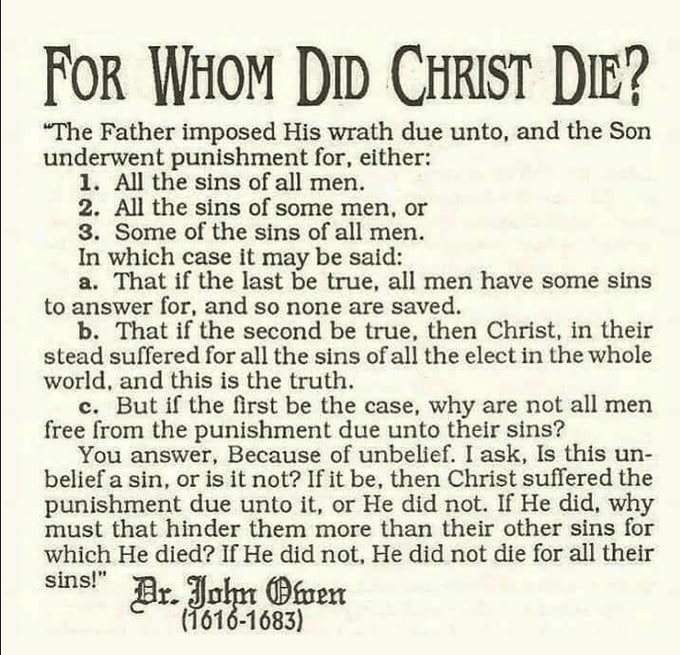
If the Atonement of Christ is applied to all, then it would be reasonable to say that all are saved (universalism). If Christ died for all, then all are forgiven once and for all, as we see their debt has been fully paid. Unless we believe in partial forgiveness and or a partial payment equaling a partial atonement. This implies that not only did Christ, our good shepherd, die for His sheep but also for the goats who are not of His herd. This thought leads us to the mindset that Christ had no particular people in mind for His substitution.
“If Jesus died for all men, why then, are not all freed from the punishment of all their sins? You will say, ‘Because of their unbelief; they will not believe.’ But this unbelief, is it sin, or not? If not, why should they be punished for it? If it be sin, then Christ underwent the punishment due to it; If this is so, then why must that hinder them more than their other sins for which he died from partaking of the fruit of his death? If he did not [die for unbelief], then he did not die for all their sins.” – Thomas Manton
He himself bore our sins in his body on the tree, that we might die to sin and live to righteousness. By his wounds you have been healed. – 1 Peter 2:24
“Christ died, not for those who perish, but for those who are chosen and believe. For if he had died for those who perish, it would necessarily follow either that he died in vain, or that they who perish, for whom he died, should not perish.” – William Ames
The choices are, therefore, an atonement of unlimited efficacy but limited extent (Reformed particularism), one of unlimited extent but limited efficacy (hypothetical universalism), or one of unlimited efficacy and unlimited extent (actual universalism). Scripture must be the guide in choosing between these possibilities.
“Christ came to save his own sheep, given to him by the Father, and none other.” – Richard Sibbes
Many of those who are in favor of a non-restricted atonement view tend to find their belief rooted in such verses as John 3:16 and 2 Peter 3:9. Anything that mentions God’s desire is for all and all to be saved. This perspective often highlights the inclusivity of God’s love and mercy, who yearns for every individual to turn towards Him. However, if we dive a little deeper, we will come to find that these verses better serve particular atonement. First, the wording that everyone clings to is the word “World” and “Whoever,” yet the word “whoever” already implies by the Greek “πᾶς ὁ πιστεύων” that it is those who are believing, not just anyone. It suggests a specific group of people characterized by their faith rather than a blanket statement applied indiscriminately. But then they cry out that Christ died for the world, and yes, we agree, he died for the people in the world, no longer just the Jews but now both Jews and Gentiles. This expands the scope of salvation, yet it invites further contemplation. But if you insist on saying Christ died for all, then you would have to apply that to Pharaoh, Cain, and Judas, who are figures that many argue were never meant to be recipients of divine grace. This view will then lead you to believe that Christ’s death wasn’t enough to save those for whom he died for; this is a massive error, for it denies the full atoning work of the Cross, undermining the significance of Christ’s sacrifice and the particularity of His atonement for those who will believe in Him. Furthermore, this misinterpretation can lead to a distorted understanding of God’s justice and holiness, as it ignores the necessity of repentance and faith, elevating a universal acceptance over the call from the Holy Spirit for new life in light of the Gospel.
‘ “For God so loved the world, that he gave his only Son, that whoever believes in him should not perish but have eternal life.’ – John 3:16

In multiple places, we have addressed the wording “all” in other articles, so I will not go in depth here. But simply leave this: that “all” doesn’t always refer to everything but does sometimes refer to every kind of thing. In this case, the wording “all” means every tongue, tribe, and race, which is the embodiment of the entire world, representing humanity and the diverse cultures that exist within it. “All” in this context can also mean all those whom He has called by His name, meaning the believers yet to come, signifying not only those present in faith today and those in the past but also future generations who will receive this calling found in the finished work of Christ.
‘The Lord is not slow to fulfill his promise as some count slowness, but is patient toward you, not wishing that any should perish, but that all should reach repentance.’ – 2 Peter 3:9
‘who desires all people to be saved and to come to the knowledge of the truth.’ – 1 Timothy 2:4
General atonement (universal atonement) denies the full efficacy of Christ’s atonement, which is a central tenet in understanding the significance of His sacrifice. It takes away from the work of the Cross and Christ’s glory by implying that His redemptive work failed for some, while it accomplished salvation for others. This perspective creates a dichotomy that challenges the very essence of God’s sovereignty and the purpose behind Christ’s sacrificial death. One cannot have a clear biblical understanding of election while holding to a General atonement view, as the two concepts are inherently at odds. The idea of election simply implies a particular calling to those whom the atonement of Christ was meant for, designating them as intended recipients of His grace and mercy. This means that the purpose of Christ’s atonement is not universal in its application; rather, it is specific and intentional, reflecting the divine plan and the love that God has for His chosen people. Embracing a view of limited atonement enhances the understanding of election, highlighting the depth of Christ’s sacrifice and reaffirming the assurance of salvation for those who believe.
Confessions and History regarding Limited Atonement
For it was the entirely free plan and very gracious will and intention of God the Father that the enlivening and saving effectiveness of his Son’s costly death should work itself out in all his chosen ones, in order that he might grant justifying faith to them only and thereby lead them without fail to salvation. In other words, it was God’s will that Christ through the blood of the cross (by which he confirmed the new covenant) should effectively redeem from every people, tribe, nation, and language all those and only those who were chosen from eternity to salvation and given to him by the Father; that he should grant them faith (which, like the Holy Spirit’s other saving gifts, he acquired for them by his death); that he should cleanse them by his blood from all their sins, both original and actual, whether committed before or after their coming to faith; that he should faithfully preserve them to the very end; and that he should finally present them to himself, a glorious people, without spot or wrinkle. – Article II.8 –The Canons of Dort
Having set forth the orthodox teaching, the Synod rejects the errors of those
I. Who teach that God the Father appointed his Son to death on the cross without a fixed and definite plan to save anyone by name, so that the necessity, usefulness, and worth of what Christ’s death obtained could have stood intact and altogether perfect, complete and whole, even if the redemption that was obtained had never in actual fact been applied to any individual.
For this assertion is an insult to the wisdom of God the Father and to the merit of Jesus Christ, and it is contrary to Scripture. For the Savior speaks as follows: “I lay down my life for the sheep, and I know them” (John 10:15, 27). And Isaiah the prophet says concerning the Savior: “When he shall make himself an offering for sin, he shall see his offspring, he shall prolong his days, and the will of Jehovah shall prosper in his hand” (Isa. 53:10). Finally, this undermines the article of the creed in which we confess what we believe concerning the church.
V. Who teach that all people have been received into the state of reconciliation and into the grace of the covenant, so that no one on account of original sin is liable to condemnation, or is to be condemned, but that all are free from the guilt of this sin.
For this opinion conflicts with Scripture which asserts that we are by nature children of wrath.
Who make use of the distinction between obtaining and applying in order to instill in the unwary and inexperienced the opinion that God, as far as he is concerned, wished to bestow equally upon all people the benefits which are gained by Christ’s death; but that the distinction by which some rather than others come to share in the forgiveness of sins and eternal life depends on their own free choice (which applies itself to the grace offered indiscriminately) but does not depend on the unique gift of mercy which effectively works in them, so that they, rather than others, apply that grace to themselves.
For, while pretending to set forth this distinction in an acceptable sense, they attempt to give the people the deadly poison of Pelagianism. – The Canons of Dort
As God hath appointed the elect unto glory, so hath he, by the eternal and most free purpose of his will, foreordained all the means thereunto. Wherefore, they who are elected, being fallen in Adam, are redeemed by Christ, are effectually called unto faith in Christ by his Spirit working in due season, are justified, adopted, sanctified, and kept by his power, through faith, unto salvation. Neither are any other redeemed by Christ, effectually called, justified, adopted, sanctified, and saved, but the elect only. – Chapter 3 .6 – The Westminster Confession Of Faith
We believe that—all Adam’s descendants having thus fallen into perdition and ruin by the sin of the first man—God showed himself to be as he is: merciful and just. He is merciful in withdrawing and saving from this perdition those whom he, in his eternal and unchangeable counsel, has elected and chosen in Jesus Christ our Lord by his pure goodness, without any consideration of their works.
He is just in leaving the others in their ruin and fall into which they plunged themselves. – Article 16 – The Belgic Confession
“Christ is sacrificed for the salvation of believers…Not all are redeemed, for not all shall be saved, but the remnant…All those who are redeemed and delivered by Thy blood return to Zion, which Thou hast prepared for Thyself by Thine own blood…Christ came to redeem Zion [a metaphor for the church] with His blood. But lest we should think that all are Zion or every one in Zion is truly redeemed of the Lord, who are redeemed by the blood of Christ form the Church…He did not give His life for every man, but for many, that is, for those who would believe.” – Jerome (A.D. 390)
Jesus died for men of every kind, not all men. “As Jacob served Laban for the cattle that were spotted, and of various forms, so Christ served even to the cross, for men of every kind, of many and various shapes, procuring them by his blood, and the mystery of the cross,” (Dialog. cum Tryph, p. 364.). – Justin. A.D. 150
Conclusion
If you believe in hell, then you believe in some form of limited atonement. If you believe in Election, then you believe in limited atonement. The matter isn’t whether the atonement is limited or not; it is more so centered around how it is limited and who sets the limit. Are such limits found in man’s hand or God’s sovereignty? Did Christ just make Himself available to all, or did He intentionally purchase some? These are important questions to answer, for they shape how we view the security and hope that is found in Christ’s finished work on the Cross. While the Gospel is good news for all people, the Gospel is especially good news for those who believe it.
| Feature | Limited Atonement | Hypothetical Universalism | Universal Atonement |
| Extent of the Atonement | Christ’s death was for the elect alone (a limited number of people). | Christ’s death was for all of humanity (universal in its provision). | Christ’s death was for all of humanity (universal in its provision). |
| Purpose/Intent | To actually and definitively save the elect. The atonement was a perfect success for its intended purpose. | To make salvation universally possible on the condition that all people believe. | To make salvation universally possible and available for all who choose to believe. |
| Efficacy | The atonement secures salvation for every person for whom it was intended. It is guaranteed to be effective. | The atonement is effective only for the elect, who are given the gift of faith by God. | The atonement becomes effective only for those who freely choose to believe and accept it. |
| Relationship to Election | God’s election of the saved precedes and determines the scope of the atonement. | God’s election of the saved follows the atonement, as God elects those who will receive the gift of faith. | God’s election is based on His foreknowledge of who will freely choose to believe in Christ. |
| Common Slogan | “Christ died for the elect.” | “Sufficient for all, efficient for some.” | “Christ died for everyone.” |
| View on Gospel Call | The free offer of the gospel to “all” is sincere, as it is a command to repent and believe. The benefits of the cross are not available to the non-elect, but they are still commanded to believe. | The free offer of the gospel is a genuine offer to all people, based on the atonement’s universal sufficiency. | The free offer of the gospel is a genuine offer to all people, as the atonement was for all people. |
| Primary Theological Tradition | Classic, “High” Calvinism | Moderate Calvinism / Amyraldianism | Arminianism / Wesleyanism |
We must wrestle with such doctrines, as they are clearly found throughout Scripture. Such beliefs change how we approach and view all things. Take time out of each and every day to think through some of the tough truths that are found in God’s word. Hopefully, through reading this article, it has challenged you to think more deeply about the things of God and to better seek to understand His will for His people.

https://www.monergism.com/thethreshold/sdg/Packer,%20J.I.%20-%20Definite%20Redemption.pdf

Leave a comment