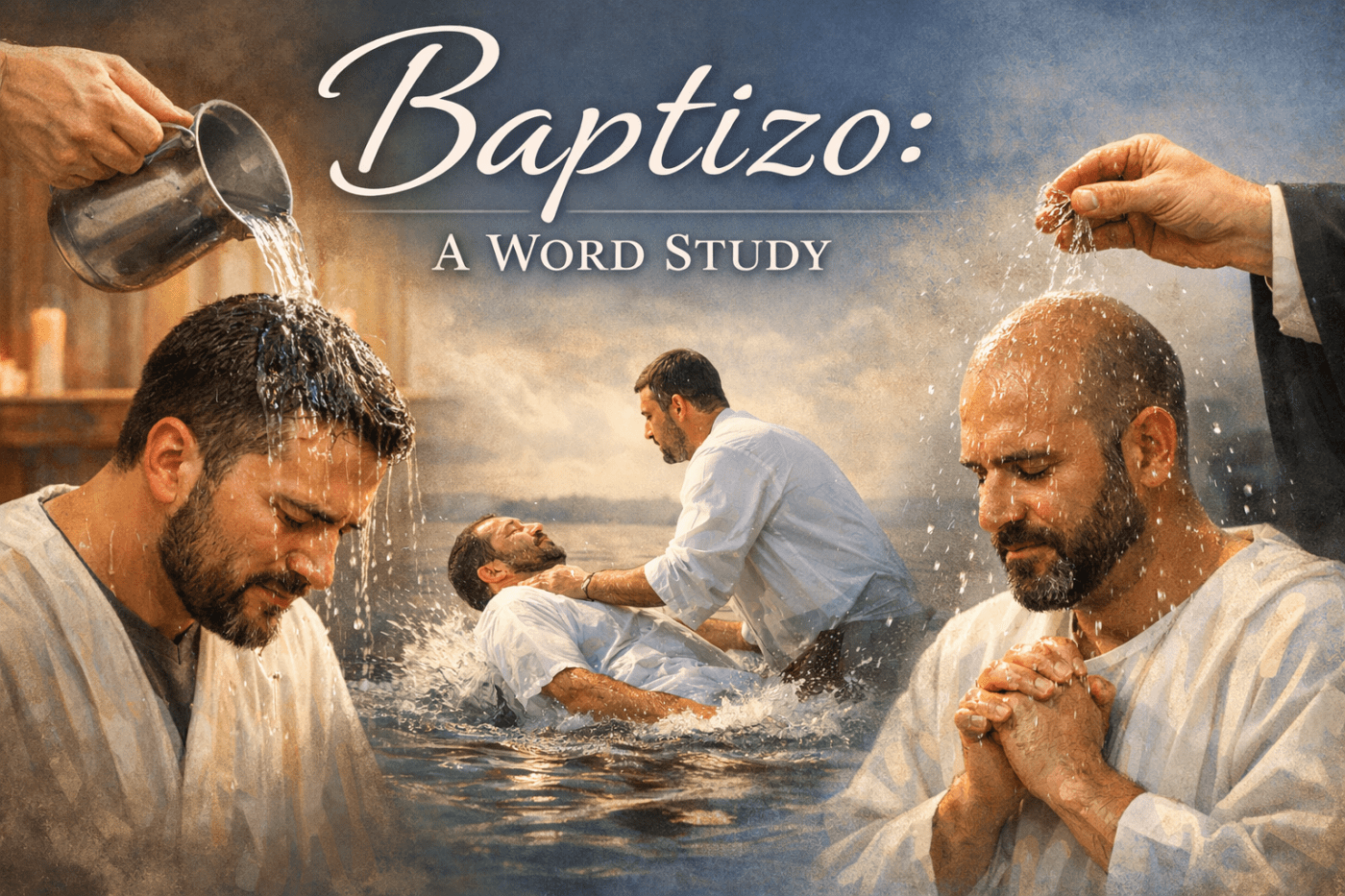
One day, I thought to ask the following question during a fellowship meal at my old Baptist church – “How do you baptize someone who cannot be immersed in water due to physical issues? If they are hooked up to machinery due to a chronic illness, can’t we pour water over their head to ensure they have been baptized?” The answer throughout the lively discussion was essentially that it was better for that person to be obedient and not be baptized than to corrupt that “moment of obedience” by not being properly dunked. While my thoughts at the time were pragmatic in origin, after rigorous study into the mode of baptism described in the New Testament, I’ve come to the conclusion that scripture supports multiple modes – effusion is just as proper1 as immersion.
First, one must admit that as we look up baptizō in several lexicons, the majority give “dip” or “immerse” as the meaning. However, we do not see where this specific meaning is explicitly stated in the New Testament at all. The word baptizō occurs roughly 80 times2 in 65 verses, but note how that with only 2 exceptions, the word is actually transliterated. While we can work through these passages where the word has been transliterated, this can still lead to a lack of clarity as we are dealing with a word “baptism” that was born from the direct word it is being translated from. So first, let us turn to Mark 7:4 & Luke 11:38 where the word baptizō is translated as wash.
When they come from the marketplace, they do not eat unless they wash (βαπτίσωνται) . And there are many other things which they have received and hold, like the washing (βαπτισμοὺς) of cups, pitchers, copper vessels, and couches.  – Mark 7:4

When the Pharisee saw it, he marveled that He had not first washed (ἐβαπτίσθη)  before dinner.
– Luke 11:38
Here Mark & Luke use baptizō for “they wash” and Mark uses the noun variation baptismos for “the washing”. Naturally, the question would be ‘what is being washed?’ so we can ascertain the mode of water being used. While the immediate context speaks of washing of hands we see that this is referring to a purification rite3 of washing to be considered clean to eat. This purification rite is not something we see directly in scripture, but rather something that evolved from the rite of washing Aaron and the priests were given in Exodus 30:17-21. Just as the priests cleansed themselves before entering the temple, so the people were taught to cleanse themselves to not defile themselves with those considered unclean4. The Mishnah5 refers to this not as a scrubbing, but as a pouring of water. While this does help inform us of what Mark & Luke were thinking of when using the word baptizō, regulations absent from the written Torah but foundational to Pharisaic tradition reflected here should not be the only study we review of this word. So, we turn to other passages where context can help inform us of mode.
So he commanded the chariot to stand still. And both Philip and the eunuch went down into the water, and he baptized (ἐβάπτισεν) him. Now when they came up out of the water, the Spirit of the Lord caught Philip away, – Acts 8:38-39a
This passage shows Philip baptizing the Ethiopian Eunuch on the roadside. We know that this road from Jerusalem to Gaza was a well-traveled road that passed through arid territory. On top of Luke’s usage of “some water”,6 maps show us that the area is marked by wadis (seasonal streams), springs, and pools, not major rivers. While the language regarding water here is one that is deliberately generic and does not imply a specific mode or quantity of water, the actions of Philip do help us paint a clearer picture of mode. Note how the text says that both Philip and the Eunuch went into and out of the water. If the act of going down into the water7 is the specific act of immersing the Eunuch, then this would mean that Philip immersed himself as well. This phrasing explains the men approaching the water source together—not the baptizing action itself. Luke, with access to specific verbs, chose not to use them, inviting us to reflect on the profound meaning behind their actions.8
Then those who gladly received his word were baptized (ἐβαπτίσθησαν); and that day about three thousand souls were added to them. – Acts 2:41
We see here that 3,000 men, women, and children9 are added to the church by baptism within eight to ten hours10 as Luke specifies this happens that day. The fact that Acts 2 continues with fellowship, meals, and worship the same day reinforces this idea of a quick timeline for these baptisms. Assuming the best circumstances, we have 12 apostles separating the crowd into even groups of 250, and we allot 60 seconds per baptism, we have over 4 hours11 to complete all the baptisms. While this is theoretically possible, it’s physically implausible as this doesn’t account for: organizational crowd control, clothing changes for layered pilgrims, physical exhaustion, or the logistics of finding a water source.
For a feast day of Pentecost, the city would be crowded with pilgrims, making the task of organizing people into groups for an assembly line style ritual extremely difficult. On top of that, since many of these people would be dressed having prepared for a long journey of days or even weeks on the road.12 They likely dressed for durability and changing weather13, not for repeated water entry. We must also remember that the apostles were mere mortal men. They were not able to function as a ritual machine dispensing sacraments at a steady pace. After a few dozen baptisms, it is likely that the time would continually extend without some intervening miracle. Since Luke does not record this detail, it is wise for us to not spiritually speculate.
Finally, there is the logistics of finding a suitable water source for the congregation. While Jerusalem had Mikva’ot (ritual baths), these were narrow and limited with space as the ritual was self-administered. We do not see the apostles reinterpreting their purpose. While cisterns were also available, the access thereof would not be simple with archeology showing us the entry often required ladders or steep steps; many were covered for hygiene and safety. Theoretically, they could have used a nearby body of water such as the Kidron Valley Stream14 but this exacerbates the issue of crowd control mentioned earlier of moving a group of thousands of people in and out of the city.
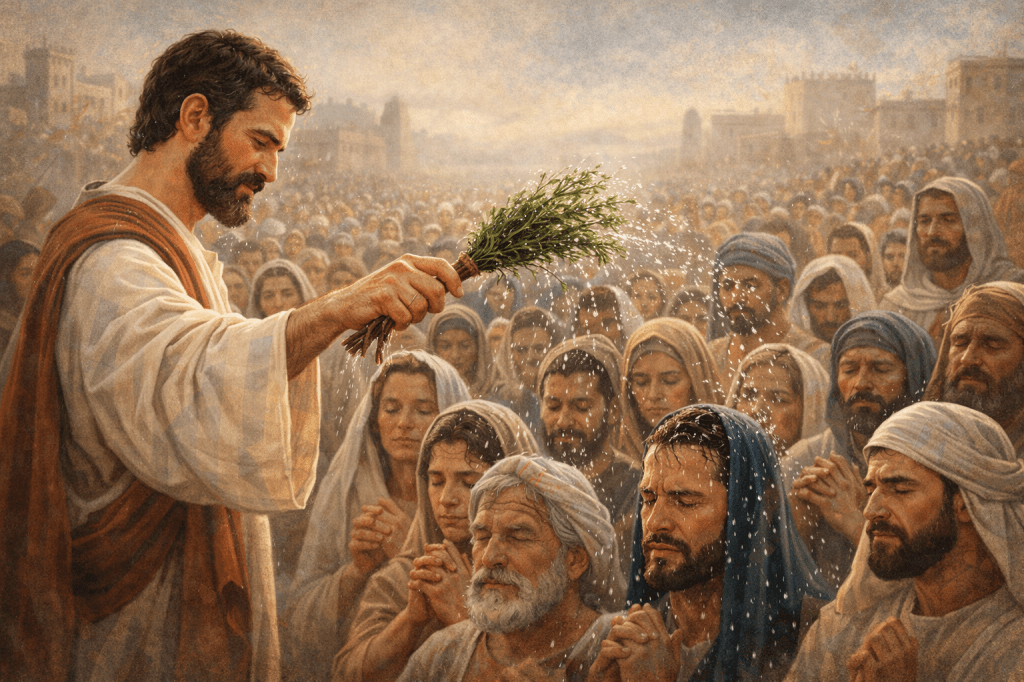
It seems much more probable that the apostles sprinkled the people that day. On top of solving what could be a logistical conundrum, Scripture shows similar imagery in the Old and New Testament. In Exodus, we see Moses sprinkle the blood of the covenant on the Israelites to mark them as God’s people.15 We see this mirrored throughout scripture of sprinkling as a rite of cleansing16 with and without the aid of hyssop.17 Peter and the apostles could have and likely did effuse the people as a crowd so that way fellowship and covenantal feasting could happen the same day.18
While this study is not an exhaustive one—as far smarter and more eloquent men have done so19— I do hope this helps people understand that pouring and sprinkling are not mere pragmatism at play, but a valid adherence to what we see in scripture. Scripture does not explicitly define one mode and one mode alone for baptism, and it would be traditions of men for us to go beyond the bounds provided. We see baptism as necessary for the Christian life, and as God places His name on us20 we should note that scripture’s explicit silence on method strongly suggests that the presence of water, not the quantity or mode, is the point of the sacrament.
- if not more proper ↩︎
- 80 Times in the Textus Receptus, https://www.blueletterbible.org/lexicon/g907/nkjv/tr/0-1/. The critical text has the word listed 77 times. ↩︎
- cf. Exodus 30:17-21, Psalm 26:6, Mark 7:3, John 2:6, John 3:25, Hebrews 9:10 ↩︎
- cf. John 18:28, Act 10:28 ↩︎
- Mishnah Yadayim 1:1–2 ↩︎
- No noun like river (ποταμός), sea (θάλασσα), spring (πηγή), or pool (κολυμβήθρα) is used here. ↩︎
- Strong’s G2597, root katabainō (κατέβησαν inflected) ↩︎
- (e.g., βαπτίζω with explicit qualifiers, or καταδύω, to plunge). ↩︎
- Luke does not use ἄνδρες (“men”), which he explicitly does just a few verses earlier in Acts 2:14. Instead, Luke uses ψυχαί (souls/persons), a term that includes all peoples for common household-level counting (cf. Acts 27:37; Gen 46 LXX) ↩︎
- Luke references the pouring of the Spirit as the 3rd hour, which would be 9AM. Jewish timing would have the day ending sometime before 8PM based on the time of year, so assuming that Peter’s sermon happened within an hour of the Spirit we have a timeline that is at its longest 10AM-8PM. ↩︎
- 4 hours and 10 minutes precisely ↩︎
- Deuteronomy 16:16 ↩︎
- cf. Exodus 22:26-27 ↩︎
- Roughly half a mile depending on where you are in Jerusalem ↩︎
- Exodus 24:7-8 ↩︎
- cf. Leviticus 8:30, Isaiah 52:15, Ezekiel 36:25 ↩︎
- cf. Exodus 12:22, Leviticus 14:4,6,49, Numbers 19:6, Psalm 51:7 ↩︎
- Acts 2:42 ↩︎
- https://www.youtube.com/watch?v=dOi59_jTNUo&t=0 ↩︎
- Cf. Matthew 28:19, Acts 2:38-39, Galatians 3:27, 1 Corinthians 1:13-15 ↩︎


Leave a comment