
God does not change, and His promises do not change. When God said to Abraham, “I will be a God to you and to your children,” He was not making a temporary arrangement, but establishing a covenant promise that extends to all who belong to Abraham by faith. Because we are united to Christ—the true Seed of Abraham—that promise is ours today.
This conviction lay at the heart of my understanding of paedobaptism—the belief and practice of baptizing the children (typically infants) of believing Christians—as I began to study its biblical foundations. But what exactly is this promise? And how does it apply to a child who has not yet made a profession of faith? Many credobaptists argue that Scripture clearly restricts baptism to those who make a credible profession of faith. Yet while certain passages, read in isolation, may appear to support that restriction, the broader sweep of redemptive history tells a different story. My aim here is not to merely mount a polemical case against credobaptism, but to unfold the promise itself—the promise given to Abraham and to his offspring. After all, if we are Christ’s, then we are Abraham’s seed, and heirs according to that promise1.
First, we understand the promise that God made to Abraham as part of what is understood as the Covenant of Grace. Though the term itself is not found in Scripture, the covenantal structure is clearly revealed, as God establishes a covenant with Abraham.2 We see this covenant unfold throughout scripture. To borrow an analogy, we might picture this covenant as a grand drama of redemption. Each act within this play reveals more, with Act One beginning in Genesis with the protoevangelium—as God promises the Seed of the Woman will crush the serpent, Christ will defeat Satan.3 As the play continues through its telling of the story, God provides this promise to Abraham, sealing it with circumcision. When we arrive at the Act of the New Covenant, the outward form of the sign changes—circumcision gives way to baptism—but the cast of characters does not. The covenant people remain believers and their children. The set, lighting, and costumes shift from act to act, yet the underlying structure of covenant membership4 stays fundamentally the same, even if the administration changes. Just as Abraham circumcised both Isaac & Ishmael as part of the promise, we baptize our children as part of the promise understanding that these signs mark inclusion in the promise to Abraham, not guaranteed salvation. At this point, many Baptists will rightly point us to passages such as Romans 6 a passage that requires careful and charitable consideration as it seems to confirm the idea that only those with a profession of faith are to be baptized. The chapter starts:
"What shall we say then? Shall we continue in sin that grace may abound? Certainly not! How shall we who died to sin live any longer in it? Or do you not know that as many of us as were baptized into Christ Jesus were baptized into His death? Therefore we were buried with Him through baptism into death, that just as Christ was raised from the dead by the glory of the Father, even so we also should walk in newness of life."5
First, Paul is attempting to solve the expected problem readers might have after chapter 5. Paul is pushing back against the antinomian6—the idea you don’t need to live as Christ says to— inference from justification by faith alone.7 The issue is if justification is free, what prevents us from moral chaos? Paul is not saying that having the experience of a profession of faith is what stops it, but that we died. Died to sin means we are under the Headship of Christ, and baptism marks belonging to Christ’s domain. How do we know that Christ’s domain of the church does not require that profession of faith for children? Because Paul appeals to to the shared community of “us” when writing to the Roman church—he addresses the visible church, as opposed to distinguishing between regenerate and unregenerate. While the instinct might be to assume inward Spirit-wrought union, Paul speaks this way because baptism incorporates one into Christ’s body. Paul uses similar language in 1 Corinthians when he says that Israel was baptized in the cloud and in the sea.8 In the passage to the Corinthian churches, Paul explicitly says not all those Israelites were saved as many died in their unbelief, and yet he uses this incorporating language of the whole visible group. That precedent is important.
The language of Paul here is strong — it might sound like the regeneration of our stony hearts to many. But so does circumcision in the Old Testament, as the Israelites are told to circumcise their hearts and is spoken of in similar terms.9 However, not all circumcised Israelites were saved. Rather, the sign was given prior to evidence of faith in infants, signifying a reality that only some of them possessed inwardly. This strong language does not automatically mean a one-on-one identity between sign and inward reality. We see this reality as we dig further into the passage. When Paul says that we are buried with Christ by baptism into death he is explaining not what baptism causes, but rather what baptism signifies and seals. Paul exhorts the Roman church, telling them ‘you have been marked out as one of those united to Christ in His death and resurrection. Ergo, you must live consistently within that identity.’ Paul presupposes the visible covenant community by reminding them to act like Christ as opposed to verifying any potential religious experience. Actually, because he is appealing to their baptism as opposed to their faith the idea of paedobaptism becomes more clear—not because baptism replaces faith, but because baptism publicly marks covenant identity. If baptism were exclusively a post-regeneration testimony, you might expect Paul to say: “As many of you as believed…” But he doesn’t. He appeals to the sign of baptism, much as the sign of circumcision was used with Abraham. Let’s now take a look at a passage that does mention faith, and see how the promise is understood there:
For you are all sons of God through faith in Christ Jesus. For as many of you as were baptized into Christ have put on Christ. There is neither Jew nor Greek, there is neither slave nor free, there is neither male nor female; for you are all one in Christ Jesus. And if you [are] Christ's, then you are Abraham's seed, and heirs according to the promise.10
If baptism is mentioned immediately after faith, does that mean baptism must be restricted only to those who already manifest faith? Before we say yes there is a lot to consider here. Paul is not giving instructions about who is to be baptized here but is speaking to an already baptized congregation. Paul is reminding them that it is not circumcision that lets them “put on Christ”, but rather baptism that marks them as being in Christ. This does not collapse as a point even if some of the Galatian church are hypocrites—if some of these baptized people were not truly saved, Paul’s comments still apply to a mixed covenant body. Paul is appealing to the covenant identity as opposed to fidelity. This is why the imagery of “putting on”11 is important to note. Paul uses this elsewhere12 as a sign of identity, or public belonging. Paul is not speaking of some inward mystery spark, but how baptism is an expression of that identity. Paul is exhorting the Galatians that they do not need circumcision as a marker of who is in the visible church, but that it has been replaced by baptism. The context of the Judaizers trying to force Christians to circumcise matters enormously, as they were denying the sign of inclusion that had already been provided. They were adding an additional barrier to the visible church, which is why Paul reminds them who is in Christ—Jew or Greek, slave or free, male or female. Paul is stating who is included in the promise of Abraham; which are those in Christ who are heirs of the promise and are baptized as part of the whole visible body. Let’s look at one final passage that mentions both baptism and circumcision.
...you are complete in Him, who is the head of all principality and power. In Him you were also circumcised with the circumcision made without hands, by putting off the body of the sins of the flesh, by the circumcision of Christ, buried with Him in baptism, in which you also were raised with [Him] through faith in the working of God, who raised Him from the dead.13
The church at Colossae were being pressured into a contradictory set of beliefs centered on denying oneself. Context shows us it likely involved food laws, ritual observances, mystical elements, and potentially circumcision14. Paul reminds them that they are already complete in Christ, and they don’t need extraneous identifiers for that. But then Paul corresponds circumcision and baptism in the following verses, in both physical and spiritual lanes of thought. The phrase “circumcision made without hands”15 shows Paul is talking about a spiritual transformation, something no one should dispute. So when Paul follows with baptism, we must ask ourselves is he stating that baptism is indeed spiritual circumcision or is it the visible sign corresponding to that spiritual circumcision. Two things would push towards the latter interpretation, the first being Paul’s insertion of “through faith”. This distinction shows that the raising with Christ is by faith, not burial marker of baptism. While our credobaptist friends would protest that the sign of baptism doesn’t confer that faith, we would agree wholeheartedly! If baptism in this text required prior regeneration—and by extension a profession of faith—then Paul’s warning passages in the Colossians 2–316 about falling away would be strange. However, Paul is speaking to those within the promise of Abraham—the visible church, not an invisible subset.
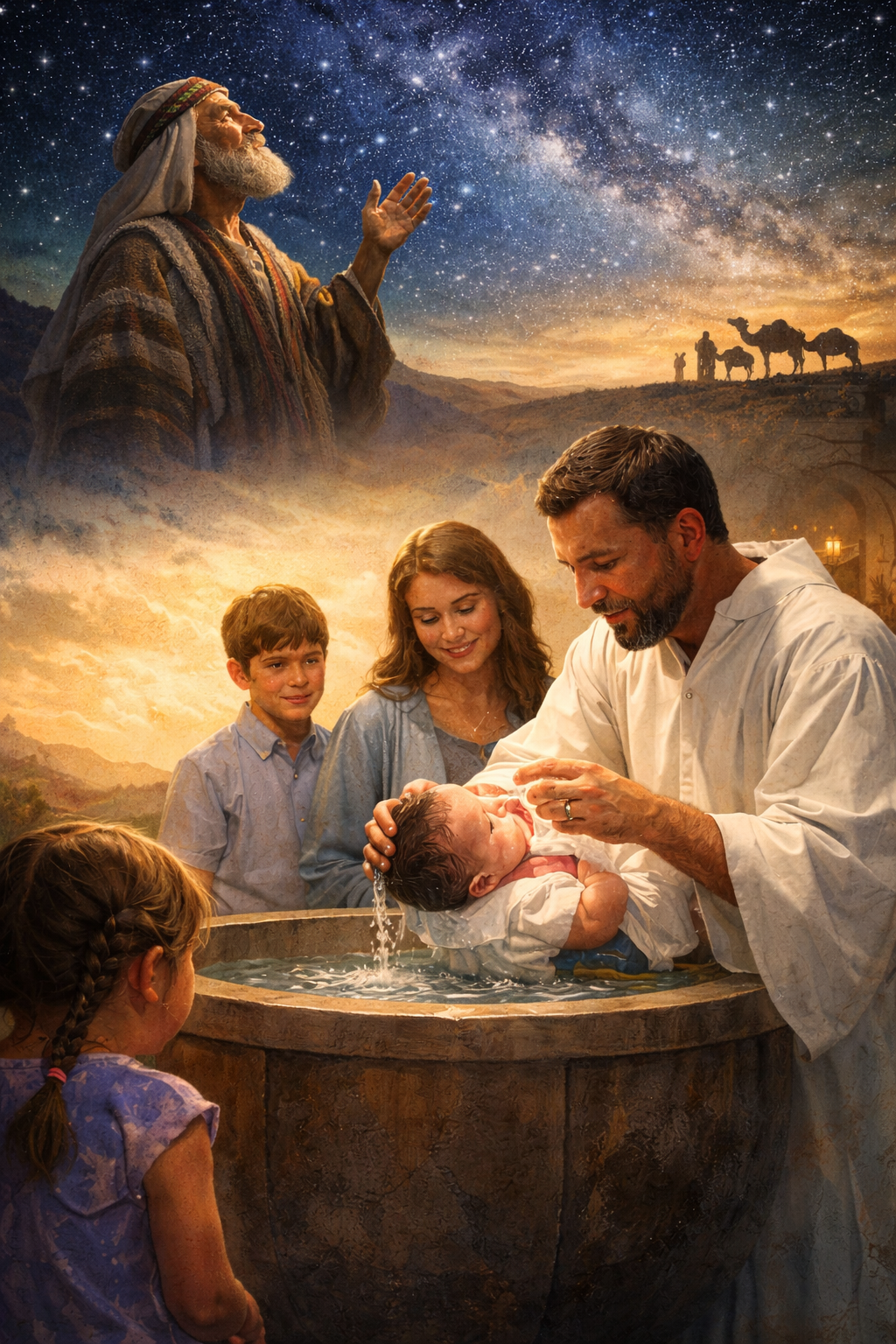
While in isolation these passages may seem to be a kryptonite to the concept of baptizing one’s children, the context shows that is simply not the case. Christians are referred to as the children of Abraham continually throughout scripture17 and as such are heirs of the promise that God gave him in Genesis 17:7 — “I will be a God to you and your children”. God knew that a sign showing that people and children of this promise would set them apart from the rest of the world. While circumcision was spoken of in spiritual terms in the old testament, the physical sign was provided to all Israelites regardless of their adherence to the Shema.18 So today, the physical sign is provided to all in the church, including infants. We know that our children who grow up in church have many blessings that those who do not step foot in a church get to appreciate. They are included in that promise, and so we mark them with the sign of that promise by baptizing them. When Paul speaks to the church reminding them to live like Christ because they are His people it is the same exhortation we give our children. God has made us stewards of these children, and we do no good by denying them the sign of the promises they might inherent. Instead, we mark them with baptism and pray that, in due time, they will own for themselves the faith that has been signified to them from the beginning.

- Galatians 3:29 ↩︎
- Genesis 17:7 ↩︎
- Genesis 3:15 ↩︎
- Believers and their children as visible church members ↩︎
- Romans 6:1-4 ↩︎
- See our article on antinomianism here: https://thoughtsinthelight.com/2026/01/09/neglected-holiness-antinomianism/ ↩︎
- cf. Romans 3-5 ↩︎
- 1 Corinthians 10:1-5 ↩︎
- cf. Deuteronomy 10:16, Deuteronomy 30:6, Jeremiah 4:4 ↩︎
- Galatians 3:26-29 ↩︎
- literally: to clothe oneself; Strong’s G1746, (ἐνεδύσασθε) ↩︎
- cf. Romans 13:14, Ephesians 4:24 ↩︎
- Colossians 2:10-12 ↩︎
- cf. Colossians 2:16-23, ↩︎
- literally: not made with hands; Strong’s G886 (ἀχειροποιήτῳ) ↩︎
- cf. Colossians 2:19; 3:6 ↩︎
- cf. Galatians 3:7; 3:29; Romans 4:11-12 ↩︎
- Deuteronomy 6:4-9 ↩︎

Leave a comment