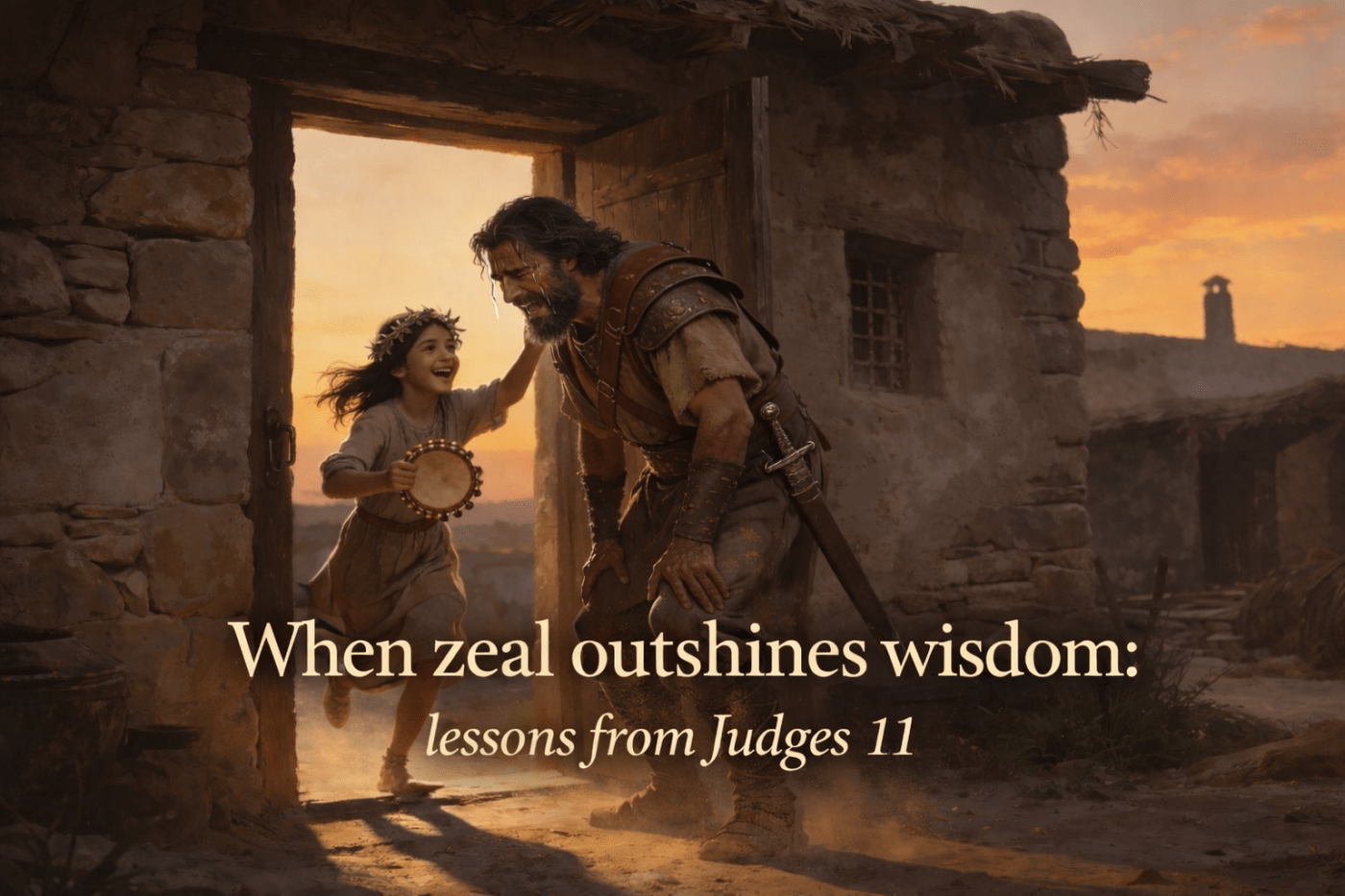
Emotions are part of reality, society, sin, righteousness, and foolishness. How well do we see this in Judges 11? Jephthah shows a pagan shortsightedness and not covenant wisdom with a systematic thought process, as we all do almost daily. If we truly read what was done, we should weep for Jephthah, his daughter, and ourselves, for we tend to lean on our own wisdom and not on the Lord.1
Have you ever gone to God to bargain with Him? “My God, will You just do this and I will do this?” How often do we feel the crook in our lot and not understand that it was put there by the very God we pray to for our good, yet we decide to pray against it. Paul did this, and the answer was “My grace is sufficient for you.”2 Consider this: “Consider the work of God: who can make straight what He has made crooked?”3. How arrogant are we who pray in a way, instead of for the mercy of God, to sway His decision!!
When times become so tough, we must remember that as Calvinists (Christians who believe what the Bible teaches, not what we want it to say) the crook, trial, nagging thing—the crook—could be a husband, a wife, a child, a parent, a grandparent, a boss, a physical illness, a mental illness, etc. As Boston so well said, “The crook in the lot is the work of God; and therefore it must be crooked, for He made it so.”4 As he so wonderfully points out, the crook is not accidental. So why do we complain like those in the wilderness, who then were condemned not to see the promised land?
When we pray to God, do we add unnecessary things that God does not require? How often do we pray simply, “Have mercy on me, a sinner,”5 which is enough to be justified? I am guilty of such prayers myself. I have literally prayed to God that He not look at what I was about to do to survive a trying time in my life, a time when I was not walking in the ways of the Lord, and I was more like those who did what was right in their own eyes.6 Well, that was wrong; I was wrong. If you think that way, you are wrong, and yes, at times I slip and am wrong, BUT GOD.
So back to Jephthah: he wins an incredible victory and makes a vow God did not require, and ends up feeling the need to kill his daughter. Later in Scripture we read this might not have been true (see Matt. 9:13 and Psalm 51:16–17). Look at James 3:5. It was not a boast, yet Jephthah did set the forest ablaze. So much so, for generations the Israelites commemorated this. Oh, how our words that we say without thinking can then break us. Reflect on it—on your own mutterings that have then caused such a break in relationship. How often have we, or do we, say off-the-cuff remarks that the Lord then puts in front of us and calls us to pay? Let us not even utter useless things, despiteful things. A prayer that I fervently pray is let me not utter words that are not from you oh my God, for they do nothing for your glory. Then I fail again and again.
Praise the Lord that the time of ignorance once overlooked has now ended. He calls all to repent and believe in His one and only Son—the propitiation for our sin that was expiated from us, imputed to Him on the cross, and His righteousness is then placed on us by faith alone, in Christ alone, for God’s glory alone. Not of us, as we have seen; even when we seemingly win a great victory, we, in a sense, muck it up.
So in closing, may we be quick to listen to each other, slow to speak, and slower to think of the words we are about to speak, as words and thoughts have a way of running away from us like the cartoon Roadrunner, and then we are just left chasing after them like the Coyote. When we find ourselves there, as it has been written, a broken spirit, a sacrifice begging for mercy: “God, be merciful to me, a sinner”. May we be quick to repent, slower to sin, and as slow as molasses to be angry, because God has brought everything upon us, and “Consider the work of God: for who can make straight what he has made crooked?”. For when we do, God might just say, “I will go before you and will level the mountains; I will break down the gates of bronze and cut through the bars of iron.”7. Let’s not forget He already did this for us, so we might be saved from His wrath. “Blessed be the God and Father of our Lord Jesus Christ! According to his great mercy, he has caused us to be born again to a living hope through the resurrection of Jesus Christ from the dead!”8. Let the thought of God giving you one way out from His wrath lead to doxology like Peter’s or Paul’s.


Leave a comment