
“The soul is framed according to what it most esteems.” – Jeremiah Burroughs
What is it that you believe shapes how you view the world, and what is it that drives how you interact with the world? Does being a Democrat or Republican shape your view of politics, influencing your stance on key issues and your responses to current events? Does being a former athlete influence your view of sports, leading you to appreciate the dedication and effort that goes into training and competition? Does being a chef inform your restaurant choices, affecting how you perceive the quality and creativity of dishes? So many things inform our thoughts and deeds nowadays; we are constantly being bombarded by worldly influences, from social media to news outlets, all contributing to our perceptions. It does matter how we view things because our view leads us to action, shaping not just our personal choices but also how we engage with the broader society. By reflecting on these influences, we can gain a deeper understanding of ourselves and our interactions, ultimately guiding us toward what we most value in life.
Colson and Pearcey in their book How Now Shall We Live? They define worldview as “the sum total of our beliefs about the world, the big picture that directs our daily decisions and actions.”
Biblical Worldview Vs Earthly worldview
Our worldview is usually cultivated by that which we have spent the most time around and/or that which we value most in life. This can stem from everything from money to personal relationships to experiences or even perhaps our own self-worth. A worldview, according to an American evangelical theologian named Francis Schaeffer, is the “grid through which one sees the world” Simply put, a worldview is the lens through which we see all things. The question is not if you have a worldview, it is what type of worldview you have? Everyone has one, but not all are equal. Here below we will walk through some of the different worldly lenses people tend to have inherited. Some are worse than others, but ultimately all outside of the Biblical eternal view fall short and are disappointing.
“A man’s thoughts are the index of his condition.” – John Flavel
Materialism vs. Eternal
We all have at one point in time struggled with this idea of needing more. Whether it be I need more money, more cars, more clothes, a bigger house, or another vacation home. You name it, someone has been unsatisfied with it. Why is that? It seems we all have been trying to find value and happiness in that which we possess (or perhaps that which possesses us). It doesn’t matter if you are a kid or an adult, rich or poor. We always want more of something. It is as if we have an unquenchable hunger for something this world can never grant us. Perhaps we were never designed to find our true fulfillment in worldly material things. The Bible tells us that what we truly desire is a relationship, one that fulfills our every need. One that quenches the eternal thirst that has been placed on our hearts.1 A relationship with our Eternal Father who restores all things and blesses those who love Him. That is the true value that we seek, not the gift but the gift giver.
What does it look like to think eternally rather than materialistic?
An eternal worldview stores up for eternity, understanding that the choices made today will resonate long into the future. A materialistic worldview consumes, focusing heavily on the fleeting pleasures and conveniences of the present moment. An eternal worldview evaluates life vertically—before God. A materialistic worldview evaluates life horizontally—before others—often leading to a relentless comparison with peers and a quest for validation. One lives with the mindset: “What lasts forever?”, while the other lives with the mindset: “What can I gain right now?”, allowing immediate gratification to dictate their choices. An eternal worldview sees life as temporary but also accountable, recognizing that actions have consequences that extend beyond this earthly existence. It places more importance on the unseen things with faith than on the things that will waste away, like material possessions and worthless achievements.
Haggai is the perfect biblical example of a people pursuing material gain (such as building their own paneled houses), while they left the eternal perspective behind (as they had left God’s temple in ruins).2
Are you viewing life through the lens of a biblical worldview with eternity in perspective, or are you just seeking gratification and identity in your next purchased item?
Humanism/Hedonism vs. Eternal
“In those days there was no king in Israel. Everyone did what was right in his own eyes.” – Judges 21:25
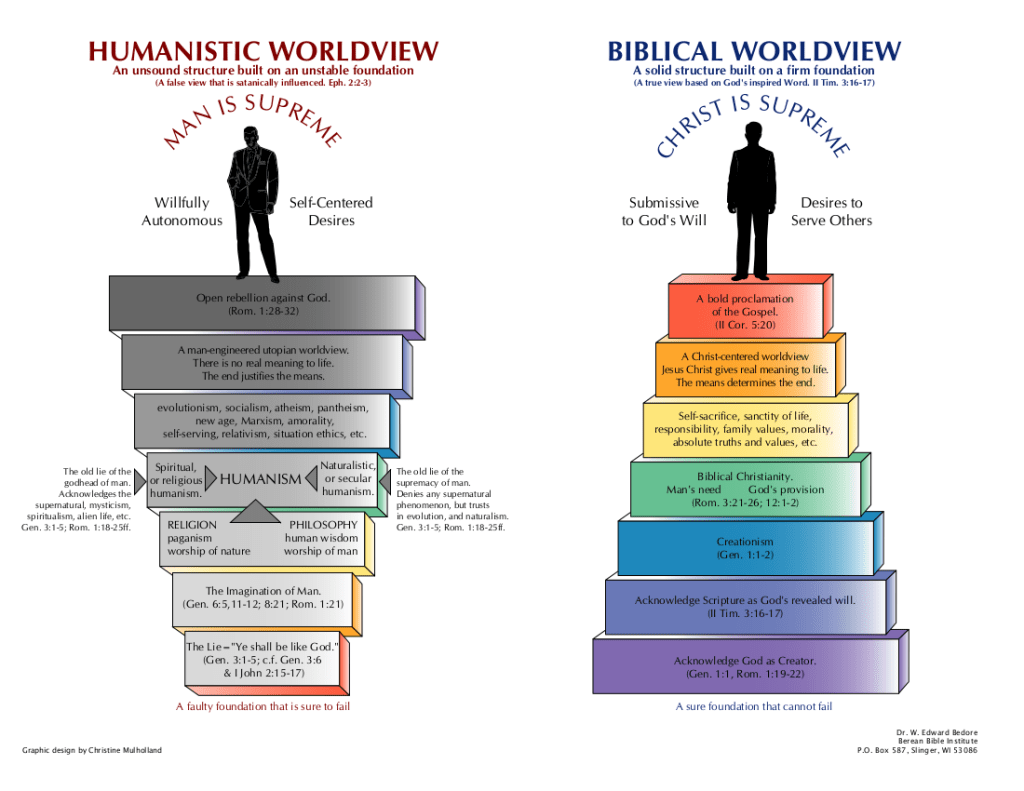
Everyone did what was right in his own eyes is probably one of the best summaries of the Humanism/Hedonism view, encapsulating a worldview that prioritizes the individual experience above all else. This perspective emphasizes that we exist primarily to serve self, making personal fulfillment the ultimate goal. Our main purpose is to do whatever brings us the most pleasure and satisfaction in life, chasing after experiences that stimulate our desires. In stark contrast, while Materialism finds its purpose in the accumulation of objects and tangible success, Humanism and Hedonism assert that their sole purpose is centered around oneself being the focal point of existence. They could care less about the notion of dying to one’s own self, as this ideology outright rejects the traditional values of self-denial or sacrifice; instead, they promote the idea that living for one’s own self alone is not just acceptable, but is the highest form of existence.
“Man’s misery began when he sought happiness apart from God.” – Stephen Charnock
In the Humanist perspective, man is the center; morality and meaning are determined by human reasoning and consensus, which leads to a Hedonistic view of the goal of life being pleasure and immediate satisfaction (“live for the moment”). Yet in the eternal biblical view, God is the center; man is accountable to Him. And our purpose is to live in light of eternity—holiness, sacrifice, and obedience matter forever.
Are your life goals aimed at God’s glory, or primarily personal fulfillment?
Moral Relativism vs. Eternal
We have all heard it said at one point or another, “that was true for them in that moment in time, but we are talking about what is true for us now.” As if all truth shifts and transforms with variations in time, location, and cultural differences. Moral relativism hinges on the idea of “What works for this moment, culture, or person might be different based on relativism.” In this dynamic landscape of moral thought, standards emerge from multiple influences, including societal norms, personal experiences, and collective consensus forged through dialogue and reflection. Morality becomes historically and personally adjustable, a fluid concept that evolves as individuals and societies encounter new challenges and perspectives. There is no unchangeable truth; rather, truth changes with perspective.
Moral relativism leads to nothing more than made-up fantasy of “truths.” It simply is a cop-out by implying that truth can be whatever I desire it to be because it is fluid based on my own personal perspective. This allows me to accept males competing in female sports because who am I to deny their personal truths? Who am I to judge? This ultimately just leads us to affirm whatever we want rather than submitting to actual truth. Truth in this context becomes nothing more than a worthless opinion.
“The world changes its dress daily, but truth never changes.” – William Gurnall
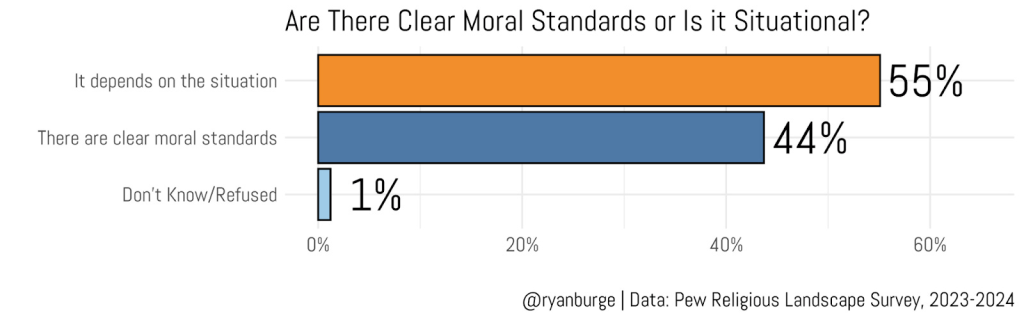
Yet in an eternal biblical worldview, we hold that truth and morality are rooted in the eternal, unchanging character of God. Right and wrong are not social agreements, emotional instincts, or shifting cultural trends. They are objective realities because they flow from the God who does not change. Morality is fixed because God is fixed. His holiness establishes the standard, and His eternal nature means that righteousness is not subject to revision. A biblical worldview asks first what is true of God and what is His will, not what we personally wish to be true.
Is your moral compass shaped more by God’s revealed will or by the emotional tone of the moment?
When culture changes its moral standards, do you instinctively follow culture or return to Scripture?
Conclusion
‘Simon Peter answered him, “Lord, to whom shall we go? You have the words of eternal life, ‘ – John 6:68
Every person lives under a worldview—but not every worldview looks beyond the grave. Not every worldview has the keys to truth and life. The question is not if you have a worldview, but whether it can bear the weight of eternity. Can your worldview stand under the pressures of the world?
We cannot think through the lens of other worldviews and not expect to be seen as more worldly rather than being seen as a Christian. Most Christians live as if they carry the same worldview as every other pagan in the neighborhood. There isn’t any distinction between them; there is a void of holiness that they lack, which comes from a biblical worldview. This void leads us to be involved in all the same sports, schools, music, books, movies, clothes, same marriages and divorces, same parenting…. If we desire our children to grow up and walk with the Lord, then we must start living like it now. We do this by deepening our biblical worldview and prioritizing it by catechizing3 our children in the Word of God daily through family worship4 and instruction. We must not be naive to the fact that education is the greatest shaper of worldviews, so what is your education shaping you towards? More importantly, what is our children’s education shaping them towards? I assure you that if we do not have a strong eternal biblical worldview, then our children will most likely not carry one either.
A worldview of eternity does not just change how you think about the future—it radically reshapes how you live in the present. Often times the people who do the most in this life, have their minds set one the life to come. Who are you living for?
Westminster Shorter Catechism
Q. 1. What is the chief end of man?
A. Man’s chief end is to glorify God, and to enjoy him for ever.
1 Cor. 10:31; Rom. 11:36; Ps. 73:25-28.
Q. 2. What rule hath God given to direct us how we may glorify and enjoy him?
A. The Word of God, which is contained in the Scriptures of the Old and New Testaments, is the only rule to direct us how we may glorify and enjoy him.
2 Tim. 3:16; Eph. 2:20; 1 John 1:3-4.
If we compared your life with that of a non-believer, would you be able to tell a noticeable difference? As Christians in modern culture, I think we are losing our distinctness; everyday Christians seem to be turning around and swimming with the current rather than against it. Hopefully, this article will be a wake-up call to cultivate a deeper eternal lens through which we can view all things biblically.


Leave a comment