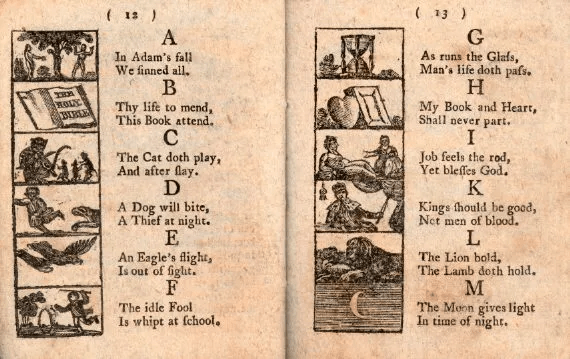
Education Advancements
| Year | Event/Institution | Location | Description | Significance |
|---|---|---|---|---|
| 1635 | Boston Latin School | Boston, Massachusetts | First public (free) school in America | Classical education for boys; feeder for Harvard |
| 1636 | Harvard College | Cambridge, Massachusetts | First higher education institution in the colonies | Trained clergy and civic leaders |
| 1642 | Massachusetts Education Law | Massachusetts Bay Colony | Required children to be taught to read | Start of mandatory education legislation |
| 1647 | Old Deluder Satan Act | Massachusetts Bay Colony | Required towns to hire teachers or build grammar schools | Created the framework for public education |
| 1650 | Roxbury Latin School | Roxbury (Boston), Massachusetts | Elite preparatory school emphasizing classical and religious education | Still operating; among the oldest in America |
| 1657 | New Haven Grammar School | New Haven, Connecticut | Grammar school founded by Puritan settlers | Supported education for ministry and civic service |
| 1660s–1700s | Various Town Schools | Throughout New England | Dozens of town-funded elementary schools created in response to 1647 law | Spread literacy and basic religious education across Puritan communities |
| 1701 | Yale College | New Haven, Connecticut | Founded by Congregationalist clergy (Puritan successors) | Continued Puritan commitment to theological education |
| 1670s–1690s | Catechism & Hornbooks Usage | Colonial New England | Used for Bible-based literacy instruction in homes and schools | Reinforced literacy and religious values from early childhood |
| Ongoing | Family-Based Education | Throughout Puritan Colonies | Parents expected to teach children reading, especially the Bible | Education began at home; promoted household moral responsibility |
Advancement in Law
| Law / Legal Principle | Date / Period | Details | Significance / Impact |
|---|---|---|---|
| Massachusetts Body of Liberties | 1641 | Included protections like trial by jury, free speech (within bounds), and protection from torture | One of the first legal codes in the colonies; mixed liberty with religious authority |
| Sabbath Observance Laws (Blue Laws) | 1600s–1700s | Outlawed all work, travel, and commerce on Sundays | Enforced strict Sabbath rest; still influences some Sunday laws today |
| Compulsory Church Attendance | 1600s | Citizens required by law to attend Puritan worship services; fines for absences | Church and civil life were intertwined |
| Banishment Laws | 1630s–1670s | Dissenters (e.g., Roger Williams, Anne Hutchinson) were legally banished for challenging doctrine | Maintained religious purity and authority |
| Witchcraft Laws | 1640s–1692 | Permitted trials and executions for alleged witchcraft | Led to infamous Salem Witch Trials; reveals fear-based moral control |
| Moral Regulation Laws | Ongoing | Criminalized drunkenness, swearing, fornication, adultery, and public lewdness | Reinforced Puritan values of chastity, modesty, and sobriety |
| Adultery Punishment | 1600s | Often punished by whipping, fines, or branding (“A” on the chest) | Inspired literature like The Scarlet Letter |
| Capital Punishment for Religious Crimes | 1600s | Crimes like blasphemy, idolatry, cursing parents could be capital offenses | Applied Old Testament law literally |
| Education Mandates (1642, 1647) | 1642, 1647 | Required parents and towns to educate children for Bible literacy | Early legal foundation of public education in the U.S. |
| Sumptuary Laws | 1634 onward | Regulated clothing to reflect religious modesty and prevent class envy | Controlled personal behavior and class expression |
| Family Law | Ongoing | Husbands were legally heads of households; disobedient children could be punished by the state | Emphasized patriarchal structure and collective discipline |
| Tithingman Laws | 1600s–1700s | Local officials monitored family church attendance and moral behavior | Enforced religious discipline at the family level |
| Inheritance & Land Laws | 1600s | Laws emphasized patriarchal inheritance and community cohesion | Ensured land remained within moral, stable family lines |
| Quaker Persecution Laws | 1656–1661 | Laws banned Quakers and imposed harsh penalties, including execution | Highlighted the lack of religious tolerance in early Puritan colonies |
| Law Against “Idle Persons” | 1600s | Outlawed laziness; required all to contribute productively to society | Reinforced the Puritan work ethic |
Other Advancements
| ⚖️ Law & Government | Massachusetts Body of Liberties (1641) | First legal code in New England; balanced individual rights and strict moral laws. |
| Blue Laws | Prohibited work, play, and commerce on Sundays. |
| Church Attendance Laws | Mandatory Sunday worship; fines for absence. |
| Sumptuary & Moral Laws | Regulated clothing, sexual behavior, profanity, and alcohol use. |
| Witchcraft Laws | Permitted trials and executions for accused witches (e.g., Salem Witch Trials). |
| Capital Laws | Death penalties for crimes like blasphemy, adultery, idolatry—based on Old Testament. |
| Town Meetings & Local Governance | Early direct democracy where (male) citizens voted on laws and elected leaders. |
| Covenant Theology in Politics | Community governed as a covenant with God—precursor to social contract theory. |
| Tithingman System | Community monitors upheld moral behavior and church attendance. |
| 🩺 Medical | Herbal Remedies & Midwifery | Used plants for treatment; midwives were primary caregivers for childbirth and illness. |
| Quarantine Practices | Used during epidemics like smallpox and measles—early form of public health. |
| Cotton Mather & Smallpox Inoculation | Promoted inoculation in 1721—controversial but medically advanced for the time. |
| 🛠️ Work & Economy | Puritan Work Ethic | Promoted hard work, discipline, and thrift as signs of godliness. |
| Community-Oriented Economy | Economic responsibility shared among towns and families. |
| Agricultural Innovation | Adapted to poor New England soil; promoted farming, trade, and self-sufficiency. |
| ✝️ Religion | Emphasis on Biblical Literacy | Everyone needed to read the Bible; religion was central to education and law. |
| Strict Religious Uniformity | Dissenters (like Quakers) were punished or banished. |
| Religious Dissent Legacy | Their rigidity indirectly led to future religious freedom movements. |
| 🏘️ Society & Culture | Family-Centered Life | Families were patriarchal, disciplined, and the core of Puritan society. |
| Role of Women in Home & Health | Women educated children and served as midwives and caregivers. |
| High Literacy Rates | Among the most literate populations of the 17th century world. |
| Modesty & Sobriety Emphasis | Regulated lifestyle around moral purity, modesty, and humility. |
| 📖 Printing & Books | First Printing Press in America (1638) | Enabled the printing of religious and educational materials (e.g., Bay Psalm Book, 1640). |
| Circulation of Religious Texts | Helped spread Puritan values and literacy across generations. |
General History Overview
| Category | Topic / Event | What to Add & Why It Matters |
|---|---|---|
| 🌍 Origins in England | English Reformation (1500s) | Puritanism was a response to what they saw as the incomplete reforms of the Anglican Church. |
| Elizabethan and Jacobean Era | Persecution and marginalization pushed Puritans to seek freedom in the New World. | |
| ⚓ Migration & Settlement | Great Migration (1630–1640) | Over 20,000 Puritans migrated from England to Massachusetts Bay Colony for religious freedom. |
| Plymouth Colony (1620) | While not strictly Puritan (more Separatist), it laid the groundwork for Puritan settlements. | |
| Founding of Massachusetts Bay Colony | In 1630, led by John Winthrop—central hub for Puritan society. | |
| 🗣️ Key Leaders | John Winthrop | Delivered the famous “City upon a Hill” sermon—vision for a model Christian society. |
| Roger Williams | Banished for advocating religious freedom—founded Rhode Island with full liberty of conscience. | |
| Cotton Mather | Prominent minister and early scientist—linked to both the Salem Witch Trials and smallpox inoculation. | |
| 🧙 Conflict & Intolerance | Salem Witch Trials (1692) | 200+ accused, 20 executed—one of the most infamous episodes of religious extremism in U.S. history. |
| Quaker Persecution | Puritans outlawed and punished Quaker presence—some executed, later led to debates on tolerance. | |
| 🪖 Native Relations | Pequot War (1636–1638) | Violent conflict between Puritans and the Pequot tribe—devastated native population. |
| King Philip’s War (1675–1676) | One of the deadliest colonial-native wars—disrupted New England and weakened native resistance. | |
| 📉 Decline of Puritan Power | Half-Way Covenant (1662) | Allowed partial church membership—response to declining religious fervor among younger generations. |
| Salem Trials Backlash & Secularization | Post-1692, Puritanism lost its grip; Enlightenment and secular governance began to rise. | |
| 📜 Influence on America | Constitutional Ideas | Puritan covenant theology and governance shaped early democratic and legal ideals. |
| Religious Freedom Debate | Ironically, Puritan intolerance sparked broader calls for tolerance and church-state separation. |

