Trustworthiness of the Bible

“Christianity, if false, is of no importance, and if true, of infinite importance. The only thing it cannot be is moderately important.” – C. S. Lewis

This is probably no shocker to most, but my expertise isn’t in Bible apologetics. However, I place my full trust in that it is the complete word of God for many reasons related to Faith and historical evidence. It is the inerrant infallible inspired word of God though and though. It is one of the main foundations of the Christian belief, without it there would be no true knowledge of Christ, The Law, and Eternal life. If we lower our view on it any small degree, then we cannot fully rely on it and or trust that it is different than any other book in history. Apart from it we would be lost and left to our confusion in a wicked broken world. Below will be a video and material from Wesley Huff, who is a incredibly gifted apologetics teacher regarding the trustworthiness of the Bible. He goes into great details with abundance of evidence that supports the claim that our Bibles today are the most accurate true message of the first hand writing of those of Christ and his followers. He explains why we can place our full trust and faith in it.


The History Of The Bible

Bible – stemming from the Koinē Greek word biblia (βιβλία), meaning “books,” this is the term that became associated specifically with “the books” of Christian scripture. The term in an ancient context would have meant “scroll” and is used several times within Scripture. For example, in Revelation 5:2, an angel asks the question “Who is worthy to break the seal and open the scroll (to biblion – τὸ βιβλίον).” In our modern Protestant context, the Bible would refer explicitly to the 66 books of the Old and New Testaments.

Manuscript – a word used to describe a hand-written document. The word itself comes from the medieval Latin manu (by the hand) and scriptus (written). Therefore, a manuscript is the term used for any written document that was hand-produced by a scribe or copyist. 

Codex – referring to what we today would typically think of as “a book.” Although codices have been around since the third century BC, their popularity did not rise to prominence until the third century AD. By the fourth century AD, the codex began to replace the scroll as a preferred form of longer writing. Unlike scrolls, codices allowed writing on both sides of the pages and made it easy to locate and go back and forth between passages – a practice that is very hard to do when dealing with a scroll.  

Papyrus – an ancient writing material made from the papyrus plant. The earliest surviving copies of the New Testament are written on this material.

Parchment – a common writing material from the 4th to 14th centuries made of animal skin. Tanners took the hides of animals, cleaned them, and scrapped them thin to produce large sheets. These sheets were folded into gatherings of parchment leaves, known as quires, which were often grouped together and bound into a codex.

Scroll – a single document written on parchment or papyrus that is rolled up. Scrolls could range in size from a few centimeters to many meters in length. 

Fragment – a surviving section of an incomplete manuscript. 

Septuagint – a modern term that refers to a stream of ancient translations into Greek of the Hebrew Bible and several other Jewish texts (also known by the abbreviation LXX). The translation project of the documents we now call the Septuagint took place between the third and first centuries BC. Many of the Greek quotations of the Old Testament found within the New Testament are quotations from the Septuagint.

Vulgate – a term derived from the old Latin word vulgata, meaning “common.” The Vulgate is a late fourth century AD translation of the Bible into Latin. The fourth-century theologian and linguist, Jerome, was commissioned by Damasus I, to translate the Bible out of Hebrew and Greek and into the “common language” of the people, i.e. Latin. The Latin Vulgate remained the official Bible of the Church between the fifth and 16th centuries. 

Dead Sea Scrolls  – a collection of 970 scrolls, dating between the third century BC and the first century AD, discovered in caves spread down the coast of the Dead Sea that exist in various stages of completeness. Although we are not entirely sure who wrote, copied, and stored all of the Dead Sea Scrolls, most of them are the product of the Jewish sect known as the Essenes. This collection includes all the books of the Old Testament (excluding Esther), as well as a number of Jewish books of theology and history. The preservation of these documents ranges from entire scrolls (like the Great Isaiah Scroll) to mere scraps of papyrus and parchment only millimeters in size.

Discussion Questions
Why did Wes and Andy go to Egypt to talk about the right texts of the Bible? 

Why has copying and translating the Bible been a consistent goal of Jews and Christians from the beginning?

 Why were so many manuscripts discovered in Oxyrhynchus and what is the significance of their discovery? 

 Despite the presence of copying errors and differences in the manuscript tradition, how does our knowledge of variances give us greater confidence that the Bible has been reliably preserved? 

 What good reason do we have that the text we possess has been faithfully maintained?

Canon – derived from the ancient Greek word kanōn (κανών) and the Semitic kánna (קָנֶה⁩), was a word that originally referred to a reed stick. These sticks were used as measuring rods, and eventually the word became synonymous with the idea of a “standard” by which something was measured. Within early Christianity the idea of a “standard” by which someone discerned the proper books considered scripture was talked about under the category of what was or wasn’t “canonical.” The final canonical list that we use today finds its shape and order from Athanasius’ Festal Letter (367 AD). Athanasius’ writing however, wasn’t a pronouncement of the canon, but merely a list of the books that had already been established and recognized as scripture for the centuries leading up to it. 

Canon – derived from the ancient Greek word kanōn (κανών) and the Semitic kánna (קָנֶה⁩), was a word that originally referred to a reed stick. These sticks were used as measuring rods, and eventually the word became synonymous with the idea of a “standard” by which something was measured. Within early Christianity the idea of a “standard” by which someone discerned the proper books considered scripture was talked about under the category of what was or wasn’t “canonical.” The final canonical list that we use today finds its shape and order from Athanasius' Festal Letter (367 AD). Athanasius’ writing however, wasn’t a pronouncement of the canon, but merely a list of the books that had already been established and recognized as scripture for the centuries leading up to it. 

Apocryphal – originating from the Greek word apocryphos (ἀπόκρυφος) meaning “strange,” “hidden,” or “secret.” The term became synonymous with non-canonical writings. It became customary within early Christianity to use the description of “apocryphal” for books that were being touted or considered scripture but did not have authentic connections for the criteria of canonicity.

Gnosticism – a modern term that included a group of mystic religious philosophies popular in the second and third centuries AD. Although there were many competing ideas within the umbrella of what we today consider “ancient Gnosticism” the common theme between all of them focused on an original perfect divinity and lesser divine beings (known as Aeons) that radiate out from the one pure divinity. Essential to Gnosticism is the idea that the physical world is evil and the spiritual world is pure. Gnostics believed that this world was created by an evil god (known as the Demi-Urge) who trapped spiritual beings within evil physical realities. To escape from this physical world one must realize, through secret knowledge (γνῶσις - gnosis in Greek, of where we get the group’s namesake) that they too are divine, and by this realization (knowledge revealed to humanity by Aeons) people can break free and release their divine spirit. Gnostic belief often appropriated already existing religious figures into the pantheon of the Aeons. Within “Christian Gnosticism” Jesus is portrayed as an Aeon who communicates this secret knowledge to his followers. Gnostic literature, such as the Gospel of Thomas, commandeered the names of key biblical characters in an attempt to popularize and legitimize these ideas. 

Examples of Famous Gnostic Gospels:

The Gospel of Judas      - Discovered in El Minya, Egypt in the 1970s;
The Gospel of Mary        - Discovered in Cairo, Egypt in 1896;
The Gospel of Thomas  - Discovered at Oxyrhynchus, Egypt in the 1890s,
                                          -  Discovered in the Nag Hammadi Dessert, Egypt in 1945;
Gospel of Philip              - Discovered in the Nag Hammadi Dessert, Egypt in 1945;
Gospel of Peter              - Discovered at Akhmim, Egypt in 1886.

Discussion Questions
Why did Wes and Andy go to Egypt to talk about the right books of the Bible? 

 From watching Episode 1, how would you explain what the Bible is?

 Many books were not included in the Bible. What was the standard the early church used to acknowledge what was or wasn’t scripture? 

 In Episode 1, what arguments do Wes and Andy discuss for why the Nag Hammadi texts (such as the Gospel of Thomas) were not, and should not, be considered scripture? 

What good reason do we have to trust that the books in our Bible today are the right ones?

Apocryphal – originating from the Greek word apocryphos (ἀπόκρυφος) meaning “strange,” “hidden,” or “secret.” The term became synonymous with non-canonical writings. It became customary within early Christianity to use the description of “apocryphal” for books that were being touted or considered scripture but did not have authentic connections for the criteria of canonicity.

Bible – stemming from the Koinē Greek word biblia (βιβλία), meaning “books,” this is the term that became associated specifically with “the books” of Christian scripture. The term in an ancient context would have meant “scroll” and is used several times within Scripture. For example, in Revelation 5:2, an angel asks the question “Who is worthy to break the seal and open the scroll (to biblion – τὸ βιβλίον).” In our modern Protestant context, the Bible would refer explicitly to the 66 books of the Old and New Testaments.

Manuscript – a word used to describe a hand-written document. The word itself comes from the medieval Latin manu (by the hand) and scriptus (written). Therefore, a manuscript is the term used for any written document that was hand-produced by a scribe or copyist. 

Codex – referring to what we today would typically think of as “a book.” Although codices have been around since the third century BC, their popularity did not rise to prominence until the third century AD. By the fourth century AD, the codex began to replace the scroll as a preferred form of longer writing. Unlike scrolls, codices allowed writing on both sides of the pages and made it easy to locate and go back and forth between passages – a practice that is very hard to do when dealing with a scroll.  

Papyrus – an ancient writing material made from the papyrus plant. The earliest surviving copies of the New Testament are written on this material.

Parchment – a common writing material from the 4th to 14th centuries made of animal skin. Tanners took the hides of animals, cleaned them, and scrapped them thin to produce large sheets. These sheets were folded into gatherings of parchment leaves, known as quires, which were often grouped together and bound into a codex.

Scroll – a single document written on parchment or papyrus that is rolled up. Scrolls could range in size from a few centimeters to many meters in length. 

Fragment – a surviving section of an incomplete manuscript. 

Septuagint – a modern term that refers to a stream of ancient translations into Greek of the Hebrew Bible and several other Jewish texts (also known by the abbreviation LXX). The translation project of the documents we now call the Septuagint took place between the third and first centuries BC. Many of the Greek quotations of the Old Testament found within the New Testament are quotations from the Septuagint.

Vulgate – a term derived from the old Latin word vulgata, meaning “common.” The Vulgate is a late fourth century AD translation of the Bible into Latin. The fourth-century theologian and linguist, Jerome, was commissioned by Damasus I, to translate the Bible out of Hebrew and Greek and into the “common language” of the people, i.e. Latin. The Latin Vulgate remained the official Bible of the Church between the fifth and 16th centuries. 

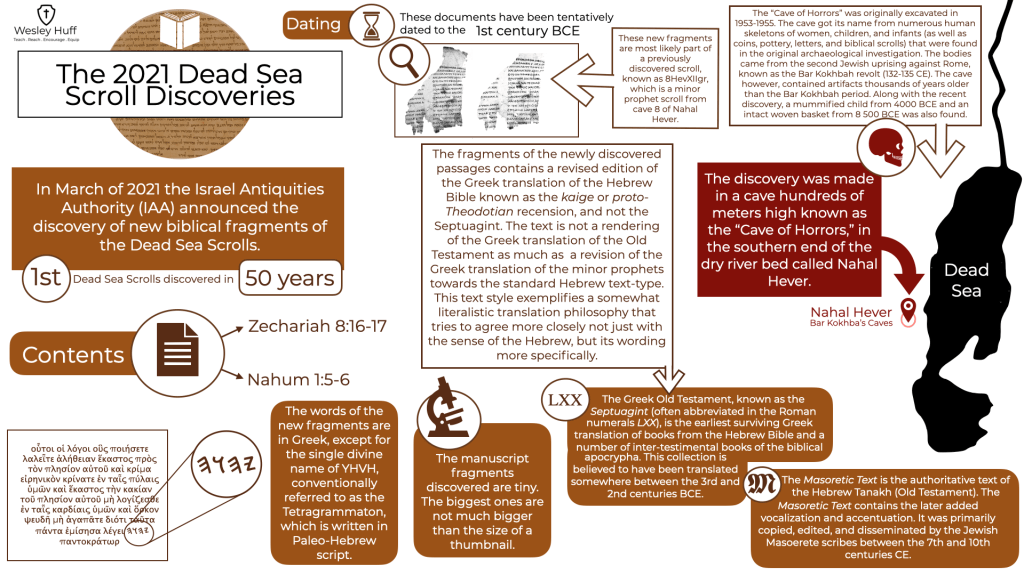
Dead Sea Scrolls  – a collection of 970 scrolls, dating between the third century BC and the first century AD, discovered in caves spread down the coast of the Dead Sea that exist in various stages of completeness. Although we are not entirely sure who wrote, copied, and stored all of the Dead Sea Scrolls, most of them are the product of the Jewish sect known as the Essenes. This collection includes all the books of the Old Testament (excluding Esther), as well as a number of Jewish books of theology and history. The preservation of these documents ranges from entire scrolls (like the Great Isaiah Scroll) to mere scraps of papyrus and parchment only millimeters in size.
Discussion Questions
Why did Wes and Andy go to Egypt to talk about the right texts of the Bible? 

Why has copying and translating the Bible been a consistent goal of Jews and Christians from the beginning?

 Why were so many manuscripts discovered in Oxyrhynchus and what is the significance of their discovery? 

 Despite the presence of copying errors and differences in the manuscript tradition, how does our knowledge of variances give us greater confidence that the Bible has been reliably preserved? 

 What good reason do we have that the text we possess has been faithfully maintained?
History of Gospels
Canonical Gospels Timeline
Non-Canonical Gospels
Apocryphal Gospels
Early Christian Writings
Dating the Gospels
Gospel Authorship
Secondary Keywords:

Development of the Gospels
Gospel Origins
New Testament History
Extrabiblical Gospels
Forged Gospels
Reliability of the Gospels
Jesus' Life Timeline (Gospel Context)
Dating Early Christian Texts
Criteria for Canonical Gospels
Long-Tail Keywords and Questions:

When were the canonical gospels written?
What are the non-canonical gospels?
Why are some gospels considered apocryphal?
What is the historical evidence for the gospels?
Who wrote the Gospel of Thomas?
When was the Gospel of Peter written?
What are the differences between canonical and non-canonical gospels?
How did the early church decide which gospels were canonical?
What does "apocryphal" mean in the context of gospels?
Understanding the timeline of early Christian writings.
Keywords Based on Visual Elements:

Timeline of Gospel Writings (image)
Canonical vs. Non-Canonical Gospels Chart
Dating of New Testament Books (image)
Authorship of Early Christian Texts (image)
Gospel Relationships (Synoptic Problem implied)
Nag Hammadi Library (keyword)
Gospel of Jesus' Wife (keyword - with "forgery" context)
Infancy Gospels (keyword)

Dead Sea Scrolls  – a collection of 970 scrolls, dating between the third century BC and the first century AD, discovered in caves spread down the coast of the Dead Sea that exist in various stages of completeness. Although we are not entirely sure who wrote, copied, and stored all of the Dead Sea Scrolls, most of them are the product of the Jewish sect known as the Essenes. This collection includes all the books of the Old Testament (excluding Esther), as well as a number of Jewish books of theology and history. The preservation of these documents ranges from entire scrolls (like the Great Isaiah Scroll) to mere scraps of papyrus and parchment only millimeters in size.


The Differences In Translations
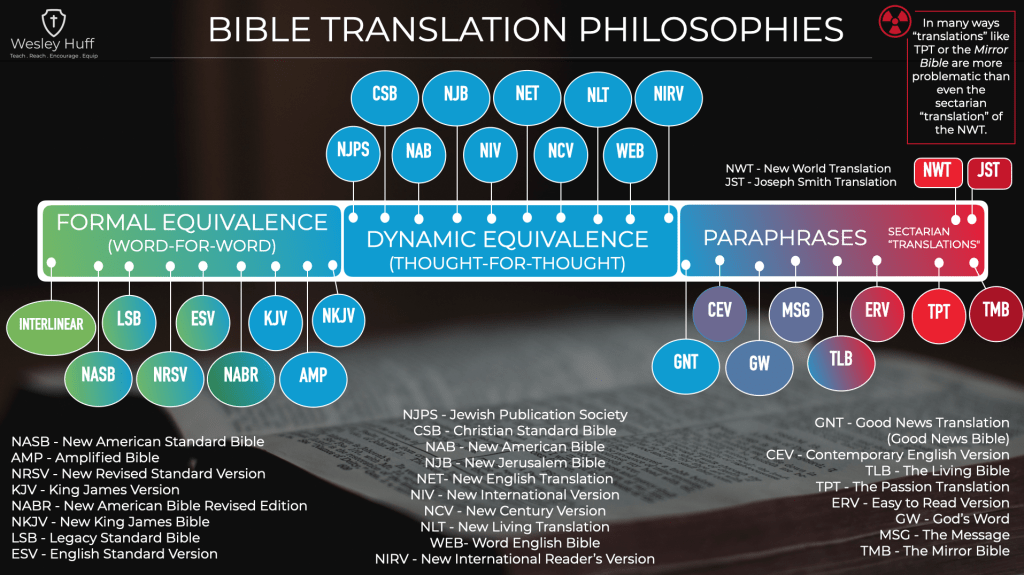
Bible Translation Philosophies
Formal Equivalence
Dynamic Equivalence
Paraphrase Bible Translations
Word-for-Word Bible Translation
Thought-for-Thought Bible Translation
Secondary Keywords:

Different Bible Translation Methods
Understanding Bible Translations
Choosing a Bible Translation
Accuracy in Bible Translation
Readability of Bible Translations
Sectarian Bible Translations
New World Translation Criticism
Joseph Smith Translation Criticism
Long-Tail Keywords and Questions:

What are the different philosophies of Bible translation?
What is the difference between formal and dynamic equivalence?
Which Bible translations are word-for-word?
Which Bible translations are thought-for-thought?
What are paraphrase Bible translations?
What are the pros and cons of different Bible translation philosophies?
Why are some Bible translations considered sectarian?
What are the New World Translation and Joseph Smith Translation?
How to choose the best Bible translation for me?
Understanding the accuracy of different Bible translations.
Keywords Based on Visual Elements:

Bible translation spectrum (image)
Word-for-word translation examples (image)
Thought-for-thought translation examples (image)
Paraphrase translation examples (image)
List of Bible translations by philosophy (image)
Criticism of sectarian translations (image)
New World Translation (NWT) (keyword)
Joseph Smith Translation (JST) (keyword)

Bible – stemming from the Koinē Greek word biblia (βιβλία), meaning “books,” this is the term that became associated specifically with “the books” of Christian scripture. The term in an ancient context would have meant “scroll” and is used several times within Scripture. For example, in Revelation 5:2, an angel asks the question “Who is worthy to break the seal and open the scroll (to biblion – τὸ βιβλίον).” In our modern Protestant context, the Bible would refer explicitly to the 66 books of the Old and New Testaments.

History of English Bible Translations
Early English Bibles
English Bible Timeline
Wycliffe Bible
Tyndale Bible
Coverdale Bible
Great Bible
Bishops' Bible
Geneva Bible
Secondary Keywords:

Pre-King James Bible Translations
Development of the English Bible
Key Figures in English Bible Translation (Wycliffe, Tyndale, Coverdale)
Influence of the Reformation on English Bible
Early Protestant English Bibles
Comparing Early English Bibles
The Road to the King James Bible
English Bible History Timeline
Long-Tail Keywords and Questions:

What were the major English Bibles before the King James Version?
When was the first English Bible translated?
Who translated the Wycliffe Bible?
What was the significance of the Tyndale Bible?
What was the Great Bible?
Why was the Bishops' Bible created?
What was the Geneva Bible and why was it popular?
How did early English Bibles influence the King James Version?
What were the challenges of translating the Bible into English?
Understanding the history of the English Bible.
Keywords Based on Visual Elements:

Timeline of English Bibles (image)
Images of early English Bibles (Wycliffe, Tyndale, etc.)
Key dates for English Bible translations (image)
Geographical influences on early English Bibles (implied by Geneva)
Comparison of different early English Bibles (implied)

Septuagint – a modern term that refers to a stream of ancient translations into Greek of the Hebrew Bible and several other Jewish texts (also known by the abbreviation LXX). The translation project of the documents we now call the Septuagint took place between the third and first centuries BC. Many of the Greek quotations of the Old Testament found within the New Testament are quotations from the Septuagint.
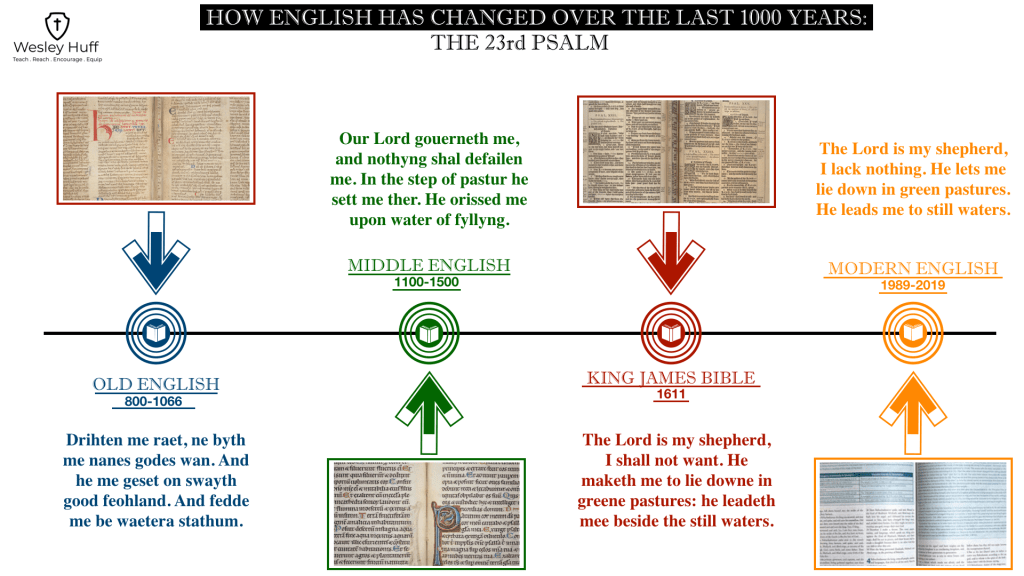
History of the English Language
Changes in English Over Time
Old English to Modern English
Middle English
King James Bible English
Evolution of English
The Lord's Prayer in Old English
Secondary Keywords:

Linguistic History of English
Development of English Vocabulary
Changes in English Grammar
Reading Old English
Understanding Middle English
King James Bible Language
The 23rd Psalm in Different English Periods
English Language Timeline
Long-Tail Keywords and Questions:

How has English changed in 1000 years?
What did English look like in the Old English period?
What are the characteristics of Middle English?
How is the English of the King James Bible different from modern English?
Can you read the 23rd Psalm in Old English?
How did pronunciation change from Old to Modern English?
What are some examples of Old English words?
What are some examples of Middle English words?
Why does the King James Bible sound different?
Tracing the linguistic roots of modern English.
Keywords Based on Visual Elements:

Timeline of English Language (image)
Old English Text (image)
Middle English Text (image)
King James Bible Text (image)
Modern English Text (image)
The 23rd Psalm in different English forms (image)
Arrows showing the progression of language (image)

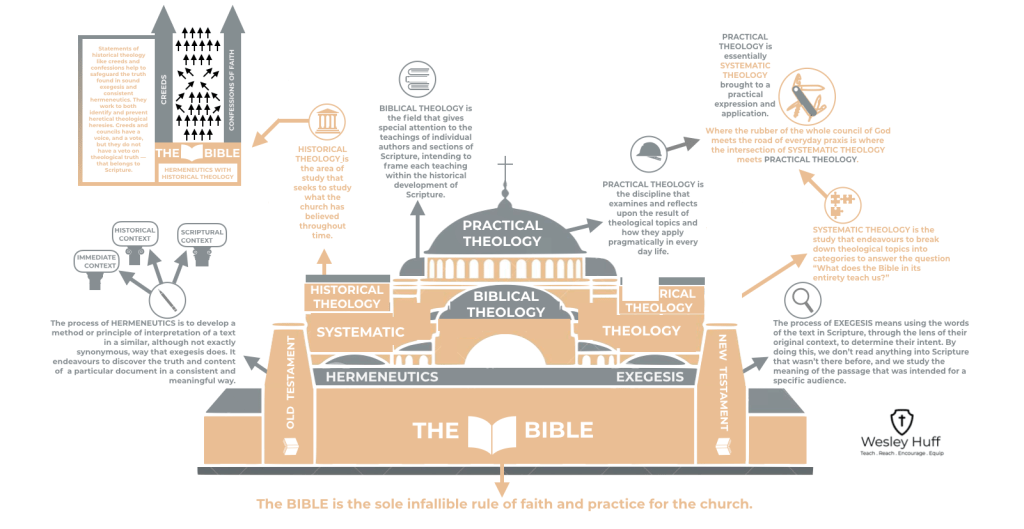
Practical Side Of This Conclusion

Biblical Theology
Systematic Theology
Historical Theology
Practical Theology
Hermeneutics (Biblical)
Exegesis (Biblical)
Theological Disciplines
Secondary Keywords:

Studying the Bible Theologically
Understanding Biblical Theology
What is Systematic Theology?
The Role of Historical Theology
Applying Theology to Life (Practical Theology)
Principles of Biblical Interpretation (Hermeneutics)
Understanding the Meaning of Scripture (Exegesis)
Branches of Christian Theology
The Bible as the Foundation of Theology
Long-Tail Keywords and Questions:

What is the difference between biblical and systematic theology?
How does historical theology inform our understanding of the Bible?
What is the purpose of practical theology?
Why is hermeneutics important for studying the Bible?
What is the process of biblical exegesis?
How do different theological disciplines relate to each other?
How does the Bible serve as the foundation for all theology?
What are the methods used in biblical theology?
What are the key questions addressed by systematic theology?
How can historical context help in understanding the Bible?
Keywords Based on Visual Elements:

Church building metaphor for theology (image)
Bible as the foundation of theology (image)
Hermeneutics as the doorway to understanding (image)
Exegesis as interpreting the text (image)
Biblical Theology examining authors and development (image)
Systematic Theology organizing biblical truths (image)
Historical Theology studying church teachings over time (image)
Practical Theology applying theological insights (image)
Arrows showing the flow of understanding (image)
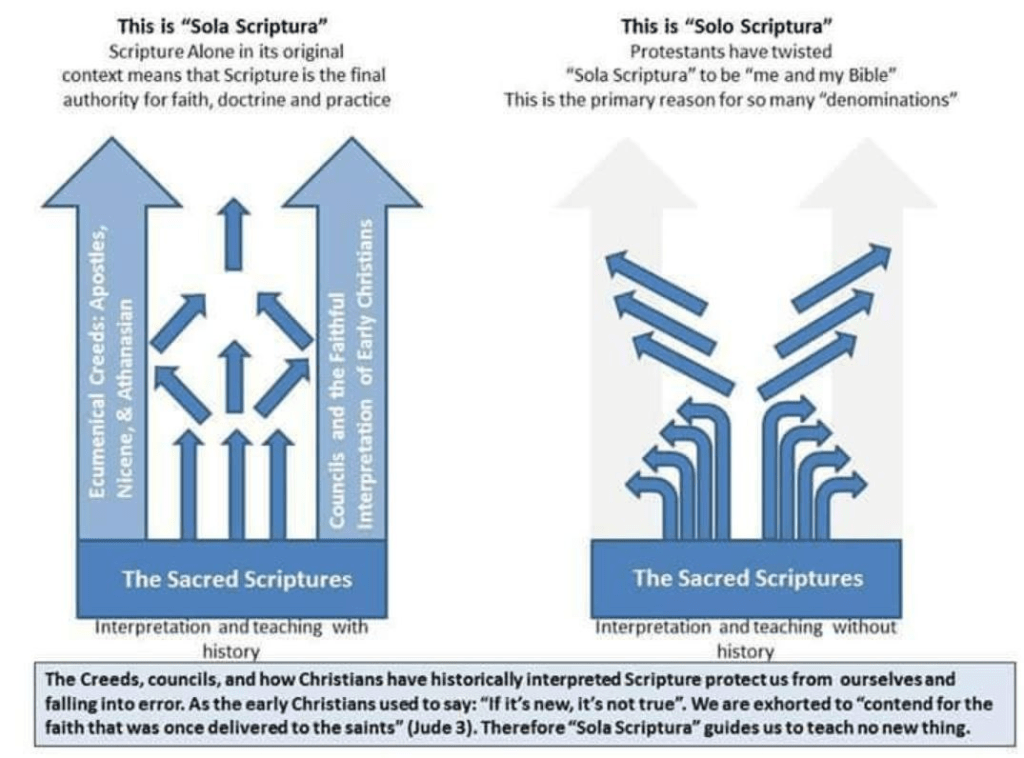
Sola Scriptura Interpretation
Scripture Alone vs. Scripture and Tradition
Protestant View of Sola Scriptura
Historical Interpretation of Scripture
Ecumenical Creeds and Scripture
Councils and Biblical Interpretation
Secondary Keywords:

Authority of Scripture
Sources of Christian Doctrine
History of Biblical Interpretation
Faithful Interpretation of Scripture
Dangers of Individual Interpretation (Bible)
Unity vs. Division in Christianity (Sola Scriptura)
The Role of Creeds in Biblical Understanding
The Role of Councils in Biblical Understanding
Early Church Interpretation of Scripture
Long-Tail Keywords and Questions:

What is Sola Scriptura and how is it interpreted?
Does Sola Scriptura exclude historical Christian teachings?
What is the Protestant view of "me and my Bible"?
Why do some argue that Sola Scriptura leads to denominations?
How did early Christians interpret the Bible?
What is the role of the Nicene Creed in biblical interpretation?
What is the role of church councils in understanding scripture?
How does historical context affect biblical interpretation?
Is "Scripture Alone" meant to be interpreted in isolation?
What are the dangers of interpreting the Bible without historical context?
Keywords Based on Visual Elements:

Two interpretations of Sola Scriptura diagram
Arrows showing influence on biblical interpretation
Scripture as the foundation (image)
Historical context influencing scripture (image)
Individual interpretation diverging from scripture (image)
Unity vs. division in biblical understanding (image)

*all this information above can be found on His site https://www.wesleyhuff.com/infographics

Hopefully, this has helped bring you more resolve around the topic of the Bible’s authenticity and the many ways it has stood the test of time, demonstrating its reliability through historical corroborations and archaeological discoveries. It is essential to recognize that the Bible is not just a book but a profound source that can be truly trusted for the Gospel message of Christ. By diving deeper into its teachings and the context in which it was written, one can better appreciate its depth and the unwavering truth and joy it offers to believers.


For more information and trusted sources, Please check out https://www.wesleyhuff.com/can-i-trust-the-bible

Leave a comment

Create a website or blog at WordPress.com

Up ↑

Discover more from Thoughts In The Light Of Eternity

Subscribe now to keep reading and get access to the full archive.

Continue reading