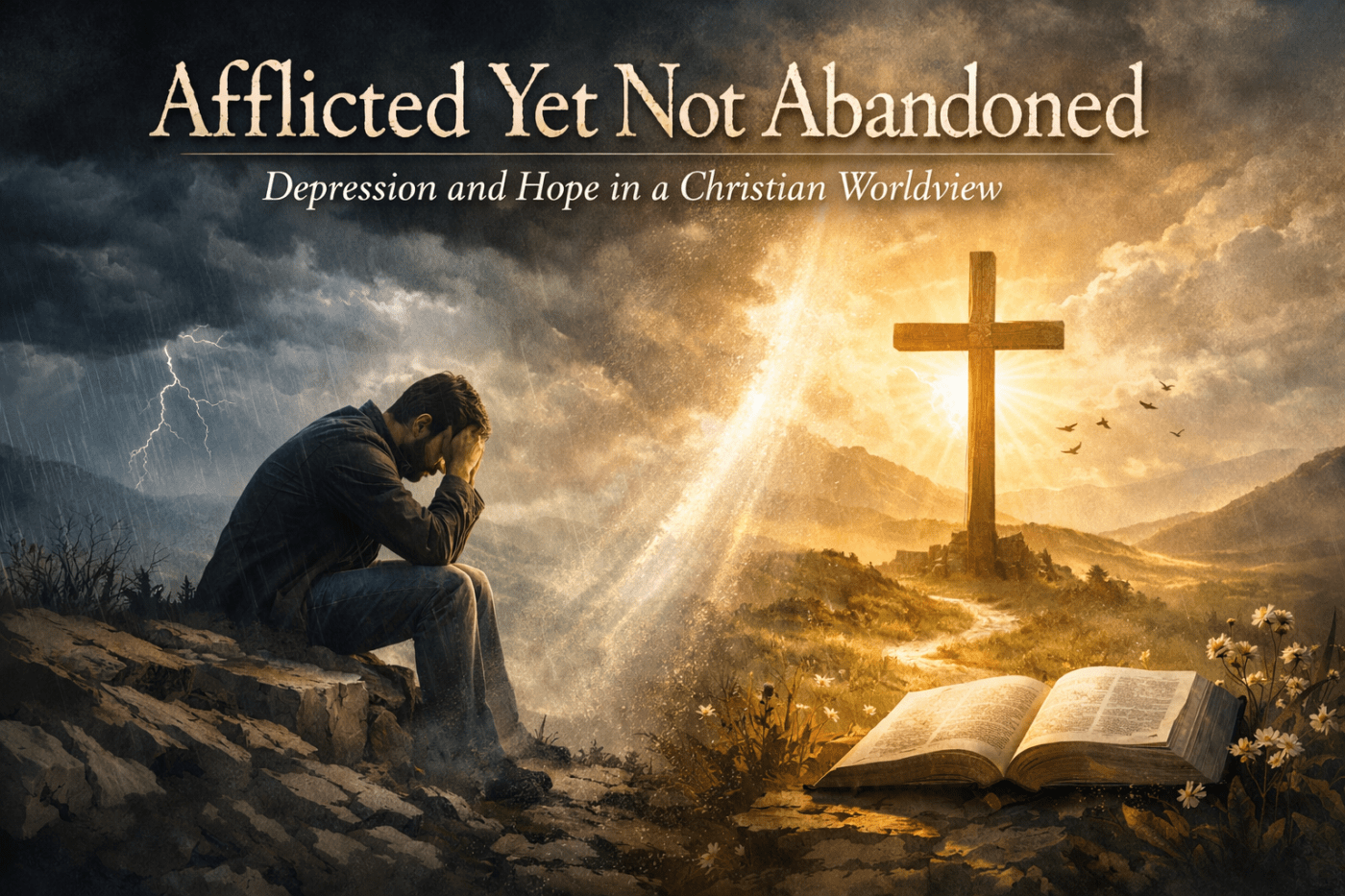
Before I begin, I feel it appropriate to clarify that I am not a medical professional. I am, however, a steward of Christ’s church, seeking to come alongside those who are suffering. Far too often I have seen attempts to address depression fall into one of two errors. Some claim that depression is merely a spiritual failure, a view that can be deeply damaging to Christians already in despair. Others insist it is merely a biological malfunction, thereby downplaying the spiritual reality of our lives before God and the comfort of our Gentle and Lowly Savior.
Depression is a real affliction in a fallen world—one that God addresses through both spiritual grace and His ordinary means. Reducing mental health struggles to only sin or only sickness is unbiblical. Christians are not immune to despair, darkness, or sorrow—even prolonged sorrow. My hope is that what follows may serve as a balm to the soul of those who suffer, and as a help to those who walk alongside loved ones struggling with depression.
Do not let someone tell you that God’s people do not experience deep psychological darkness—that’s patently unbiblical. The prophet Elijah, after seeing the fruit of his faithfulness on Mount Carmel fell into a suicidal despair, saying “It is enough! Now, LORD, take my life, for I am no better than my fathers!”1 Even as the false prophets of Baal were destroyed, Elijah felt that God’s people would still not return to Him. Instead of Ahab & Jezebel repenting, she had moved to kill Elijah. Faced with this, it should not be impossible for us to see how Elijah could fall into despair, and yet the Lord doesn’t rebuke him for weak faith in this moment, He reminds Elijah of His promises.2 Jeremiah, the weeping prophet, also had similar bouts. After prophesying to Pashhur, he goes so far as to curse the very day that he was born and wish that he had never been born.3 Yet Jeremiah is faithful, because spiritual darkness does not mean apostasy. Let us not forget that Job, who continually refused to curse God—showing his faithfulness speaks of his prolonged anguish saying “My heart is in turmoil and cannot rest; Days of affliction confront me.”4 These texts show us that we can dismantle the notion that depression means a weak faith.
Depression is a genuine affliction that can involve the body, mind, and soul— hormones, brain chemistry, memories, anguish, spiritual numbness, and more can be at play. Thankfully beloved, God cares for both our body and soul. Just as he knows our soul, Scripture says “He knows our frame”,5 and God is aware of the limitations of a physical body. Christ Himself affirms the legitimacy of physicians when he says “Those who are well have no need of a physician, but those who are sick.”6 God knows that sickness can afflict people, and that while God may supernaturally heal one who is suffering we should be aware that “God makes use of means, yet is free to work without, above, and against them.”7 This means that while God can do miracles, sometimes God uses regular ordinary means to comfort His children. This legitimizes medicinal and therapeutic care when one is struggling with seasons of despair. In fact, Paul provides Timothy medicinal counsel when he tells him to “use a little wine for your stomach’s sake and your frequent infirmities.”8 God cares about our body, mind, and soul, in our sanctification9, even if that sanctification is not completed on this side of glory.
No one’s “spiritual performance” disqualifies them from compassion—even the best works of believers are imperfect and defiled.10 This is why God is near us in our darkness, even when it feels like we are alone. “The LORD is near to those who have a broken heart, and saves such as have a contrite spirit.”11 Take heart in the fact that nothing can separate one of God’s children from His love.12 Christ Himself entered mental anguish13 in the Garden of Gethsemane—and so He sympathizes with that weakness as the writer of Hebrews states.14 You do not have to be embarrassed or ashamed of depression or mental affliction when you come to the cross. God preserves His elect even through grievous lapses and struggles. It is not about what we are doing, but rather trusting in what He has already done.

So what is one to do when in this crisis? Christians, it is okay to seek help not because God seems absent, but rather because He is present and generous in provision. When you seek help, look for practitioners who acknowledge complexity and limits in treatment. Avoid professionals who reduce depression to mere sin requiring repentance alone or mere chemistry requiring no spiritual concern. Don’t forget to maintain distinctions in your care— therapists treat psychological symptoms, physicians treat physiological concerns, and ministers & elders shepherd souls. None of these can replace one another, but rather operate in their God-given space. The church is entrusted with the ministry of grace—not medicine.
Conversely, when you are seeking professional treatment, let your elders know so they can come beside you attend to your spiritual needs. Professional care should never pull believers away from the church.15 Be aware that modern therapy can often assume an expressive individualism by default. Remember that we as believers are anchored in our identity in Christ, accountability within the church,16 and our submission to Scripture. Your care should always support—not replace— the church’s care. If you are an elder reading this encourage sufferers not to interpret numbness as failure, just as Psalm 88 despondence does not have a resolution, depression is not something easily fixed and is rarely a linear progress. Avoid shaming those who take medication—and those who do not. Ensure them that a lack of improvement does not equal a lack of faith. True hope is durable, not dramatic. Believers should not have to choose between prayer and treatment, Scripture and medicine, or faith and care. We pray while we pursue help. We trust God through the means He provides, and we remember that hope is not measured by how we feel, but by our beloved Savior who holds us—even when we cannot feel Him holding us.

- 1 Kings 19:4, cf. 1 Kings 18:20-46 ↩︎
- cf. 1 Kings 19:18 ↩︎
- Jeremiah 20:14-18 ↩︎
- cf. Job 30:25-27 ↩︎
- Psalm 103:14 ↩︎
- cf. Matthew 9:12, Mark 2:17, Luke 5:31 ↩︎
- Westminster Confession of Faith V.3 (cf. Hosea 1:7, Job 34:20, Romans 4:19-21) ↩︎
- 1 Timothy 5:23 ↩︎
- 1 Thessalonians 5:23 ↩︎
- Westminster Larger Catechism 78 (cf. Isaiah 64:6, Exodus 28:38, Galatians 5:16-18) ↩︎
- Psalm 34:18 ↩︎
- Romans 8:35-39 ↩︎
- Matthew 26:38 ↩︎
- Hebrews 4:15-16 ↩︎
- https://thoughtsinthelight.com/2026/01/19/the-importance-of-the-local-church-body/ ↩︎
- https://thoughtsinthelight.com/2025/11/25/the-keys-the-flock-and-the-fold-a-reformed-defense-of-membership/ ↩︎
