
Every time I go to a new restaurant, they seem to have some kind of rewards club to join. “Just give us your phone number for perks!” the screen—or an eager staffer—insists, while I mentally calculate whether I really want to hand my number to yet another corporation. “What’s in it for me?” is the thought that always comes to mind. Unfortunately, many in Christendom approach church membership with that same consumeristic instinct. If the perceived perks aren’t compelling enough, they are happy to attend, participate, and enjoy fellowship—so long as no real commitment is required. But the church was never designed to function as a rewards program. Scripture presents membership as essential to knowing what the church is, whom the elders are accountable for, and who the “one another” is that we are commanded to love, serve, and care for.
First, church authority requires an identifiable membership. We see the first display of this in the gospels when Christ mentions the keys of the kingdom of heaven with the authority to bind and loose.1 This is actually expounded upon slightly later in the text regarding church discipline.2 Christ has given binding and loosing authority, and this second passage helps us understand what is being bound and loosed. As Zachary Ursinus summarizes:
The preaching of the holy gospel, and Christian discipline, or excommunication out of the Christian church; by these two, the kingdom of heaven is opened to believers, and shut against unbelievers.
-Question 83, Heidelberg Catechism
When Jesus walks through church discipline in this passage He is showing us that the church is a knowable body that has the authority of heaven behind it. Marking unrepentant sinners as “a heathen and a tax collector”3 shows that there is known boundaries—there is an inside and an outside—someone on “the fringes” is willing to come in for worship without actually joining the church as Jesus describes. Paul echoes these words when dealing with the church of Corinth. When he tells them to “deliver this man to Satan”4 there’s an understanding that the church must assemble as a body and act as an entity while removing someone from something. The man in sin however cannot be removed unless he was first included. When Christ gives His keys to the church, that is a distinct body of something. The body with keys is the body believers must join.
Second, oversight requires recognizable membership. When Paul gives instructions to the Ephesian elders, he says to “take heed to yourselves and to all the flock”5 it’s understood that there is a defined flock. This flock isn’t given to just any person—it’s entrusted specifically to specific elders. Peter tells the elders to “shepherd the flock of God that is among you.”6 This means that not only are the elders responsible for specific people, but that those people are identifiable. We’re not certain what membership role looked like in the apostolic church, though it is absolutely a far cry from the digital spreadsheets and databases used today. However, in both of these cases, we know that they cannot be fulfilled with some process for membership. The author of Hebrews cements this “Obey those who rule over you, and be submissive, for they watch out for your souls, as those who must give account,”7 which provides us two implications. We must know which elders we submit to & Elders must know which souls they are to give an account for. This mutual identification is membership! Elders must know who are under their care, officially.
Finally, mutual obligations require formal membership. The clearest way that we can show that we are disciples of Christ is to “have love for one another”.8 This ‘one another’ refers to the visible community of disciples, not an undefined floating group. This is echoed by Paul in his exhortation to “let us do good to all, especially to those who are of the household of faith.”9 The church is a special circle with special obligations to each other. We define this as church membership to be decently and in order. The Christian life was never designed to be a lone-wolf journey. We grow, heal, and persevere together—joined to a body, not orbiting around it. While many believers faithfully enjoy the blessings of a local church, they may unintentionally miss the deeper blessing of belonging to it. When we partake in the church’s fellowship without ever committing ourselves to its life, it creates an imbalance: we receive care, teaching, and community, but cannot fully give ourselves in service, accountability, or shared responsibility. The responsibility to care for one another dictates we must know who one another is.
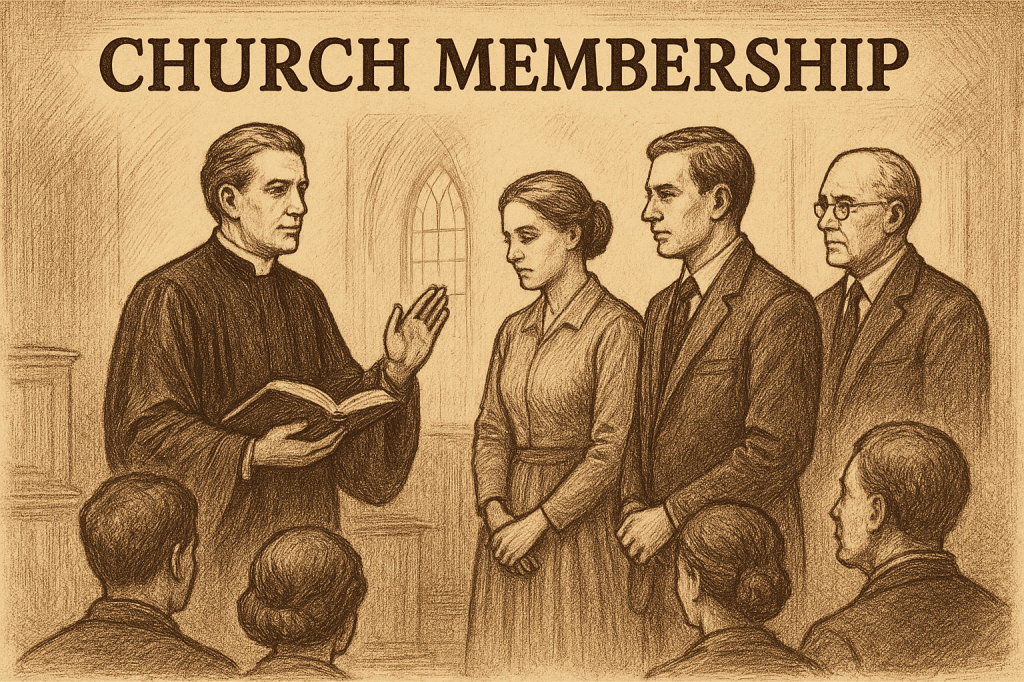
Put positively, membership is the pathway that moves us from merely benefiting from a church to being knit into its life—more like the covenant security of marriage than the uncertainty of a casual relationship. It invites us not only to be loved, but also to love; not only to be carried, but to help carry others; not only to attend, but to belong. That belonging is what Christ has designed for us in church membership. His instructions for the church’s authority and order assume an identifiable membership. Paul urges the Corinthians to “do everything decently and in order”10, and Christ’s commands in Matthew 18 cannot be practiced in any orderly way without knowing who is actually part of the flock. Oversight requires recognizable membership. Scripture calls us to give “double honor”11 to those who rule well, and one of the most basic ways we show that honor is by willingly submitting to the elders who watch over our souls. But how can they care for you faithfully if you remain half-in and half-out?
Likewise, our mutual obligations require a committed membership. Hebrews 10:24–25 commands us to stir one another up to love and good works and to not forsake assembling together. The best way to embody that promise is to formally covenant with a local body—to say, in effect, these are my people, and I am theirs.
There are far greater blessings in belonging to Christ’s church than in waiting for the “right deal” like a spiritual rewards program. If you are attending a church without being a member, let me encourage you: reach out to an elder, begin the conversation, and step into the rich grace God gives through committing yourself to a local body of believers.


Leave a comment