
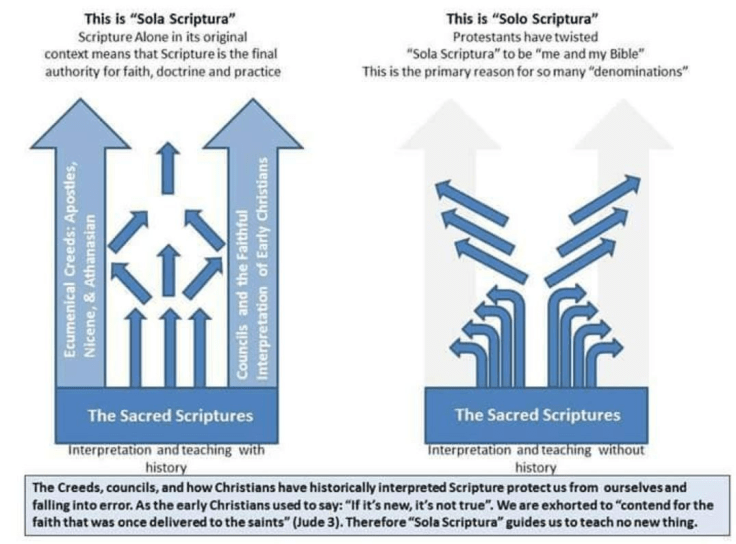
As Protestants, we get accused of many things, but one of the most common accusations is that we all just interpret the Bible to be whatever we want. Statements like “Protestants are their own pope and just get to choose and pick whatever they want to believe; that’s why there are over 600 Protestant denominations.” Yet, if you are a more conservative Protestant and have any knowledge of history, you know this isn’t true. We get accused of this because of our doctrine of “Sola Scriptura,” which means Scripture Alone. Those who do not know better usually think of this as meaning Scripture only, yet this is far from the full picture. Sola Scriptura points to the final authority of all teachings, meaning that the Bible is the final matter pertaining to all of faith and practice. Under this belief, we can still hold to man-made spirit influenced creeds, confessions, and councils, recognizing that they can err and they do not hold ultimate authority in and of themselves. They err when they stray away from the sound teachings of the Word of God; an example of such would be the Council of Trent when they anathematized the Gospel. Here below, we are going to talk more about the strength and safety that confessions and creeds can add to one’s faith when it comes to remaining faithful to the Word of God and daily Christian practices.
“all you evangelicals are is nothing more than just little christ’s” – Dr. Scott Clark quoting someone else
What Makes Up A Confession and Creed
Before we can discuss the benefits of following the confessions or creeds, we must first define them and decide what makes them valid. You will shortly find out that there are a great many out there, and many of them have different focuses and topics. You will find that each branch of mainline Christianity has them, whether it be Lutheran, Reformed, or Anglican. There are also many that are upheld by all orthodox Christianity, found in many eras of time, some dated in the 1500s while other creeds came even earlier in the 300s.
Creeds and Confessions are never our ultimate source of authority on matters; they might be a source (a really good one), but ultimately we resort to the Scriptures as our final authority. Therefore, the Creeds and Confessions we uphold must support Biblical truths, not add to them, nor take away or distort them. They must be rooted in contextual evidence of the doctrines and teachings of the Bible, not man’s opinions. It is essential to continually examine these documents in light of Scripture, ensuring they align with its teachings and the core tenets of our faith. By doing so, we maintain a framework that honors the Word of God while allowing for a deeper understanding of its implications in our lives.
“Confessions are the church’s testimony. As martyrs witness with their blood, so the church witnesses with her confession.” – William Ames
Creeds
A Creed is a [brief] formal statement or declaration of religious belief, often recited as a public expression of faith. In Christianity, creeds are summaries of core beliefs and are frequently used in worship services. The word “creed” comes from the Latin “credo,” meaning “I believe”.
Creeds tend to be brief singular statements of belief. They were usually written to combat heresy that arose in the early church, serving as a defense against divergent interpretations of the faith. Their main purpose was to reaffirm the essential doctrines and teachings of the Bible, ensuring that core beliefs were consistently articulated and understood. They were also used to unite all Christians in common biblical truths: past, present, and future saints together in one belief. In essentials, unity is to be found, as these creeds highlight the foundational truths that all believers share, fostering a sense of collective identity among Christians across various denominations, cultures, and times. This unity not only strengthens individual faith but also illustrates the broader significance of shared beliefs in a world often marked by division and disagreement. While many Christians disagree on secondary issues, we can at least agree upon such essential truths summed up in these creeds. Through the affirmation of these creeds, Christians are reminded of their mission to uphold the teachings of Christ and promote harmony within the body of believers.
Apostles’ Creed (2nd–4th century) (A brief summary of the apostles’ teachings)
Nicene Creed (325) (A summary of the orthodox faith of the early Christian church)
Niceno-Constantinopolitan Creed (381) —
Definition of Chalcedon (451) (A response to certain heretical views concerning the nature of Christ.)
Athanasian Creed (5th–6th century) (Teachings of the Trinity, Incarnation, and Two-natures of Christ.)
Click here to read the full versions
“A creed binds no conscience but by the authority of Scripture contained in it.” – William Perkins
Confessions
Confessions are documents that reflect the theology and practice of the Church, that which is built upon the Word of God as the final authority. Confessions are subordinate ecclesiastical standards upon the Bible on what Christians should believe and how to practice their faith. Generally, they a more fuller and extensive version of creeds built upon multiple broader doctrinal views of the Bible.
Confessions are fuller and more comprehensive statements of faith that articulate how the church understands and teaches the doctrines of Scripture. They were often written in response to doctrinal errors, ecclesiastical controversy, or moments of reform, serving not only as a defense of the truth but also as a clear exposition of biblical teaching. Their primary purpose is to set forth the system of doctrine taught in Scripture, ensuring that the faith is confessed carefully, consistently, and publicly by the church. Confessions also function to unite believers within a shared theological framework, binding churches and generations together in a common understanding of the gospel. While Christians may differ on secondary matters, confessions help distinguish essential doctrines from those of lesser importance, providing clarity and stability within the life of the church. Through the use of confessions, the church bears collective witness to biblical truth, strengthens the faith of its members, and promotes order and unity within the body of Christ. In confessing these truths, believers are reminded of their responsibility to uphold sound doctrine and to live faithfully in light of the teachings they publicly affirm.
Augsburg Confession (1530) (Lutheran)
The Scots Confession (1560) (Reformed & Presbyterian)
The Belgic Confession (1561) (Reformed & Presbyterian)
The Second Helvetic Confession (1566) (Reformed & Presbyterian)
Thirty Nine Articles (1571) (Anglican)
The Canons of Dort (1619) (Reformed & Presbyterian)
The First London Baptist Confession of Faith (1646) (Reformed Baptist)
The Westminster Confession Of Faith (1647) (Presbyterian)
The Second London Baptist Confession of Faith (1689) (Reformed Baptist)
Click here to read the full versions
The primary disagreement, and the one on which the others depend, is the question of whether Scripture is the authority on all matters of faith and practice or whether Scripture is an authority on par with the dogmatic tradition of the church and the pronouncements of the pope. – Kevin Deyoung
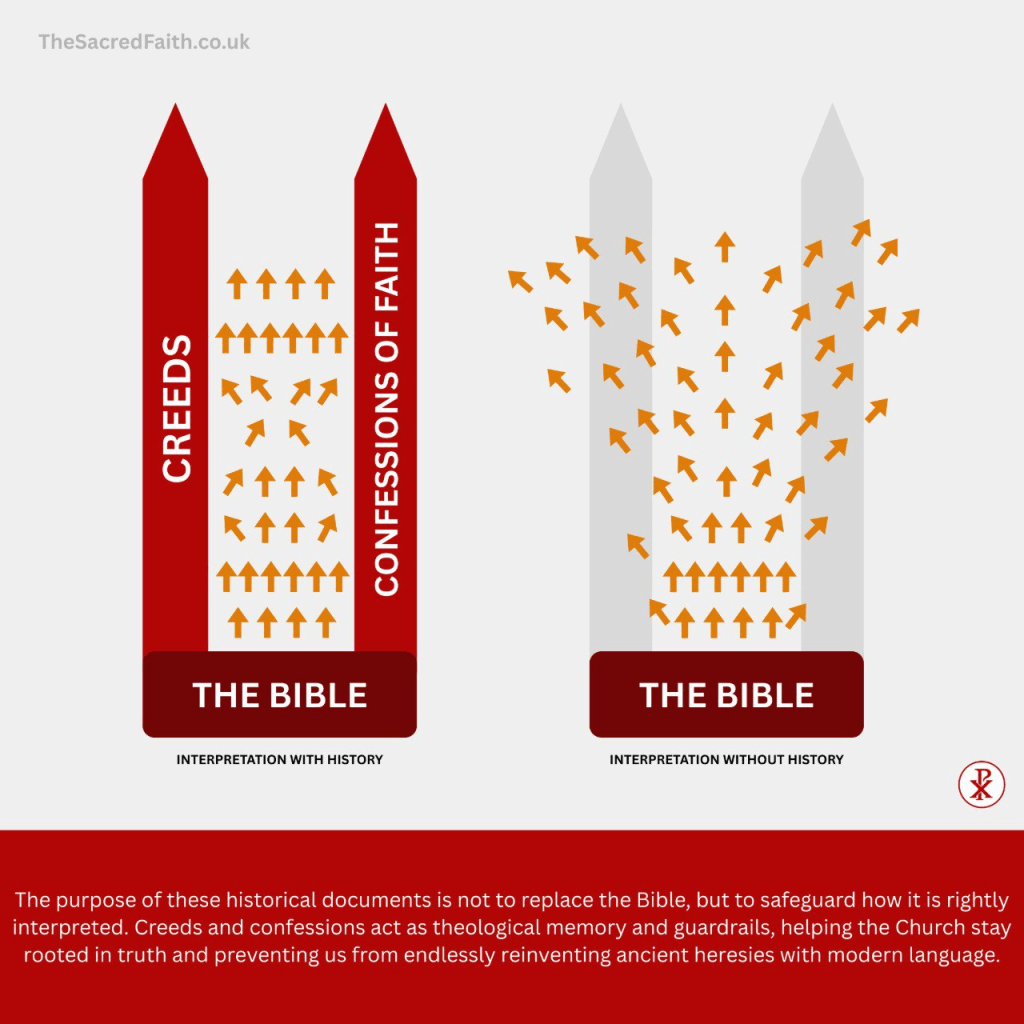
For Guiding and Guarding
“Error hates the light. This is why confessions are necessary—they bring truth to light and leave error ashamed.” – Thomas Brooks
Those who uphold Confessionalism are less likely to end up in heresy and false teaching. They are also going to arrive at a cleaner and more precise theological doctrine of the word of God. You might be asking yourself what are some more reasons to support this view. Well confessionalism is usually supported through a range of five biblical themes found below:
1. The Church must confess the faith.
I. The Church Must Publicly Confess the Faith
A. Confession of Christ
Matthew 10:32 — “Whoever confesses Me before men…”
1 Timothy 6:12–13 — Timothy made “the good confession” in front of many witnesses.
Romans 10:9–10 — Salvation involves confessing with the mouth that Jesus is Lord.
Hebrews 4:14 — “Let us hold fast our confession.”
Hebrews 10:23 — “Let us hold fast the confession of our hope without wavering.”
Hebrews 3:1 — Jesus is the Apostle and High Priest of “our confession.”
B. Biblical Creedal Summaries
Scripture itself includes short confessional statements that function as doctrinal summaries:
Deuteronomy 6:4 — The Shema: “Hear, O Israel…”
Philippians 2:5–11 — Christ-hymn (likely an early confession).
1 Timothy 3:16 — “Great indeed… is the mystery of godliness…” (a creedal formula).
1 Corinthians 8:6 — A Christianized confession of monotheism.
1 Corinthians 15:3–5 — Paul cites a pre-apostolic creed: “I delivered to you what I also received…”
Ephesians 4:4–6 — One body, one Spirit… one Lord, one faith, one baptism.
Implication: If Scripture commands the church to confess its faith publicly, then written confessions are a natural, faithful extension of that calling. And if Scripture uses creeds, then the church is following Scripture by doing the same.
2. The faith is a set body of truth that can be summarized.
II. The Faith Is a Definite Body of Truth (Can Be Summarized)
A. “The Faith Once Delivered”
Jude 3 — “The faith once for all delivered to the saints.”
Acts 2:42 — The church continued in “the apostles’ teaching.”
Galatians 1:23 — Paul preaches “the faith he once tried to destroy.”
1 Timothy 4:6 — “The words of the faith.”
1 Timothy 6:20 — “Guard the deposit entrusted to you.”
Implication: If the faith is a deposit—something definite—then it can be summarized, protected, and articulated in confessions and creeds.
3. Teachers must pass on a pattern of sound words.
III. Teachers Must Hold to a Pattern or Form of Sound Words
A. Central biblical basis for confessionalism.
2 Timothy 1:13–14 — “Follow the pattern of sound words… Guard the good deposit.”
2 Timothy 2:2 — Commit these teachings to faithful men who will teach others.
B. Teaching Must Be Ordered & Systematic
Matthew 28:19–20 — Make disciples by teaching them to observe everything Christ commanded.
Hebrews 5:12–14 — Move from elementary doctrine to maturity (a system of doctrine assumed).
Proverbs 22:20–21 — “Have I not written for you thirty sayings… to make you know what is right and true?” (biblical precedent for systematic instruction)
Colossians 1:28 — Teach “with all wisdom.”
Key point: The Greek hypotypōsis (“pattern,” “outline,” “form”) indicates a structured summary of doctrine—precisely what confessions are. Instructing others presupposes organization and summary—exactly what catechisms, confessions, and creeds provide.
4. Creeds and doctrinal tests protect the Church from error.
IV. Doctrinal Testing & Doctrinal Boundaries Prescribed in Scripture
A. The Church Must Test Teachers
1 John 4:1 — “Test the spirits.”
1 Corinthians 14:29 — Prophets must be evaluated.
1 Thessalonians 5:21 — “Test everything; hold fast what is good.”
Revelation 2:2 — Commended for testing those who claim to be apostles.
B. The Church Must Reject False Teachers
Romans 16:17 — “Watch out for those who cause divisions contrary to the doctrine you have learned.”
Titus 1:9 — Elders must “instruct in sound doctrine and refute those who contradict it.”
2 John 9–11 — Do not receive anyone who brings another doctrine.
Implication: You cannot judge doctrine unless you have a recognized doctrinal standard. Confessions and creeds are that standard.
5. The church has authority to judge doctrine.
V. The Church Has Authority to Make Doctrinal Judgments
A. Church Councils in Scripture
Acts 15 — Apostolic council at Jerusalem establishes doctrinal decree.
Acts 16:4 — The churches observe the “decisions” of the council.
B. The Church as the Pillar of Truth
1 Timothy 3:15 — The church is “the pillar and buttress of the truth.”
C. Pastoral Office Requires Doctrinal Fidelity
Titus 1:9 — Elders must “hold firmly to the trustworthy word.”
1 Timothy 3:2 — Elders must be “able to teach.”
Acts 20:27–30 — Shepherds must guard the flock from false doctrine.
Implication: If the church must uphold the truth, it must define and articulate that truth clearly—i.e., through confessions. Also officers must be tested against something objective—therefore, confessions exist to bind officers to “the form of sound words.”

Conclusion
‘and what you have heard from me in the presence of many witnesses entrust to faithful men, who will be able to teach others also. ‘ – 2 Timothy 2:2
To sum all this up, creeds and confessions have played a huge role in church history, defining what we believe while also guarding us from man’s error and keeping us away from heresy. These meaningful statements of faith have served as a foundation upon which countless generations have built their understanding of God and His teachings. I encourage everyone reading this to take heart towards the confessions of the saints that came before, recognizing the wisdom and devotion that inspired them, so that we may continue to pass down the faith that has been entrusted to us. It is essential to remember that these confessions are not merely historical documents alone nor are they equal to scripture. For we must always be judging the value of these confessions by the supreme authority of God’s word, which remains unchanging and true amidst a world of shifting beliefs. Doing all this properly will help guide us in pursuing sound teaching and doctrines, ensuring that we remain grounded in truth.
Become Creedal and embrace Confessionalism!


Leave a comment