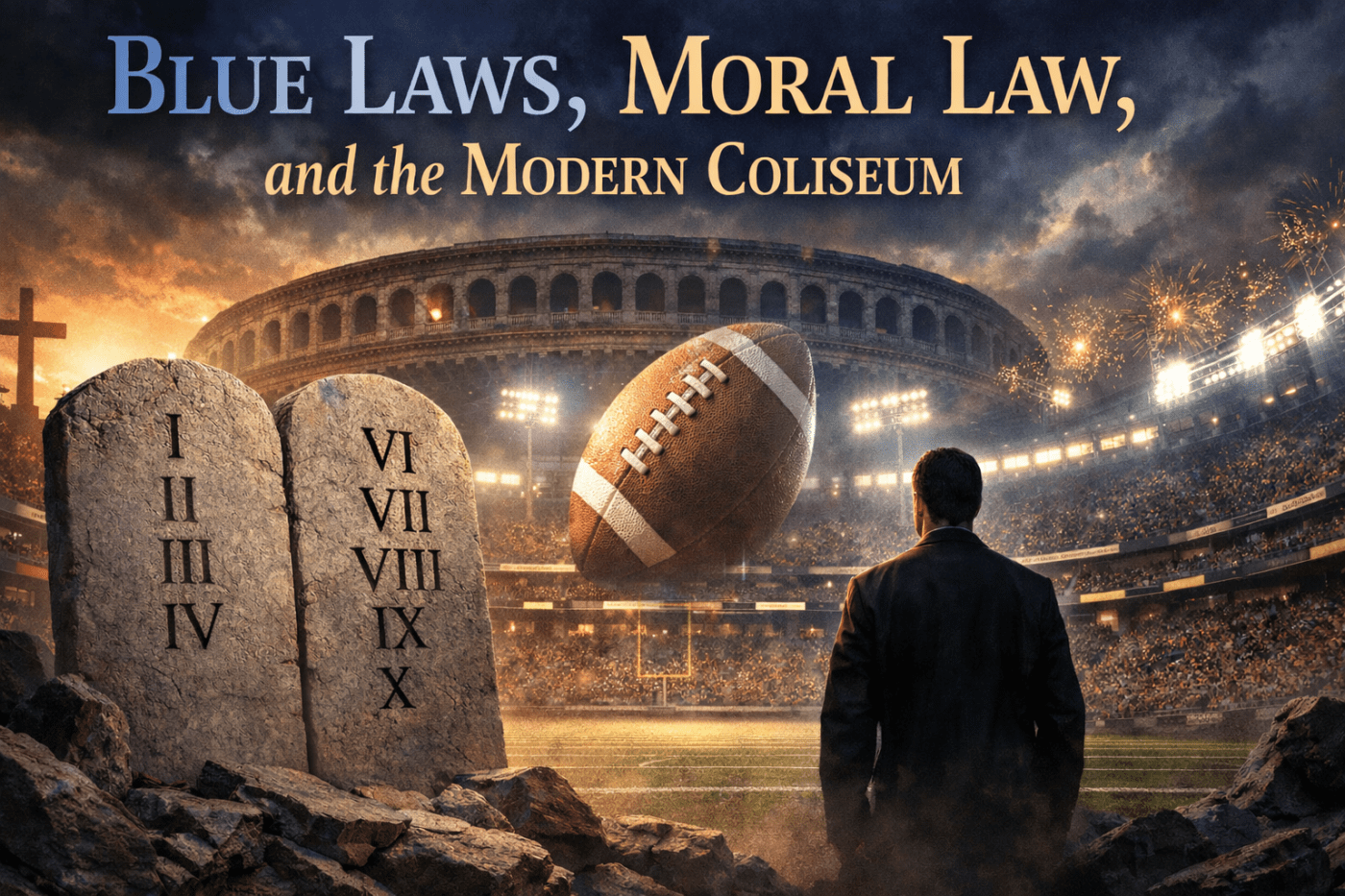
As the NFL barrels toward its zenith in the 60th Super Bowl this winter, millions are preparing for a national liturgy of food, spectacle, and celebration. Some churches, rather than resisting the cultural tide, now adjust service times or devise themed novelties to accommodate the event.1 Much has already been written lamenting how football has come to dominate February within the life of the church. But the problem runs deeper than one “Big Game.” What we are witnessing is the long decline of the Christian Sabbath itself.
America has had blue laws2 on the books within living memory,3 laws that once acknowledged—however imperfectly—the moral claim of the Fourth Commandment upon public life. Yet many Christians today will shrug at their disappearance while simultaneously crying outrage that the Ten Commandments might be removed from public spaces. But what good is displaying the Moral Law of God if we so openly disregard it? Had we held the Lord’s Day in higher esteem, perhaps we never would have arrived at a moment when such laws are dismissed as unnecessary—or even bigoted—in the public square.
The Sabbath did not begin at Sinai, but at creation—when God himself rested and blessed time. For this reason, the Fourth Commandment cannot be dismissed as merely ceremonial. The Moral Law of God is forever binding, even before it is explicitly codified. Adam did not need a written prohibition against murder in the garden to know that taking innocent life would be sin.4 The law revealed at Sinai did not create moral obligations, but declared openly what was already binding upon man by virtue of creation.5
While this principle is readily granted for most of the commandments, the Fourth Commandment has long been treated as an exception, as though it were uniquely temporary or ceremonial. Yet Scripture resists this conclusion. Before Israel ever arrived at Sinai, Pharaoh accuses Moses of making the people “rest” when Moses calls them to worship the LORD.6 The language employed is closely related to the idea of Sabbath rest, suggesting that Moses was calling Israel back to a creational pattern long suppressed by the burdens of slavery.7 This explains why Sabbath observance must be reintroduced: the yoke of Egypt left no room for rest. This pattern becomes unmistakable in Exodus 16, where Israel is commanded to cease from gathering manna on the seventh day—well before the law is given at Sinai.8 Later, the author of Hebrews explicitly grounds the continuing hope of God’s people in God’s rest on the Sabbath.9 The author does not use the general word for rest in the phrase “There remains therefore a rest for the people of God”10 but a word for honoring the Sabbath. God’s rest transcends the Mosaic Covenant11 and thus is a moral principle for the believer today.
In the country I live—America—blue laws once shaped social patterns around rest, worship, and family time. Our government knew it was a good thing to uphold God’s Moral Law in this regard. In fact, blue laws repeal caused a 5% decrease in church attendance.12 Once these laws were no longer there to help structurally reinforce a shared day for worship; society began to replace worship with commerce, consumption, and leisure. As people turned away from church, denying the pattern of work and rest led to a rise of mortality in “deaths of despair” during the time these laws were repealed.13 Blue laws indirectly supported public engagement by maintaining a weekly rhythm ties to a communal life— without them, voter participation fell14 in states as blue laws were removed from the books. As the Moral Law was not enforced by the government, illegal drug use also increased—particularly by those who no longer attended church after the repeal of these laws.15 Laws were no longer there to restrain evil, so why is it any surprise that things degraded without God’s boundaries?
The influence of blue laws was not limited to retail or liquor; they once forbade organized sports on the Lord’s Day entirely. In 1933 Bert Bell helped lead a political push to modify blue laws in order to obtain an NFL franchise in Philadelphia. At the time Pennsylvania had barred all professional sports on Sunday. It was impossible for NFL teams to play in that market, because they refused to adjust their schedule to honor the Christian Sabbath. Bert Bell wasn’t just casually lobbying — the very structure of professional football’s calendar depended on altering Sunday restrictions that were rooted in Christian Sabbath norms.16 Professional sports have been part of the commercial pressures that helped dismantle Sabbath observance in public life. These changes reflected the cultural shift in which leisure and and commerce increasingly trumped religious restraint on the Lord’s Day— reshaping American Sunday life, undermining the very creation principle that the Fourth Commandment expresses.
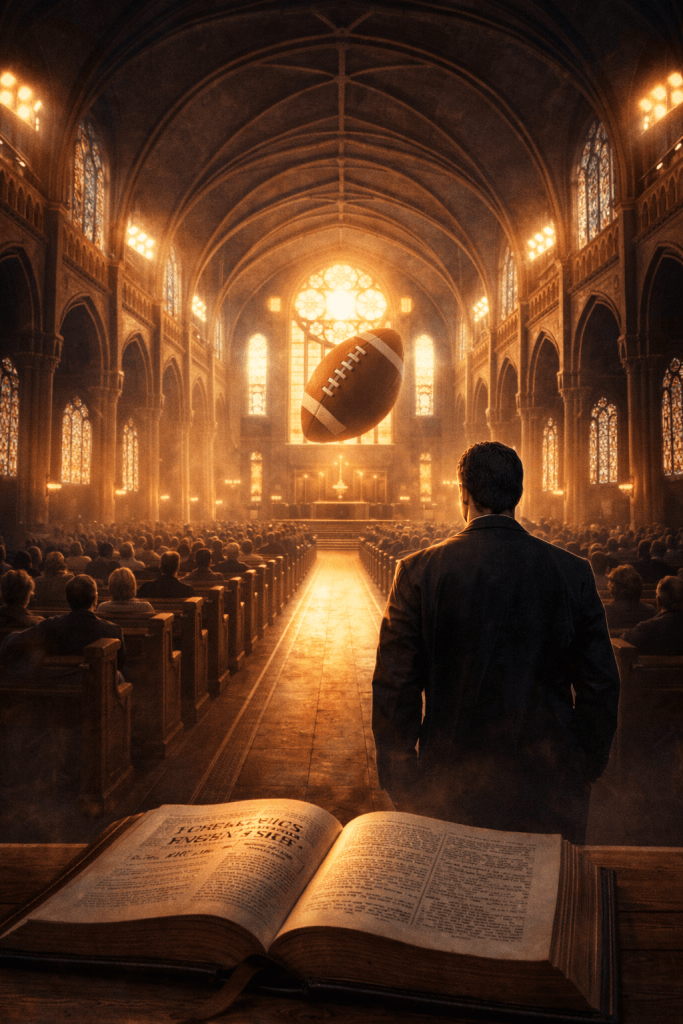
Football itself is not the ultimate issue here. Games & recreation have proper places in God’s good creation. Even Paul uses sports as analogies for our faith and walk with Christ.17 The problem is what football has become on the Lord’s Day; a rival liturgy that commands our attention, shapes our schedules, and even catechizes hearts to believe rest is found in entertainment rather than in God. We often find ourselves functionally ignoring the Fourth Commandment for commerce, convenience, and cultural pressure as football on Sunday not only occupies our time but trains us to think of the Lord’s Day as negotiable.
The Sabbath was given not as a burden, but as a gift18– a weekly declaration that man doesn’t live by bread, spectacle, or profit alone. We as Christians should focus and delight in the Lord’s Day and reject the modern coliseum, the open market places, and the notion that the day God blessed and made holy is the same as any other. If we shift our worship time to accommodate kickoff we cannot be surprised that society has degraded to deny God’s Law when we do not honor it ourselves. A society will never honor what God’s people regard as optional. If we lament the loss of public restraint, we must first recover private and ecclesial obedience. Turn off the first quarter and invite people over for fellowship and worship at your house. Ignore the half-time show and sing psalms, hymns, and spiritual songs. Reject the modern coliseum on Sunday, and spend that time with the gathering instead. We should not just remember the Sabbath day, but we should work to keep it holy.

- https://protestia.com/2024/02/12/oh-megachurch-pastor-punts-bible-across-stage-for-superbowl-themed-church-service/ ↩︎
- also known as Sunday laws, blue laws restrict or ban various activities on Sunday ↩︎
- https://en.wikipedia.org/wiki/Blue_laws_in_the_United_States ↩︎
- cf. Genesis 2:16-17 ↩︎
- cf. Genesis 12:18-19; Romans 2:14-15 ↩︎
- Exodus 5:1-5 ↩︎
- “You make them rest (תַּשְׁבִּיתוּ) from their burdens!” / “Sabbath” (שַׁבָּת) ↩︎
- Exodus 16:22-30 ↩︎
- Hebrews 4:1-11 ↩︎
- Hebrews 4:9 the word translated to rest is sabbatismos (Sabbath-Keeping) not katapausis (rest) ↩︎
- cf. Genesis 2:1-3; Hebrews 4:3-5 ↩︎
- https://www.cambridge.org/core/journals/british-journal-of-political-science/article/does-church-attendance-cause-people-to-vote-using-blue-laws-repeal-to-estimate-the-effect-of-religiosity-on-voter-turnout/93635E6256C9082E1D3097C7267724EC ↩︎
- https://www.nber.org/bh/20232/blue-laws-religious-observance-and-health-outcomes ↩︎
- https://www.nber.org/papers/w14303 ↩︎
- https://news.mit.edu/2008/bluelaws-tt0521 ↩︎
- https://eric.ed.gov/?id=ED109103 ↩︎
- 2 Timothy 4:7 ↩︎
- Mark 2:27 ↩︎

I know this is difficult to hear for people super into sports but it can be done another day!
LikeLike
This really resonated with me. I’m old enough to remember when Sundays truly felt different—quiet, set apart, almost sacred. Nothing was open, people slowed down, and there was a sense that the day mattered. I’m a football fan myself and even played until a knee injury ended it, and for most of my adult life I worked retail, so Sundays were just another workday for me. Back then, I hadn’t yet come to faith. Since finding Christ, my view of Sundays has changed completely. The Lord’s Day isn’t about gimmicks or squeezing church in around entertainment—it’s about rest, worship, and re-centering our hearts. I honestly believe we lost something good when Sundays became just another day, and your post captured that loss really well.
LikeLike