The Law of God, unfortunately, is not as clear in many Christian circles as it ought to be. Some wield it as a cudgel, measuring the sanctification of others against their own standards and striking where they perceive deficiency. Others, appealing to the grace of the cross, assume that because Christ has earned our merit, the Christian is now free to live without regard for obedience. Still others decry God’s commands in theory while casually ignoring them in practice, preferring recreation and worldly pursuits over holiness.
As we have noted elsewhere on this site, much of this confusion stems from a failure to understand how God’s law is meant to function. When its purpose is conflated, Christians tend to drift toward legalism,1 antinomianism,2 or an inconsistent application that changes with convenience.3 Yet Scripture teaches both that Christ redeemed those who were under the law4 and that His people are still called to walk in obedience5. How are these truths held together in the Christian life?
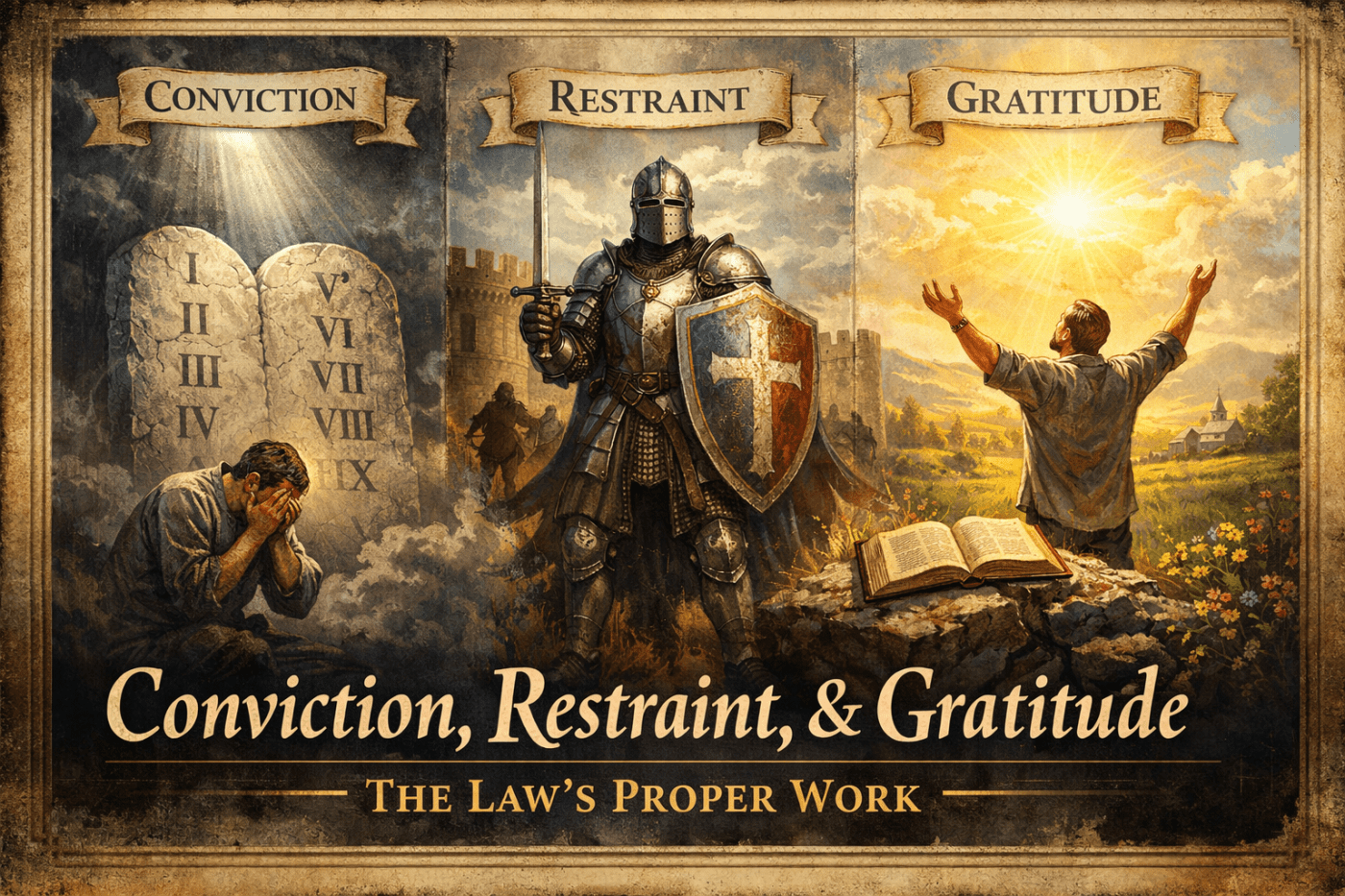
The answer begins with a proper understanding of the three uses of the law: how it convicts us of sin, restrains evil in the world, and directs the redeemed heart toward grateful obedience.
What Law are we talking about? The Moral Law of God, which is understood as the 10 commandments. These tenets, while enumerated at Mount Sinai, have been binding since the creation of the world. We see before Exodus 20 that murder is wrong as Cain murders Abel and is cursed.6 The pagan king Abimelech knew that adultery was wrong when Abraham lied about his wife Sarah.7 We see stealing condemned as Joseph questions his brothers in Egypt as well.8 There are many additional examples9 that show as Roman 2:14-15 says, “the work of the law is written on their hearts”— a confirmation that these commandments are on our hearts, and not merely tables of stone. Understanding this truth is essential to understanding how the law works in our lives today.
First, this law is provided as a mirror that drives sinners to Christ. Paul tells us that he would have not known what it is to covet if the law had not said ‘You shall not covet’.10 The concept of this mirror is a pedagogical sense—a word for tutor based on the Greek word paidagōgos.11 This tutor—as the law—is used to teach us of our sins and how we have fallen short of God’s law. As Romans 3:19-20 tells us, “through the law comes knowledge of sin.” The law teaches us of our shortcomings which are sins—transgressions against God’s law. It hold’s God’s perfection as a mirror to us, showing our failings and debts to God and convicts our hearts of our own actions. This bad news is what prepares one for the Good News of Christ—Christ has done what we can never do, and so we trust on His work and not our own. This function of the law exposes guilt, silences self-justification, and prepares the sinner for the gospel. It cannot justify, but it can condemn rightly.
Second, the law is a curb on external evil in society. We see in 1 Timothy 1:9-10 that the “law is not laid down for the just but for the lawless and disobedient”. As God has provided our civil leaders as God’s ‘ministers to punish evil’12 the law provides the magistrate a guideline for what evils should be punished so man’s natural corruption is restrained. Nehemiah shows us that the enforcement of the Sabbath order for public good is a righteous thing as he bars the gates of Jerusalem from commerce.13 The clearest example is seen in Deuteronomy 13:11 when after describing capital punishment it says “So all Israel shall hear and fear, and not again do such wickedness as this among you.” Judicial punishment is a deterrent to rampant evil in a society. Even if society is filled with unregenerate people that do not profess to be Christians, all people are accountable under the law, and it is in a government’s duty to help legislate this morality. This is why in even the simplest of moral societies, laws against stealing and murder are commonplace. This function of the law restrains sin externally, even among the unregenerate, preserving order and limiting wickedness by fear of consequence.
Lastly, the law is a rule of life for the believer. Loving God’s law is a delight—not a burden.14 Christ doesn’t abolish the law15 allowing us to have a blank check on our behavior, but rather provides us the Spirit that helps “direct and bind us to walk accordingly.”16 As the law shows us our failings as a mirror, the Spirit once we are regenerated helps us live out God’s law in gratitude. While we cannot do so perfectly as the flesh dwells in us, the Spirit enables us to conform ourselves to the example Christ gave us. He followed the law perfectly and obediently as the Son of God, and we follow the law as a rule of life to “keep His commandments”.17 This is where the New Testament calls to follow the law become clear. We do not follow them as a basis for our righteousness with God, but as a consequence for our righteousness with God. Christ’s obedience is the root of our salvation, and our obedience is a fruit of that salvation. For the justified believer, the law no longer condemns, but directs grateful obedience. This use presupposes union with Christ and the indwelling Spirit.
As we are convicted by the law, it points us to the only One who fulfilled it perfectly—Jesus Christ. The law, in the hand of Christ, reminds us that He alone is the way, the truth, and the life. As evil is restrained by the law, God preserves a world in which the gospel may be heard. The Father uses His moral law to uphold life and order, ensuring space for the mission of the church. And as the law directs believers toward grateful obedience, it shows us what a life transformed by grace looks like. The Spirit uses the law not only to enable us to walk according to this rule of life, but also to keep us leaning on Christ’s righteousness rather than our own.
The moral law convicts sinners, restrains evil, and guides believers—each use distinct, harmonious, and subordinate to the gospel. The law cannot justify us, exposing the error of legalism which confuses obedience with righteousness.18 Neither can it condemn those who are regenerate, yet it continues to instruct19 and bind them as a rule of life. As has been noted elsewhere,20 obedience to God’s law benefits society as a whole—both by shaping the lives of believers who seek to follow Christ and by restraining wickedness among unbelievers. God’s law, therefore, is not opposed to the gospel, but beautifully serves it.

- https://thoughtsinthelight.com/2025/10/23/distorted-righteousness-legalism/ ↩︎
- https://thoughtsinthelight.com/2026/01/09/neglected-holiness-antinomianism/ ↩︎
- https://thoughtsinthelight.com/2026/01/12/blue-laws-moral-law-and-the-modern-coliseum/ ↩︎
- Galatians 4:4-6 ↩︎
- Galatians 6:2 ↩︎
- Genesis 4:1-15 ↩︎
- Genesis 20:6-7 ↩︎
- Genesis 44:8 ↩︎
- cf. While the commandments are not explicitly stated, we see here that the moral ideas from the 10 commandments are shown in scripture pre-Sinai. While this in and of itself could be an article, the following will have to suffice for now: 1st (God’s exclusive worship) Gen 4:3-7; Gen 35:2, 2nd (God regulates His worship) Gen 4:4-5; Exo 16:23, 3rd (God’s name is holy) Gen 4:26; Gen 9:26, 4th (Sabbath principles) Gen 2:2-3; Exo 16:22-30, 5th (Authority structures in society and family) Gen 9:6; Gen 18:19, 6th (Murder) Gen 9:6, 7th (Sexual Morality) Gen 39:9, 8th (Theft) Gen 31:30, 9th (False Witness) Gen 12:18-19; Gen 27:35, 10th (Coveting) Gen 6:5; Gen 13:10-11 ↩︎
- Romans 7:7 ↩︎
- Strong’s G3807, cf. Galatians 3:24-25 ↩︎
- Romans 13:3-4 ↩︎
- Nehemiah 13:15-21 ↩︎
- Psalm 119:1-6, 97-104 ↩︎
- Matthew 5:17-19 ↩︎
- WCF XIX.6 “Although true believers be not under the law as a covenant of works, to be thereby justified or condemned; yet is it of great use to them, as well as to others; in that, as a rule of life, informing them of the will of God and their duty, it directs and binds them to walk accordingly” (cf. Rom 7:12,22,25; Psm 119:1-6; 1Co 7:19; Gal 5:14-23) ↩︎
- John 14:15 ↩︎
- https://thoughtsinthelight.com/2025/10/23/distorted-righteousness-legalism/ ↩︎
- https://thoughtsinthelight.com/2026/01/09/neglected-holiness-antinomianism/ ↩︎
- https://thoughtsinthelight.com/2026/01/12/blue-laws-moral-law-and-the-modern-coliseum/ ↩︎

Leave a comment