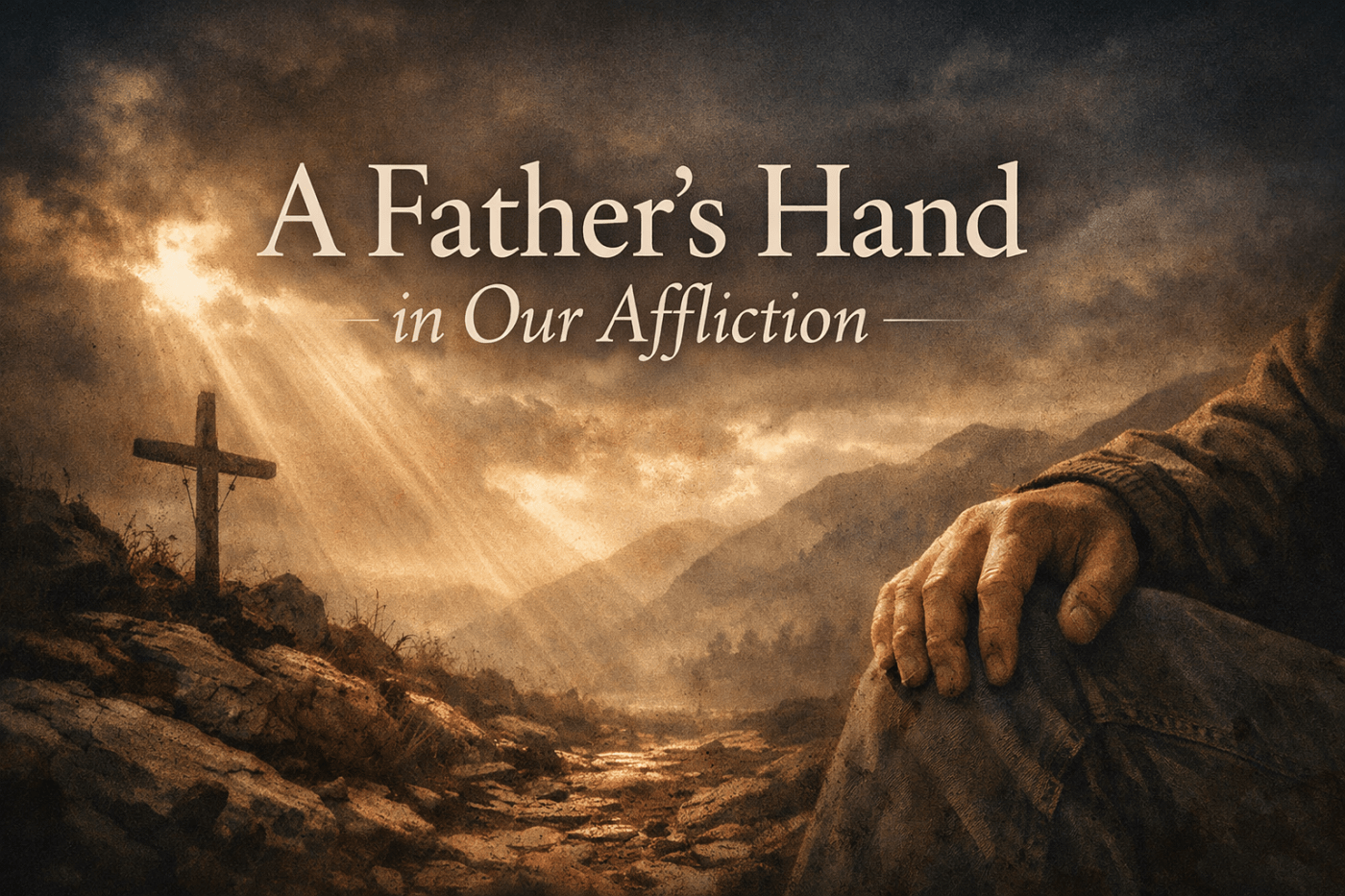
A question that seems to rise up time and time again in discussions of religion is “if God is real, why do bad things happen to good people?” Usually the question is not abstract. It comes after a funeral, a terminal diagnosis, or some other sorrow that tears through ordinary life. In such moments, the best ministry is often shared silence and tears. Deep wounds are not healed by quick logic but by warm presence. Yet for the believer, we are not left without an answer. Scripture assures us that God works all things for the good of our salvation1 —that, as the Heidelberg Catechism beautifully states, “not a hair can fall from my head without the will of my Father in heaven.”2 That confession comforts us in ordinary days. But when affliction presses in, and God feels distant rather than near, understanding what that means can be a struggle. It is precisely there—in the painful places—that Hebrews 12 speaks, showing us how even our deepest trials may be the loving discipline of a Father who is committed to our good.
For consider Him who endured such hostility from sinners against Himself, lest you become weary and discouraged in your souls. You have not yet resisted to bloodshed, striving against sin. And you have forgotten the exhortation which speaks to you as to sons: "My son, do not despise the chastening of the LORD, Nor be discouraged when you are rebuked by Him; For whom the LORD loves He chastens, And scourges every son whom He receives." If you endure chastening, God deals with you as with sons; for what son is there whom a father does not chasten? But if you are without chastening, of which all have become partakers, then you are illegitimate and not sons. Furthermore, we have had human fathers who corrected [us], and we paid [them] respect. Shall we not much more readily be in subjection to the Father of spirits and live? For they indeed for a few days chastened [us] as seemed [best] to them, but He for [our] profit, that [we] may be partakers of His holiness. Now no chastening seems to be joyful for the present, but painful; nevertheless, afterward it yields the peaceable fruit of righteousness to those who have been trained by it.
– Hebrews 12:3-11
A striking note here is that Jesus endured hostility and suffering in the incarnation. The perfect Son of God suffered more deeply than any man3—not because He had done anything wrong, but according to the Father’s redemptive plan to reconcile a people to Himself. He endured betrayal, slander, injustice, torture, and even death by crucifixion. This comforts us in two ways. First, Christ does not call us to walk a road He Himself has not walked. He knows our weakness and sympathizes with our suffering. Second, His suffering was not for His own sin4, but for ours. Therefore, the afflictions that come into the believer’s life are not expressions of God’s judicial wrath. Christ has already borne that fully, nailing our debt to the cross.5 While suffering entered the world through sin, not every affliction is tied to a specific wrongdoing—as Jesus Himself taught concerning the man born blind.6 For those united to Christ, what may feel like punishment is instead the loving discipline of a Father who is shaping His children. These trials are not evidence that God has abandoned us, but that He is committed to our holiness. He is helping us remember core truths we have lost sight of, such as God being in control, or His love for us. Even if we understand these logically, we might have lost that meaning in our heart.
It might not be comforting initially to hear of this instruction from God. However, as the author continues the fact that there is instruction should be comforting as it is a confirmation that you are a child of God. This does not mean that anyone who suffers in de facto a child of God; suffering exists because of the Fall in the Garden.7 The same affliction may fall on two people, yet it does not come to them in the same way. For one, it is a sorrow within a world still under condemnation. For the other, it is the discipline of a Father who has already removed condemnation. For those who love God, suffering has a purpose, it is a refining moment that confirms we are His children. Christians do not suffer less than others, but that suffering is different, as it yields the peaceable fruit of righteousness. One benefit is the ability to be able to minister to those in a similar crisis by comforting them as God comforted us.8
In 2024, my mother-in-law passed away from recurrent cancer. Throughout her illness she remained a steady witness to Christ. When she received her final diagnosis, she prayed—not for herself first—but for the doctor who had to deliver such difficult news. I was grateful to help care for her in hospice during her final days. A few days before she passed, she asked me to review the funeral plans she had prepared. Her concern was not merely logistics, but clarity: she wanted people to know where she was going and to hear the gospel plainly proclaimed. What could have been an unbearably somber conversation became one marked by quiet hope. In her, I saw what Hebrews 12 describes as “the peaceful fruit of righteousness.” The cancer was grievous. The loss remains painful. Yet there was a settled confidence that this suffering was not the hand of a judge condemning her, but the hand of a Father preparing her for glory. And even now, our sorrow is tempered with the sure hope that we will see her again in Christ. There is no raw wound, but a blessed expectation of that reunion day in glory.

So what do we do when we are in these trials? We shouldn’t take suffering stoically, angrily, or fatalistically. Growing weary is what the author warns of as he exhorts to “no despise the chastening of the Lord” Rather, as James says in his epistle, ask of God for the wisdom needed in trials.9 In the context of trials, wisdom can help us know how to react, and how to run the race set before us.10 Instead of resisting we should submit—not as a passive resignation, but actively trusting in the Lord. We realize that God is sovereign and rest in His love. This transforms discipline into growth. That growth is achieved when we look to Christ as our anchor. Christ bore the wrath of God and can sympathize with us in our time of need.11 Glory followed Christ’s suffering and that is a glory we can partake in. For the believer we do not endure discipline to earn God’s love—we endure discipline because we already have it. Affliction is not a waste if it drives us towards holiness, and the glory that is to come as a child of God.
Author’s Note: Sometimes in the midst of affliction, depression can be at our doorstep. If this is something you are struggling with, we recommend our article on depression, which seeks to balance professional care with biblical wisdom.

- cf. Romans 8:28-32 ↩︎
- Heidelberg Catechism Q&A: 1. cf. Matthew 10:29-31; Luke 21:16-18 ↩︎
- cf. Isaiah 52:14 ↩︎
- As Christ was perfect and sinless, Hebrews 4:15; 7:26; 1 Peter 1:19; 2:22; 2 Corinthians 5:21; 1 John 3:5; John 8:46; Acts 3:14; Isaiah 53:9; Roman 5:19; cf. Westminster Confession Faith 8.2; Heidelberg Catechism Q&A 16. ↩︎
- Colossians 2:14 ↩︎
- John 9:1-5 ↩︎
- See Genesis 3 ↩︎
- 2 Corinthians 1:3-7 ↩︎
- James 1:2-5 ↩︎
- Hebrews 12:1-2 ↩︎
- cf. Hebrews 4:14-16 ↩︎

Leave a comment