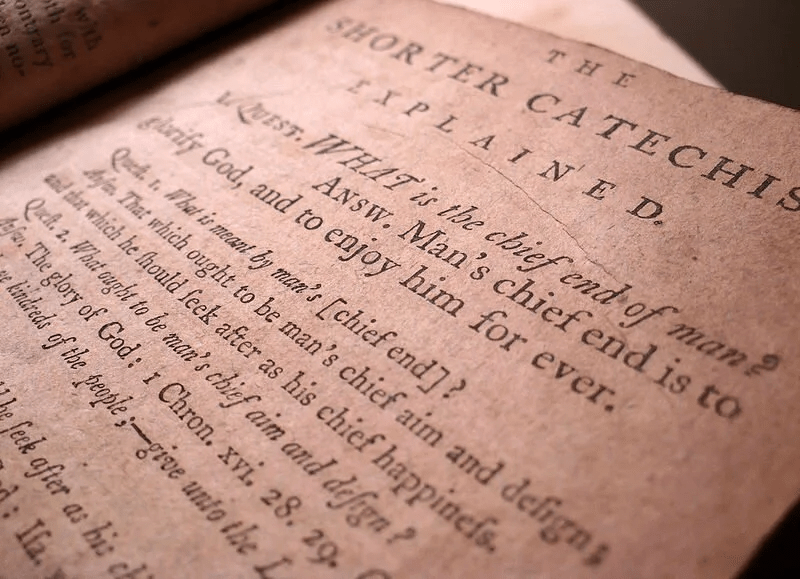
A Catechism is a summary of religious doctrine, traditionally in a question-and-answer format, used for religious instruction, particularly in Christianity to teach foundational beliefs like the Creed, Sacraments, moral life, and prayer. The term comes from a Greek word meaning “to teach orally”.
“Catechisms serve as a rule of instruction, whereby the fundamentals of faith are clearly delivered and firmly held.” – William Ames
Click Here to read more in detail about the necessity of Creeds, Confessions, and Catechisms.
“A catechism is milk for babes and meat for strong men; the weak grow by it, and the strong are strengthened.” – Thomas Watson
The Heidelberg Catechism (1563)
The Heidelberg Catechism was written during the Reformation in the German Palatinate to provide a clear, pastoral summary of Reformed Christian doctrine. Commissioned by Elector Frederick III and primarily authored by Zacharias Ursinus and Caspar Olevianus, it was designed for both teaching and preaching within the church. Structured around comfort, guilt, grace, and gratitude, the catechism emphasizes salvation by grace alone through faith in Christ, the authority of Scripture, and the believer’s union with Christ. Its warm, devotional tone helped it gain widespread acceptance and it became a foundational confession within the continental Reformed tradition.
The Westminster Shorter Catechism (1647)
The Westminster Shorter Catechism was produced by the Westminster Assembly in England during a time of intense ecclesiastical and political reform. Intended especially for instructing children and new believers, it presents Reformed theology in concise questions and answers. The catechism famously opens with the declaration that humanity’s chief end is “to glorify God, and to enjoy him forever,” setting a God-centered framework for all doctrine. It clearly teaches the doctrines of Scripture, God’s sovereignty, sin, redemption through Christ alone, and the moral law as a guide for the Christian life. It became a standard teaching tool in Presbyterian and Reformed churches.
The Westminster Larger Catechism (1648)
The Westminster Larger Catechism was also authored by the Westminster Assembly and serves as a more detailed companion to the Shorter Catechism. Intended primarily for ministers and advanced instruction, it offers fuller explanations of Reformed doctrine, ethics, and Christian practice. The Larger Catechism provides extended teaching on the Ten Commandments, the means of grace, and the believer’s communion with Christ. Together with the Westminster Confession of Faith, it helped define classic English-speaking Reformed theology and remains a doctrinal standard in many Presbyterian and confessional Reformed churches.
“The catechism is a plain and orderly setting forth of the grounds of religion, for the benefit of the unlearned.” – William Perkins

