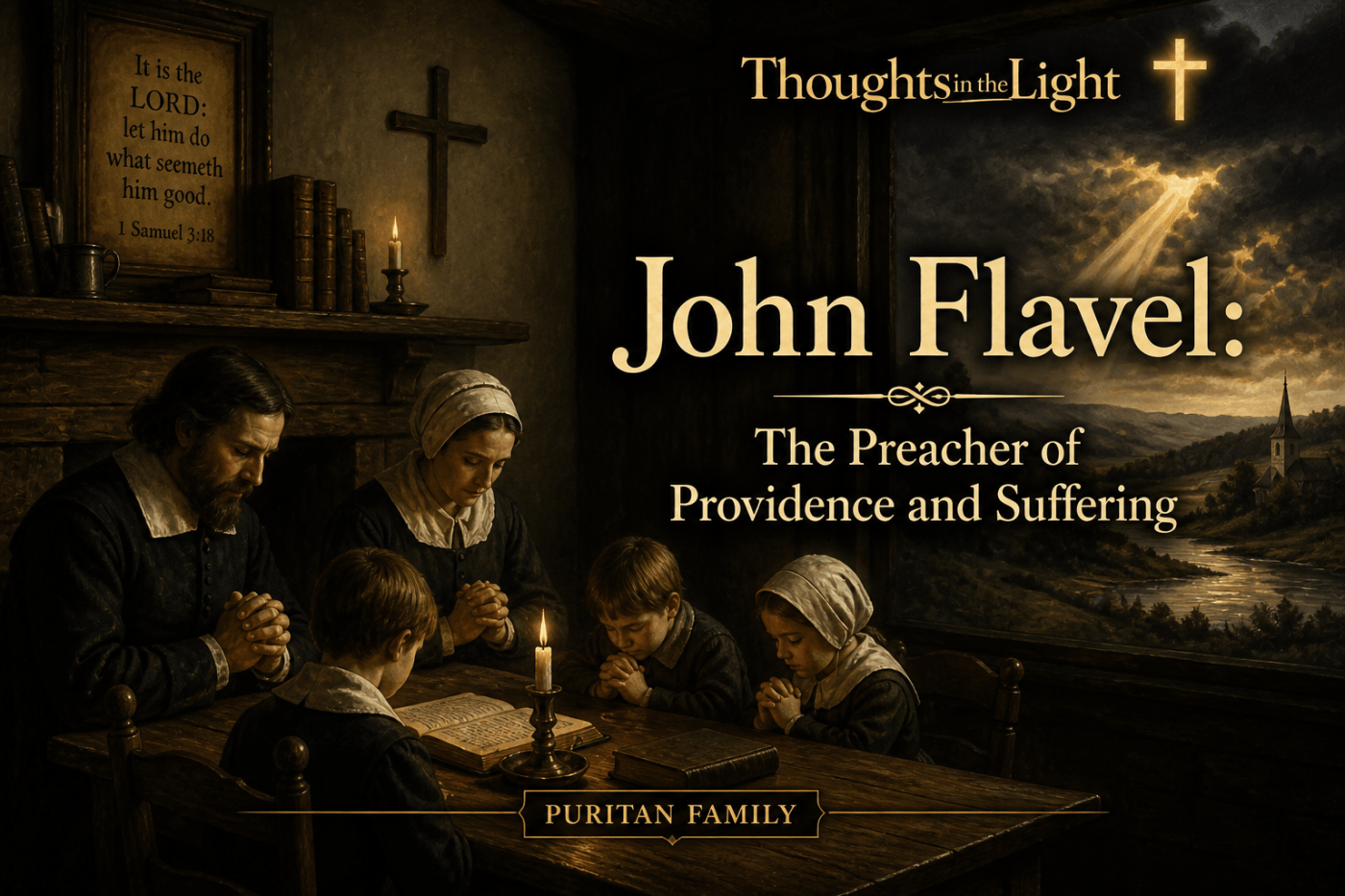
John Flavel (c. 1627–1691) stands as one of the most prominent and practical of the English Puritan divines. Often referred to as the “Preacher of Providence,” his life and ministry were characterized by deep personal suffering, a relentless commitment to his flock during periods of intense persecution, and a literary legacy that continues to provide spiritual comfort to millions.
Early Life and Oxford Education
Flavel was the eldest son of Richard Flavel, a “painful and eminent minister” who, like his son, was eventually ejected from his living for nonconformity. Born in Bromsgrove, Worcestershire, John was religiously educated by his father before attending University College, Oxford, as a commoner. At Oxford, he was known for his diligence and quickly exceeded many of his contemporaries in university learning.
In 1650, Flavel began his ministry as an assistant to the infirm Mr. Walplate in Diptford, Devon. Later that same year, he was ordained by the presbytery at Salisbury. In Diptford, Flavel demonstrated his pastoral heart by voluntarily lowering the cost of tithes for his parishioners so that financial matters would not hinder the success of his spiritual labor.
Ministry in Dartmouth and the Great Ejection
In 1656, Flavel accepted a call to become the minister at the thriving seaport of Dartmouth. Although this move resulted in a lower income, he believed the opportunity to heal spiritual breaches in a more populous town was a divine mandate. His preaching at Dartmouth was described as “heart-searching” and “plain,” capable of affecting even the most “hard heart”.
The sunny decade of his early ministry ended abruptly with the Act of Uniformity in 1662, which turned Flavel and nearly 1,800 other ministers out of their pulpits for refusing to comply with state-mandated religious forms. Despite being officially silenced, Flavel refused to abandon his congregation, meeting secretly with them in woods and private homes.
Life Under Persecution: Disguises and Escapes
Following the Five Mile Act of 1665, which prohibited Nonconformist ministers from coming within five miles of their former parishes, Flavel moved to Slapton. His life during these “wilderness years” was marked by dramatic escapes and unwavering boldness. He once disguised himself as a woman on horseback to reach a secret meeting place to preach and administer baptism.
When pursued by authorities on another occasion, he plunged his horse into the sea and escaped by swimming through a rocky area to reach safety. He even utilized unique “pulpits” such as Salstone Rock, an island in the Salcombe Estuary that was submerged at high tide; the congregation would linger in worship until the rising water forced them back to their boats.
A Legacy in Writing
When persecution prevented him from standing in a pulpit, Flavel took up his pen. His written works, which now fill six large volumes, were designed to be accessible, experimental, and deeply affectionate. Some of his most significant works include:
- The Mystery of Providence (1678): Considered by many the definitive Puritan treatment of the doctrine of divine providence, teaching believers how to discern God’s hand in all stages of life.
- The Fountain of Life: A comprehensive Christology containing 42 sermons on the mediatorial glory and offices of Jesus Christ.
- A Token for Mourners (1674): Written in the wake of his own deep personal losses, this work provides biblical rules for moderating sorrow and finding support in Christ during the death of loved ones.
- Keeping the Heart (also known as A Saint Indeed): An influential treatise on the “great calling” of every believer to watch over their spiritual state.
- Navigation Spiritualised and Husbandry Spiritualised: Books that used common metaphors from seafaring and farming to illustrate profound spiritual truths to the working class.
Personal Suffering and Character
Flavel’s theological insights were forged in the “crucible of affliction”. He suffered the loss of four wives over his lifetime: Joan (who died in childbirth along with their first child), Elizabeth, Ann, and Dorothy. He also witnessed his father and mother die of the plague while in prison for their faith.
Despite these tragedies, Flavel was described as humble, learned, and a “mighty wrestler with God in secret prayer”. He lived with a “well-grounded assurance” of heaven, once experiencing such a “ravishing comfort” of heavenly joy while traveling that he lost sight of the world around him, later stating he learned more of heaven in that moment than from all the books he had ever read.
Final Years and Death
The “Glorious Revolution” of 1688 finally brought lasting religious liberty to England. Flavel’s congregation in Dartmouth celebrated by building a large chapel for his return. However, his years of labor and stress had taken their toll; he described himself and his fellow veteran ministers as “almost worn out”.
On June 26, 1691, while visiting Exeter to promote a union between Presbyterian and Independent ministers, Flavel suffered a massive stroke. As he was being carried to bed, he expressed his confidence in God’s goodness, stating, “I know that it will be well with me”. He died that evening at the age of sixty-three and was buried in Dartmouth churchyard. His life remains a testament to the Puritan ideal of “heaven on earth” achieved through a heart stayed on the providence of God.


Leave a comment