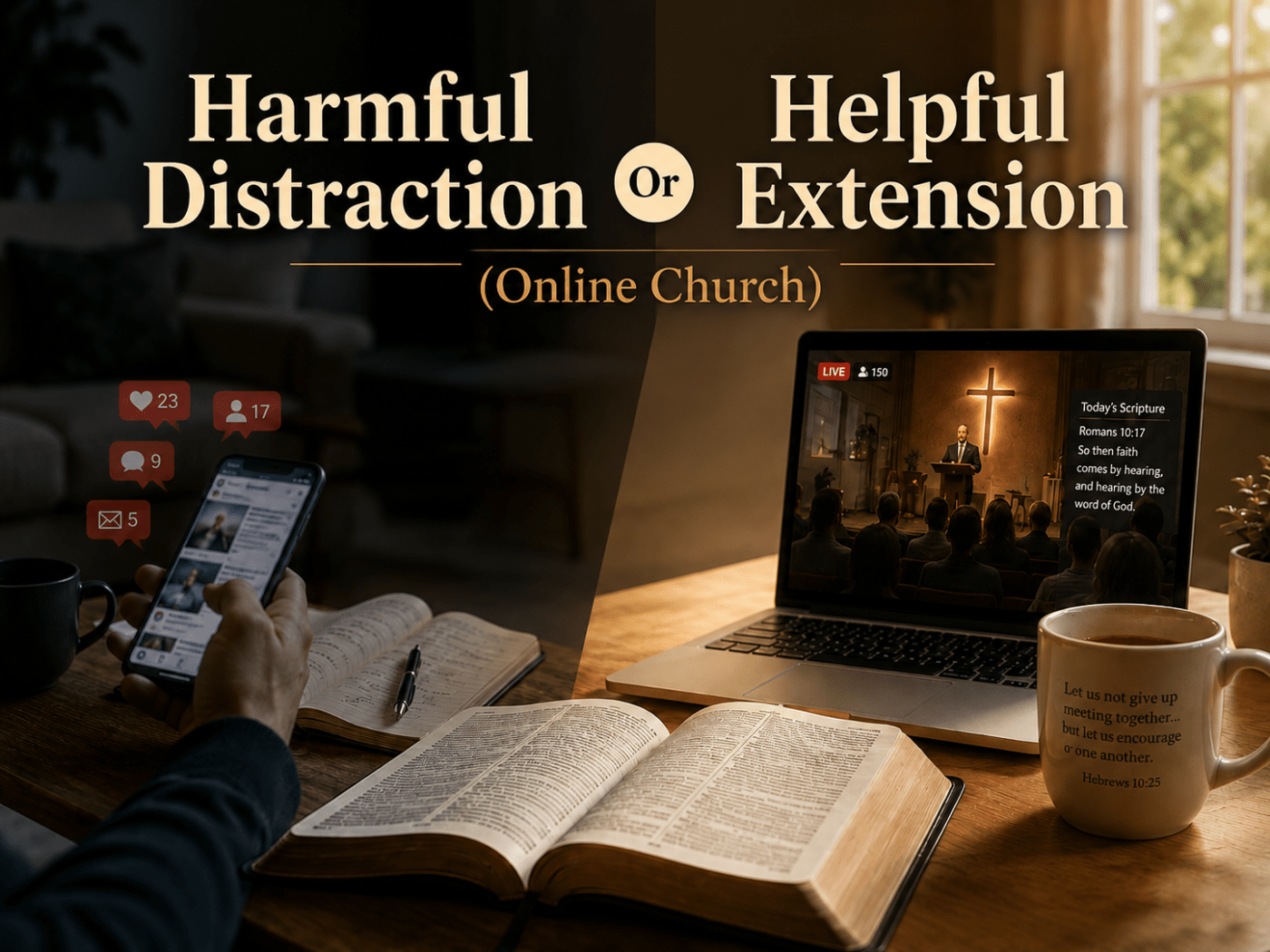
‘And let us consider how to stir up one another to love and good works, not neglecting to meet together, as is the habit of some, but encouraging one another, and all the more as you see the Day drawing near.’ – Hebrews 10:24-25
With time comes change; this includes what our churches look like in both functional and aesthetic manners. Whether it be the change of building designs or the programs of the church, perhaps the change of music, or even the change of liturgy, advancement in technology brings many new ways for the church to function and appear different from prior generations. However, with this change comes a lot of uncertainties, errors, and stumbling blocks, alongside many helpful uses that serve the body of Christ. So how do we go about defining what the Church is, and where do we draw the line when it comes to using technology within the Church itself for the advancement of both the universal and local Church?
“The church is the company of the faithful called out of the world.” – William Ames
What makes up the Church
First, we must define what the Church is and how it has always been defined. When we talk about the Church and its definition, some confusion can arise between two meanings. In one aspect, the Church is the universal bride of Christ, also known as the Body of Christ. In another sense, when we speak about the Church, we are referring to the local physical church, which is the common meeting place of the saints. One refers to a group of people, while the other refers to a location or building. When addressing online Church, we will need to discuss both aspects briefly before proceeding.
The Body of Christ
Throughout the Scriptures, the body of believers has commonly been referred to as the Church1. We know that Christ taught us that where we gather in His name, He is among us2. This is important because without Him, we would have no Church, since it was Christ who said He will build His Church3. When we most commonly refer to the Catholic Church, we don’t speak about the Roman Catholic Church but the Universal Church, which is made up of all the saints of the faith over all time4. Another common factor in the conversation regarding the Church is this idea of the living temple. Prior to the New Testament, everyone was very familiar with God’s presence dwelling in the temple, and His people were known for the temple. Yet God has now stated that we are the living temple because we are a new creation, and God’s Spirit dwells in us5. This is great news because now, by the power of the Holy Spirit and the great intercessor that we have in Christ our Lord, we are able to go directly to God our Father. So, anytime we refer to the great body of saints or even just a few gathering together, we can be called the Church. Now remember, this is our identity that we are referring to in this context; next, we will speak to the physical location, which is also known as the Church.
“This holy church is not confined, bound, or limited to a certain place or certain persons, but is spread and dispersed throughout the entire world.” – Belgic Confession, Article 27
“The visible church… consists of all those throughout the world that profess the true religion.”
(Chapter 25) Westminster Confession
“The church is Christ’s mystical body, consisting of believers united to Him by faith.” – Thomas Watson
The Meeting place of the Saints
Now that we have talked about the Church (the people), let us now talk about the local physical Church6. The people of God have always had a gathering place to worship God. We see this in the Old Testament through the forms of altars, from the tabernacle to the temple. These were the local physical locations where God met His people, and His people offered different forms of worship, from prayers to sacrifices. Once we enter into the New Testament, we see Christ’s promise to build a Church. This Church would be known for preaching once for all the sacrifice of Christ upon the Cross, along with His resurrection. Not only this, but we would also have the sacraments present, which Christ instituted7. Along with those would come Church structure, such as discipline and offices. Throughout the New Testament, we see many references to the local churches. These churches can only operate the design and task they were given if they have a meeting place8. We are called to gather together to worship and serve one another, to encourage and challenge each other for the purpose of being sharpened and refined into becoming more like Christ. Such things cannot be possible without meeting together as a congregation.
Church is a means by which all believers can come together and use their spiritual gifts to help one another grow in Christ. The Church and fellowship of the body are necessary for your growth, as one believer does not possess every tool for sanctification. The Christian faith was never meant to be a lone wolf-type journey. We break bread and have true fellowship with one another only in the form of being physically present among the saints. Faithful oversight was designed for in-person relationships, for this is the only way the offices of the Church can operate. We see Paul writing letters to churches, but we must remember that these were bodies of believers who were already a local body in and of themselves. Paul had either already been present with them or was going to join them in the near future. Paul was no stranger to them, nor was he satisfied with watching them from afar. As Paul said, “I may come to you with joy and be refreshed in your company.”9. Oh, what a great joy it is to be found among the meetings of the saints.
“The marks of the true church are… the pure preaching of the gospel, the pure administration of the sacraments, and the exercise of church discipline.” – Belgic Confession, Article 29
“Particular churches… are more or less pure, according as the doctrine of the Gospel is taught and embraced.”
(WCF 25.4)
“Every church ought to be governed by pastors and elders appointed according to Christ’s ordinance.” – William Perkins
Observing Online Church
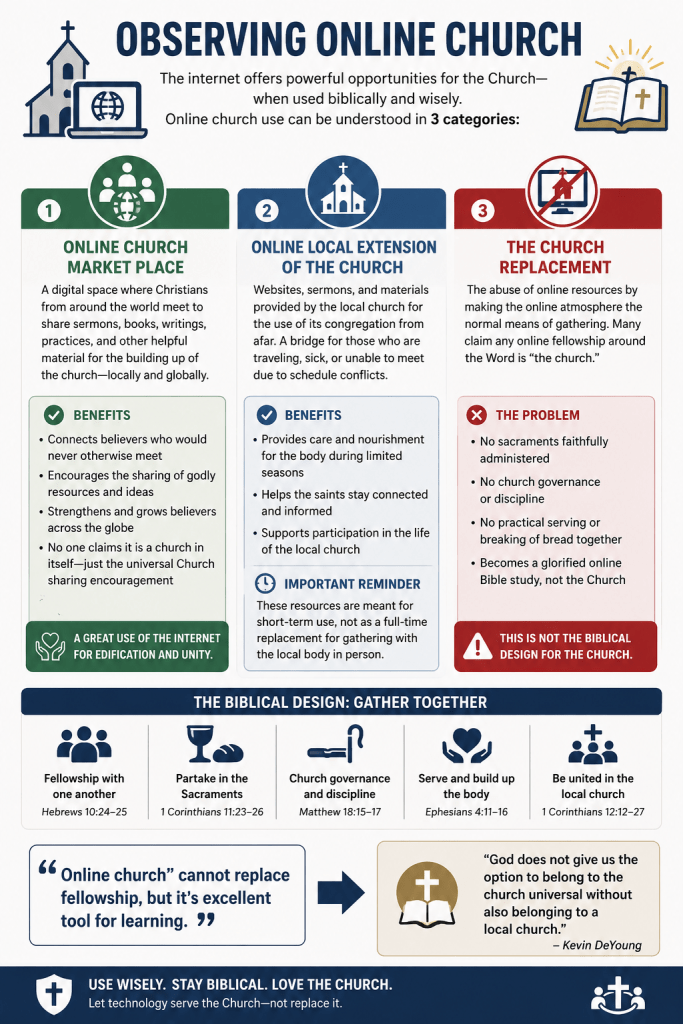
Now, onto the digital space and its use for the Church and its benefit. When we talk about the online use for the meeting of the saints, we must break it down into three categories: Online Church Marketplace, Online Local Extension of the Church, and The Church Replacement. Below, we will briefly walk through each of them in depth and evaluate their use in a modern context.
– Online Church Market Place is the term I have given to describe the digital space where Christians meet one another online to share sermons, books, writings, practices, and other helpful material for the building up of the church both locally and globally. This is a great use of the internet for growing and strengthening believers that otherwise would have never met nor discussed and shared such ideas. In this atmosphere, no one is claiming this to be a church in and of itself; rather, just the universal Church sharing encouragement.
– Online Local Extension of the Church, this would be the websites, sermons, and material passed out by the local church meant for the local congregation’s use from afar. This is simply the local physical church providing for its herd. For those who are traveling or sick, and for those who are unable to meet due to scheduling conflicts. This is meant to bridge a gap for a limited time, so that the body is not starved nor neglected. These things are never truly meant for full-time use to excuse them from belonging to the local body in person weekly.
– The Church Replacement. This is the abuse of the former two uses of online edification of the church. This aspect concerns those who seek to make the online atmosphere the normal means by which the saints gather. Many have argued that any online community which discusses the word of God and centers around fellowship is the church; they see this as being enough for them. However, within this, there is no room for the Sacraments to be faithfully distributed, nor do we see any form of church governance and discipline. There is no practical serving and breaking of bread with one another. This ends up being nothing other than a glorified online Bible study. “Online Church” is no different than someone who doesn’t attend church but watches a televangelist. TV Church is not church; you are merely watching from afar others who are actually doing church.
“God does not give us the option to belong to the church universal without also belonging to a local church.” – Kevin DeYoung
Online church cannot replace the local church, but it is an excellent tool for learning. Places such as Discord, Twitch, X, Facebook, Telegram, or any other online communities, while helpful for sharing resources among the saints, will never be able to operate as the Church. Again, when we speak of what makes up the church, it is the people along with the local meeting place where the Church can observe the Word, Sacraments, order of discipline, and disciple others. No TV nor online place will be able to do this. While Paul wrote to his churches from afar, he never neglected the opportunity to meet with them in person.
Conclusion
‘And they devoted themselves to the apostles’ teaching and the fellowship, to the breaking of bread and the prayers. ‘ – Acts 2:42
I believe absolutely that the Church is composed of all believers in Christ across all time and space, but more specifically that it is made up of local communities of believers who worship, learn, and serve together. Those who observe the sacraments often and who visibly see Church discipline exercised. While online can be a helpful extension of the Church, it can never act as the Church nor replace the Church ever. Like I said above, the digital extension of the local Church is a wonderful thing for those who are sick, traveling, or tied up in some form. But it is never meant to be the norm. I think COVID did great harm to believers because it removed them from meeting locally and forced them merely to observe through screens from afar. Many Christians bought into the lie that this is the same thing, and therefore they never returned. Online communities that claim to be the Church are guilty of stealing from the local Churches; they have starved others of true fellowship and accountability.10
“The church of Christ is a society of men called by the Word and united to Christ their Head.” – John Owen
Skipping in-person church when not providentially hindered is both a sin of omission and a sin of commission. You are committing the sin of putting something or someone else above the worship of God, and you are omitting your gifts from being used to exhort and edify the body of Christ. This is not a light matter. Take sports, travel for work, or many summer weekends spent at the lake; these are all things that hinder our walk with the Lord, simply because we are actively choosing them over the choice of worshiping God with His people.
It is a great problem of the modern-day church that we have lowered our view of church attendance, membership, and accountability.11 Our elders should know us because they will one day give an account for us, and we should be convicted if we are not known by an elder of the local church body. The Church has a responsibility to know the people that attend both in person and virtually. It is a concerning matter if one has no desire to be committed to the visible church. If you attempt to walk through this life alone and away from the rest of the local flock and the protection of a local shepherd, you may very well be led astray and even devoured by Satan.
So much of the Christian life can be boiled down to two simple truths. First, you are no longer your own; you belong to Christ. Secondly, you are no longer on your own; He gave you the Church. There are many facets of in-person relationships that cannot be experienced through the online experience. May this article be helpful in convicting you and others of the underlying harm that “online church” has, while also encouraging the saints to plug into the local Church and highlighting the importance it has for the body of Christ.
“Zoom church is not Church, It’s watching TV. There’s nothing about that that fulfills the biblical definition of coming together, stimulating one another to love and good works, coming together.” “The Church is the Church when it corporately worships, when it corporately prays, when it corporately hears preaching of the Word of God.” “The definition of a Church is crystal clear in the New Testament. We see the picture of it. They came together the first day of the week. They worshiped the Lord, they prayed.… It was fellowship and it was the breaking of bread in the Lord’s supper.” – John MacArthur

- Eph 5:25, Philippians 3:6, Matthew 16:18 ↩︎
- Matthew 18:20 ↩︎
- Matthew 16:18 ↩︎
- 1 Thessalonians 3:13 ↩︎
- 1 Corinthians 3:16 ↩︎
- https://thoughtsinthelight.com/2026/01/19/the-importance-of-the-local-church-body/ ↩︎
- Matt 28:19, Luke 22:19, 1 Corinthians 11:26 ↩︎
- Acts 18:7, 1 Corinthians 11:34, Hebrews 10:24 ↩︎
- Romans 15:32 ↩︎
- Hebrews 13:17 & 1 Peter 5:1-3 ↩︎
- https://thoughtsinthelight.com/2025/11/25/the-keys-the-flock-and-the-fold-a-reformed-defense-of-membership/ ↩︎

Leave a Reply