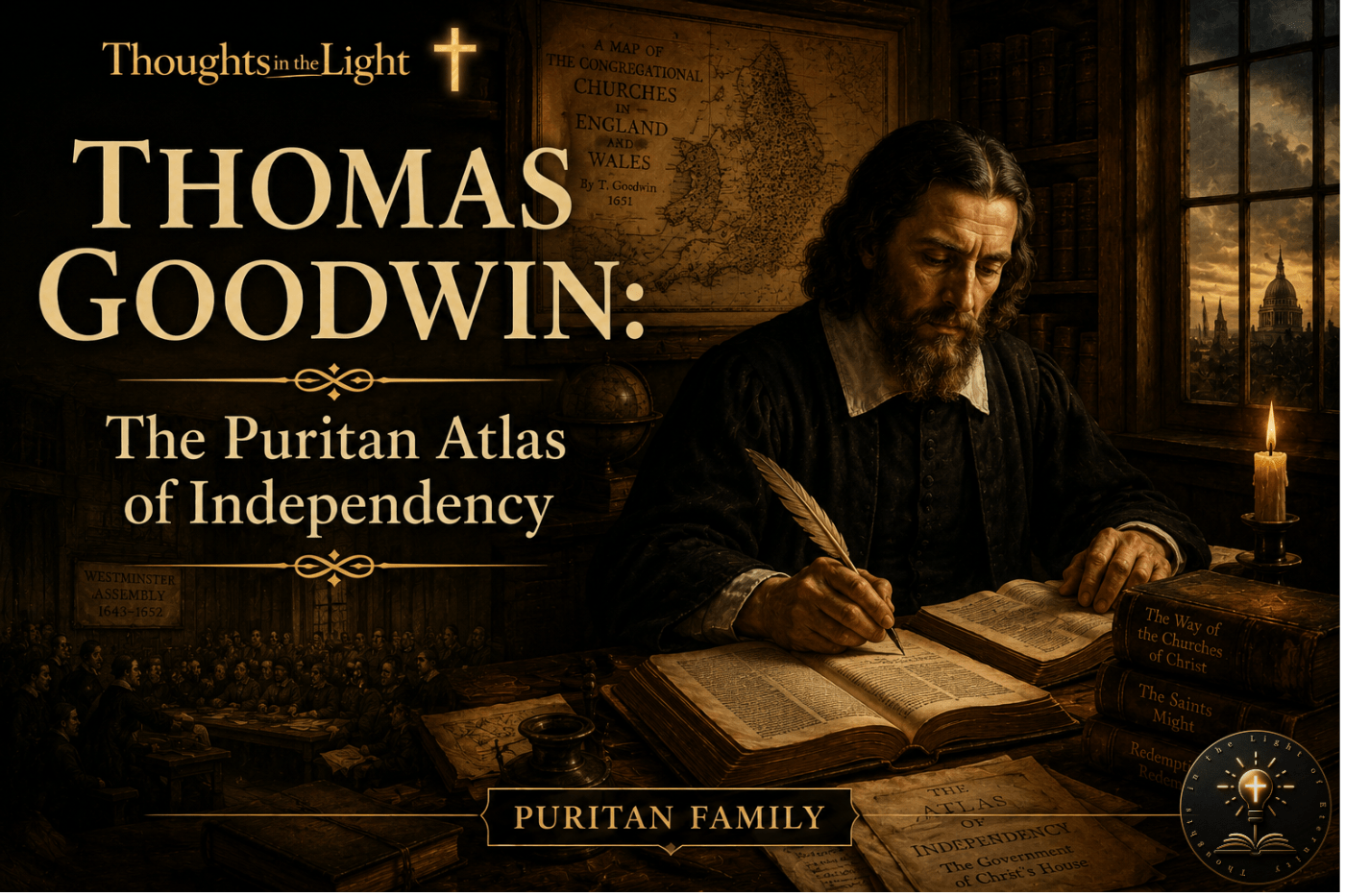
Thomas Goodwin (1600–1680), frequently referred to as the “Atlas of Independency,” stands as one of the most formidable intellectual and spiritual pillars of the Puritan era. A contemporary of John Owen, Goodwin was a scholar of international renown, a trusted advisor to Oliver Cromwell, and a pastor whose writings continue to be celebrated for their unique blend of theological depth and pastoral tenderness.
Early Life and the Struggle for Assurance
Born on October 5, 1600, in Rollesby, Norfolk, Goodwin was raised by godly parents in a region deeply influenced by Puritanism. His intellectual precociousness was evident early; he entered Christ’s College, Cambridge, in 1613 at the age of only twelve. Despite his early academic success, his youth was marked by a poignant struggle with his stature and spiritual standing. A famous anecdote recounts how, as a young student, he was once turned away from the Lord’s Table because a tutor deemed him “too little to partake” of communion.
In his early university years, Goodwin was more interested in becoming a “celebrity preacher” and a “great wit” of the pulpit than in genuine piety. However, in 1620, after hearing a funeral sermon on Luke 19:41-42, he experienced a profound awakening. This sparked a seven-year period of intense spiritual struggle. During this time, Goodwin focused inward, searching for signs of “habitual grace” within himself to prove his salvation. He finally found peace when a godly minister, Mr. Price, urged him to look away from himself and live by faith in Christ alone. Goodwin later remarked, “I tell you Christ is worth all”. This personal journey profoundly shaped his later ministry, leading him to emphasize the free grace of God over legalistic introspection.
The Cambridge Ministry and Resignation
Goodwin’s formal ministry began at Cambridge, where he became a Fellow and lecturer at St. Catherine’s Hall. In 1628, he succeeded his mentors, Richard Sibbes and John Preston, as the lecturer at Holy Trinity Church, eventually becoming its vicar in 1632. However, the ecclesiastical climate was shifting under Archbishop William Laud, who began enforcing “high church” innovations that troubled Goodwin’s conscience.
In 1634, unable to conform to these ceremonies, Goodwin resigned his prestigious positions and became a Separatist. He spent the following years as an Independent minister in London before fleeing to the Netherlands in 1639 to escape persecution. In Holland, he pastored an English-speaking congregation in Arnhem and further refined his views on Congregational church polity.
The Westminster Assembly and Oxford
Goodwin returned to England in 1641 following the convening of the Long Parliament. In 1643, he was appointed to the Westminster Assembly of Divines, where he became the primary spokesman for the “Five Dissenting Brethren”. This small group resisted the Presbyterian majority, advocating for the Independent form of church government. His influence was so significant that he was tasked with writing many of their foundational documents, including An Apologeticall Narration.
With the rise of Oliver Cromwell, Goodwin’s prominence grew. In 1650, he was appointed President of Magdalen College, Oxford. There, he was known for his “sartorial whimsies,” including a fondness for wearing multiple nightcaps, which earned him the nickname “Dr. Nine Caps”. More importantly, he was a dedicated mentor to students, often inviting them to his home to discuss their conversion stories and spiritual health. During his tenure at Oxford, he worked closely with John Owen to draft the Savoy Declaration (1658), which adapted the Westminster Confession to fit Congregationalist church government.
Later Years and the Great Fire
Following the restoration of the monarchy in 1660, Goodwin was removed from his position at Oxford. He returned to London to pastor an Independent congregation at Fetter Lane. His later years were marked by both productivity and trial. In 1666, the Great Fire of London destroyed more than half of his massive library. Interestingly, while the fire spared his home, it consumed the books he had specifically moved to a “safe” location for protection. This loss prompted him to write a treatise on patience under sudden trials based on the book of James.
Goodwin died on February 23, 1680, at the age of eighty, after contracting a fever. His final words reflected his lifelong communion with God: “I am swallowed up in God… Now, I shall be ever with the Lord”. He was buried in Bunhill Fields.
Key Works and Theological Contributions
Goodwin was a prolific author whose complete works fill twelve volumes. His writings are noted for being “massively detailed” yet filled with “warmth, unction, and experience”. His theological focus often centered on three themes: the seriousness of sin, the wrath of God, and the gracious remedy in Christ.
His most influential works include:
- The Heart of Christ in Heaven towards Sinners on Earth (1645): His most famous work, which explores Christ’s ongoing compassion and sympathy for believers from his position in glory.
- Christ the Mediator (Vol. 5): A massive treatise relishing in Christ’s fitness and willingness to serve as the only hope for humanity.
- Christ Set Forth: An exposition on the glories of Christ’s person and work.
- A Child of Light Walking in Darkness: A pastoral guide for Christians experiencing spiritual desertion or the loss of assurance.
- The Vanity of Thoughts: A practical sermon on the interior life of the believer.
- The Object and Acts of Justifying Faith (Vol. 8): A deep dive into the nature of personal faith.
Legacy
Thomas Goodwin’s legacy is that of a “true Christian pastor” who refused to separate the head from the heart. He was a master exegete—Alexander Whyte called him the “greatest pulpit exegete of Paul”—who used his immense learning not to patronize, but to comfort and humble his readers. Even today, his works are cherished for their ability to bring the reader “very low” in humility while lifting them “very high” in the contemplation of God’s free grace.


Leave a Reply