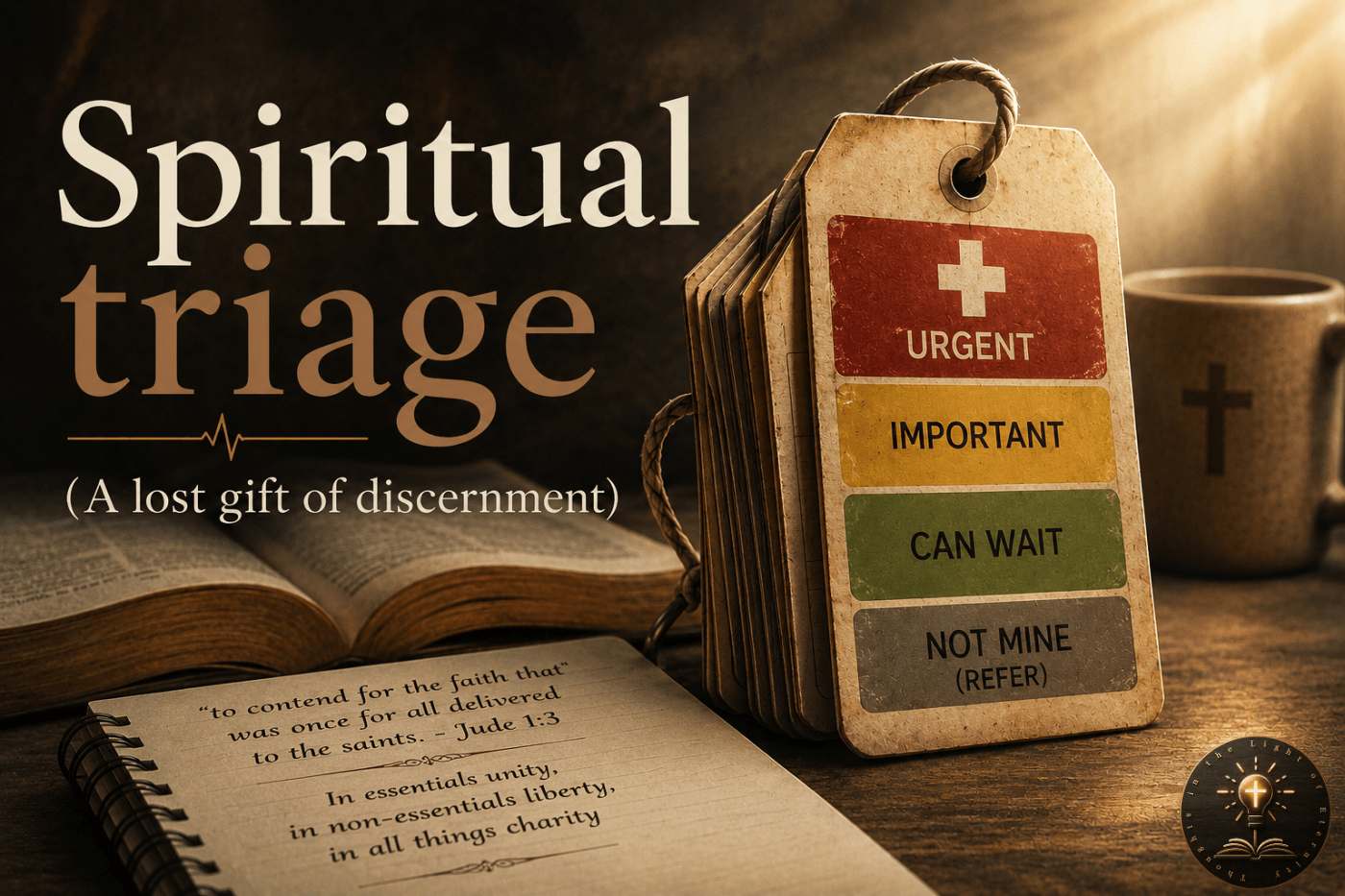
When we think of what the core of our faith is in comparison to other doctrines, we must exercise discernment along with wisdom. It takes a level of understanding to divide that which is necessary to believe in order to be saved or considered an orthodox1 Christian. To do this effectively, we must learn to apply the practice of triage to spiritual matters.
Now, for those who are unfamiliar with the term triage, it is a medical term. Doctors and nurses are trained to use triage during times of great need, such as war, when many people are admitted into their care at once. They have a duty to respond first to those in the most critical condition. They accomplish this by evaluating all patients through a triage method of assessment. Medical personnel quickly examine each person and use discernment to determine whether immediate care is necessary or whether treatment can be delayed. This allows them to save more lives than if they treated every patient equally and strictly in the order they arrived. Surely the man with a broken arm does not need treatment before the man who has suffered multiple mortal gunshot wounds. You can see how this serves as a crucial tool for applying the Word of God in a practical way, helping us discern between issues in a God-honoring manner.
“Though every truth of God is precious, yet all truths are not of equal necessity unto the salvation of them that do believe.” – John Owen
Primary
“Woe to you, scribes and Pharisees, hypocrites! For you tithe mint and dill and cumin, and have neglected the weightier matters of the law: justice and mercy and faithfulness. These you ought to have done, without neglecting the others.’ – Matthew 23:23
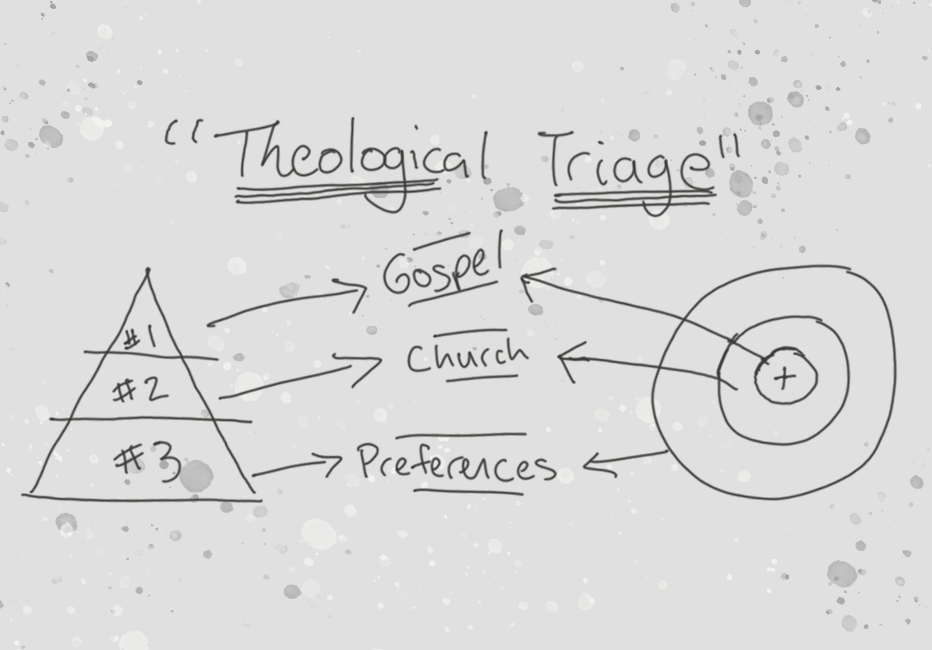
When we approach discerning what primary doctrines are, we must think in three categories. First, the Nature of God. Second, the Gospel. Third, Salvation. Starting with the Nature of God, it is important to believe the very things that God has revealed about Himself, not adding nor subtracting. Such as there is but one God and that He was not created. That all things are upheld by Him and all things created through and by Him. That while He is but one in essence of divinity, God is also three distinct persons. We worship one God in Trinity and the Trinity in unity, neither blending their persons nor dividing their essence. This is important and primary because it is strongly revealed who the true God is. This separates our faith from that of Muslims, Jews, Mormons, and Jehovah’s Witnesses. The early Church wrestled hard against many heresies that sought to harm, separate, or confuse the Trinity. These heresies are as such but not limited to: Gnosticism, Adoptionism, Modalism, Arianism, Macedonianism, and Tritheism. Basically, all these could be summed up into two categories: one God, but not three persons, or three persons, but one or more are not fully God. Our biblical truths and core doctrines were all defended by the early Church through the application of the early creeds, such as the Athanasian Creed, Nicene Creed, and Chalcedonian Creed.
Next, we go on to say that which makes up the Gospel is necessary and primary doctrine for Christianity. If I were to ask you what makes up the Gospel, you might start with the virgin birth or perhaps you would start with creation because Christ was present there. You might jump to Christ’s death upon the Cross, or perhaps you would explain how He lived a perfect and righteous life. Then you would proceed to the fact that all of us are guilty of sin from birth. All these things are necessary in order to profess a full and complete presentation of the Gospel as a whole. We can’t deny these things since they have been revealed in Scripture. The best overall brief but full summary we have of the Gospel can be found in the Apostles’ Creed. The Creed is broken up into three sections: the first about God the Father and our creation; the second about God the Son and our redemption; and the third about God the Holy Spirit and our sanctification. See how it is also Trinitarian. Now, another important aspect of our Gospel presentation and our core doctrines is how we came about them. How did we receive such truths? This leads us to the importance of viewing the Scriptures as the authoritative and inspired word of God. Apart from holding the Bible as the full word of God, all of our other beliefs will crumble. Scripture must be 100% inspired, and we must hold to a view of Biblical inerrancy. If we don’t, then we can no longer have full faith in all that has been revealed throughout the Word.
“There are certain truths that are the foundation, and there are other truths which are superstructures upon the foundation.” – Richard Sibbes
The last category that I and many others would argue is of crucial importance is that of Salvation. It is important to hold a true biblical view of redemption and how it is applied to us. It is important to distinguish between that which leads to justification (faith) and that which is a part of sanctification (works). This is one of the main reasons behind the Reformation, the Protestant split from Roman Catholics. Being united to Christ can only come through faith alone. So, our salvation is fully dependent upon the works of Christ, namely the atonement on the Cross. This leads to a greater and more crucial understanding of what took place on the Cross. It is important that we take the Bible at its word when it states Christ fully and completely paid the debt for our sins2. That Christ took upon himself the entire wrath of God that was poured out on Him3. We have been set free from being slaves to sin, and death has been defeated. Some would argue, as I myself would also, that a Penal Substitution Atonement view is primary in regard to salvation. It is crucial to see Him through the lens of being our federal representative. Not only is the atonement special, but so is His resurrection and ascension. Apart from Him rising on the third day, we would just be believing in another dead man. Not to mention, if He never ascended, we would have no one interceding for us before the Father. We would also have never been gifted the Holy Spirit had He not ascended into Heaven. It is through all of this that we are imputed Christ’s righteousness and have full union with Him through faith.
As you can now see, these have been laid out before you as core primary beliefs among the orthodox Church. Believing in these doctrines defines whether or not you are a Christian. In the past, liberalism has crept in and moved many of these core doctrines to a lower degree of importance. This leads to nothing more than a compromise of the truth, and we must know where these issues lie and leave them there. We cannot add to nor take away from the core doctrines within the Word of God. Now, there are many who might not understand these things or have been taught their importance. That doesn’t mean they are not Christians; however, if they actively deny any of the things above, then perhaps they do not belong to the same faith.

Secondary
‘Do not be conformed to this world, but be transformed by the renewal of your mind, that by testing you may discern what is the will of God, what is good and acceptable and perfect.’ – Romans 12:2
Now, the secondary category is usually made up of elements that separate denominations, traditions, and local churches, such as, but not limited to, Baptism, Ecclesiology4, View of the Lord’s Supper, Eschatology5, Gifts of the Spirit, the doctrine of hell, views of the Sabbath, and worship practices. Although these aspects might divide us in the local physical practice of faith, we still remain united on primary issues and, therefore, should still be considered Christians, even though we are divided.
“There are some truths that are of absolute necessity, and there are other truths which, though excellent and useful, are not of equal concernment.” – Jeremiah Burroughs
Secondary issues can sometimes be falsely treated as primary beliefs, which can cause many to stumble and judge one another harshly. To help us avoid this, we try to define that which is primary as things required to believe in order to be saved and considered a Christian. Outside of that, it is a healthy thing to a degree that we have some division, as it allows for more local peace, unity, and understanding. Imagine if Protestants and Roman Catholics had to attend the same church; it would end up looking like an intercity school recess, with multiple fights needing to be broken up every week. No one would be able to agree on things and this would only become a distracting stumbling block within the faith. Nonetheless, we are instructed in Jude6 to contend for the faith, meaning we must distinguish what is of importance. This is where we profess the statement, “In essentials unity, in non-essentials liberty, in all things charity.”
Tertiary
“Have nothing to do with foolish, ignorant controversies; you know that they breed quarrels.” – 2 Tim 2:23
With many of the bigger doctrines covered by primary and secondary beliefs, we can now move on to tertiary beliefs. These lean more towards opinions and preferences rather than clearly taught principles within Scripture. Tertiary examples include, but are not limited to, creational views, the age of the earth, dinosaurs, infralapsarianism and supralapsarianism, tithing views, head coverings, Nephilim, holidays, and so on. These are not issues to divide over; they are merely speculations on beliefs and practices, highlighting the differences between that which is correct and what is perhaps almost correct. Such issues, if not handled properly and with care, will ultimately breed unnecessary quarrels among the local body of Christ. It is completely acceptable to study and believe in such things, but we must not elevate them to an unhealthy state of weightiness among Christians. We cannot burden others’ consciences with matters that Scripture does not place importance on or provide clarity about. Leave such things to be personal convictions that you uphold and believe to be true, while also acknowledging that there isn’t certainty within some of these beliefs. It is enjoyable to stumble upon like-minded people who can have healthy conversations and discussions regarding tertiary issues.
“Not all questions in divinity are of the same weight; wisdom consists in discerning what most concerns faith and godliness.” – William Ames

Conclusion
This spiritual triage is a lost art of discernment within the modern Church. So often, we sway left or right based on our feelings rather than the biblical truth of importance that God has laid out for us. We have lost the practice of weighing everything against the Word of God, and instead, we follow our own corrupt opinions. On the other hand, there are those who stir up division and foolish controversy over matters of little importance. We must balance the proper amount of discernment and charity. Contend for the faith in a God-glorifying way, not for the sake of your ego or the desire to be correct in every matter. We have unity in the primary doctrines that define what it is to be a Christian. We have liberty in secondary matters that we hold true in our local churches. All things in Scripture are important and should be treated with care, but not everything is equally important.
Spiritual discernment is not merely knowing doctrines but understanding the relative weight of doctrines—holding fast to the foundation, carefully teaching the important things, and exercising humility along with grace in lesser matters7. May God bless you with knowledge that leads to healthy discernment among theological matters and grant you humility to be charitable to others in lesser issues.
“Satan labors to keep men busy about lesser things, that weightier matters may be neglected.” – Thomas Brooks

- meaning those who hold to established, traditional, or “correct” doctrines with Christianity. It broadly describes adherence to accepted norms and classically approved creeds. ↩︎
- Matt. 20:28 ↩︎
- Isaiah 53, Luke 22:37 ↩︎
- Study of Church Government ↩︎
- Study of End times ↩︎
- Jude 1:3 ↩︎
- Matthew 23:23 ↩︎
https://holyjoys.org/theological-triage/
https://albertmohler.com/2005/07/12/a-call-for-theological-triage-and-christian-maturity/

Leave a Reply