It’s that time of year again when the smell of pumpkins is in the air, the excitement of candy and dressing up can’t come soon enough, and the once-nice, clean lawn becomes the neighborhood graveyard. The sounds of screams and the darkness of all that is evil fill the night. Yep, Halloween has once again come to a city near you. But how are we, as Christians, supposed to think about such a holiday and genre? That is something I would like to address today, understanding that there are many different passionate views regarding this topic among Christians. By no means am I trying to throw stones or ruffle feathers; rather, I want to challenge the modern thoughts and traditions surrounding whether or not Christians should and can biblically participate in this holiday.
Differing levels of Involvement
When discussing gray issues such as this, we must realize that there are not always clear-cut black-and-white categories. Yet it is still helpful to define where one falls so that we can discuss the matter appropriately and avoid misunderstandings. Generally, Christians tend to fall into one of three different camps when it comes to participating in Halloween: total abstinence, full participation, or partial participation.
Full participation is generally the most common view among Christians these days regarding Halloween: the holiday celebrated today is filled with nothing but wholesome fun for the entire family, and nearly everything is permissible to participate in, such as dressing up, decorating the house with horror themes, watching horror films, playing horror games, and perhaps even entertaining mild sorcery or witchcraft, as long as it does not affect them and is intended in a playful spirit. They would avoid saying that Halloween is rooted in darkness or that it could ever be sinful to participate in.
Partial participation might describe those who still embrace the holiday but hold varying degrees of skepticism. They would generally say that dressing up, handing out candy, and perhaps even enjoying most horror-related activities are permissible. Some might even view the holiday as an opportunity to redeem the day or use it as a time for evangelism while avoiding the dark side of witchcraft and evil spirits. Generally, they would appeal to Christian liberty and be led by their conscience in this gray area.
Total abstinence is generally the view that Christians cannot participate in the Halloween tradition without compromising their spiritual health. It is probably the least popular view today, but many faithful Christians throughout history have held it. Those who take this position generally appeal to Halloween’s dark pagan history and its association with darkness, arguing that the blood in the water has defiled the entire body of water.
It is important to acknowledge that Christians have held all of these positions throughout the history of the holiday. By no means are we saying that one cannot be a Christian and hold to one of these three camps. However, we will state that there are biblical commands to avoid such darkness and witchcraft, as darkness cannot be in partnership with light. Yet it falls to biblical discernment to determine where to draw the lines and to develop a well-informed conscience within Christian liberty. We must not enter blindly!
Short History of Halloween
It is important to fully understand the history surrounding the tradition of Halloween. The name “Halloween” is derived from “All Hallows’ Eve” (October 31), the day before “All Saints’ Day” (November 1)—both holidays established by the Roman Catholic Church to remember the martyrs who came before. All Saints’ Day was originally celebrated in Rome on May 13, beginning in AD 607, but Pope Gregory III later moved it to November 1 in the eighth century.
“For centuries, the first of November was known to be the new year’s day for the Druid religion, which actively influenced many throughout Ireland and Britain in that century. October 31 was “new year’s eve” for the Druids. So the move of the new and popular Christian Festival of All Saints to that same date was intended to compete, head-to-head, with the entrenched druid new year’s celebrations (much as TV networks today move hit programs into certain time-slots to win viewers away from competitors).” – David Bissett, in the Puritan Reformed Journal.
Then how did it become known for such evil and darkness? Well, Christians are not the only ones who have claimed that date; in fact, they were not even the first to celebrate it. The first to celebrate the day were the Celtic Druids, for whom it marked the beginning of the new year. It is safe to say they did not honor the day as we do our modern New Year’s Eve. Just think about what is associated with our modern Halloween tradition: death: skeletons, corpses, and graves; the occult: witches, cauldrons, and crystal balls; supernatural evil: ghosts, demons, and the haunted; and fear and darkness: bats, spiders, and horror imagery. All of these things were first used by the Druids to honor their Samhain holiday.
The spooky stuff we associate with Halloween, such as ghosts, the dead entering our world, and communing with spirits, can be traced to Samhain (the Druid holiday), which centuries of Christian tradition never completely managed to stamp out. – Eamonn Kelly, former Keeper of Irish Antiquities at the National Museum of Ireland
We see this holiday as the night when the mundane folk try to reach down inside and touch the “darkness” which for Satanists is a daily mode of existence. Particularly in the United States, Halloween is a time for celebrating monster films, wearing costumes of a macabre nature, and evoking the thrill of “fun fear.” Children (of all ages) can indulge their fantasies by donning costumes that allow for intense role-playing and the release of their “demonic cores,” the parts of their personalities often hidden from their friends, co-workers and families. – Church of Satan, “Is Halloween Important to Satanists?,” accessed September 18, 2026.
Regardless of whether you think the Christian holiday or the Celtic holiday tradition seems more appropriate, only one of them is widely recognized as modern Halloween. News flash: it is not the Christian tradition. Who do you know who avoids all the darkness and celebrates only the Christian martyrs on this day? Very few people. So why must we continue to participate in and defend such a tradition of death?
“The custom of wearing costumes, especially costumes imitating evil spirits, is rooted in the Celtic pagan culture.” – Al Mohler
Christian liberty and Conscience
The cries from Christians who advocate participating in Halloween traditions usually stem from an appeal to Christian liberty or from following one’s conscience. This is a biblical practice of relying on God’s grace while honoring Him in matters that are not clearly determined by Scripture. It helps us avoid making man-made rules or burdening other people’s consciences with our own personal convictions. Exercising this liberty is a good and healthy practice; examples include casual alcohol use, tattoos, clothing styles, and entertainment. All these things can become sinful if used improperly or if they harm an individual’s conscience, but they are not inherently sinful when treated with respect.
Of Christian Liberty and Liberty of Conscience – The Westminster Confession Of Faith
2. God alone is Lord of the conscience, and hath left it free from the doctrines and commandments of men, which are, in anything, contrary to his Word; or beside it, if matters of faith, or worship. So that, to believe such doctrines, or to obey such commands, out of conscience, is to betray true liberty of conscience: and the requiring of an implicit faith, and an absolute and blind obedience, is to destroy liberty of conscience, and reason also.
3. They who, upon pretense of Christian liberty, do practice any sin, or cherish any lust, do thereby destroy the end of Christian liberty, which is, that being delivered out of the hands of our enemies, we might serve the Lord without fear, in holiness and righteousness before him, all the days of our life.
I respect everything said so far, but my issue stems from the thought that this so-called “gray area” of Halloween is actually darker than most people see it. I think the average Halloween enjoyer would have to jump through many hoops to make it a gray-area issue. Given the holiday’s dark origins and the practices that are still widely associated with it, I find it more harmful than harmless today. That said, many people can enjoy this tradition without ever being fully exposed to its true evil and dark origins. I am still extending grace to those who do not see this the same way, and I acknowledge that I could be wrong (though I do not believe I am). I also recognize that there are varying degrees of participation, as I mentioned above, and that not all forms of participation should be treated the same. This article advocates complete abstinence but is understanding of those who engage in limited partial participation in a God-glorifying manner, such as giving out candy and allowing children to wear costumes in a pure way. At the same time, on some specific issues, it is possible for one Christian to abstain from something out of conviction while another Christian participates with a clear conscience1. We should make room for both, neither slandering nor unnecessarily judging others for their beliefs.
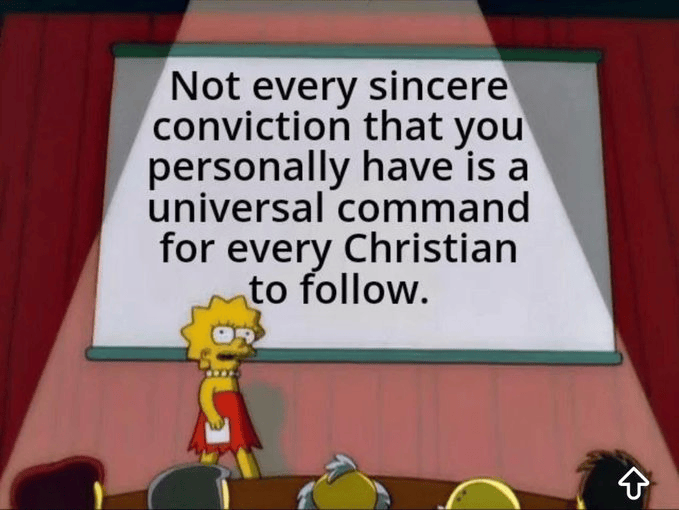
Even though we have liberty in Christ, as we do in many areas, we still need to be watchful about what we consume. Ultimately, whatever kind of film or entertainment we enjoy, we have freedom within moral boundaries; yet our strongest pursuit should be that which edifies and strengthens us in Christ2. Here are some questions to help us understand what the Bible invites Christians to think about and meditate on regarding Christian liberty:
Am I violating my conscience? (Rom 14:23)
Is it wise? (Eph 5:15–17)
Is this helpful? (1 Cor 10:23)
Is it beneficial to others and myself? (1 Cor 6:12)
Can I do this for the glory of God? (1 Cor 10:31)
What thoughts and desires is this cultivating in my life? (Phil 4:8)
Is this becoming something that controls me? (1 Cor 6:12)
Am I celebrating evil and or recognizing it as evil? (Eph 5:11)
Can I engage with this in a way that honors God? (Col 3:17)
There are many things that are permissible for Christians, but not all of them are beneficial to the soul. Often, the better question is not, “Can I?” but, “Should I?” We should allow the Word of God and the Holy Spirit to guide us in our day-to-day lives—not our own opinions, emotions, or desires.
A biblical Case for discernment when it comes to Halloween
“7 Therefore do not become partners with them; 8 for at one time you were darkness, but now you are light in the Lord. Walk as children of light 9 (for the fruit of light is found in all that is good and right and true), 10 and try to discern what is pleasing to the Lord. 11 Take no part in the unfruitful works of darkness, but instead expose them.” – Eph 5:8
In regards to Halloween, let us think about what the Bible says about Condemnation of Witchcraft and the Occult
- Deuteronomy 18:10–12: Prohibits sorcery, mediumship, and calling up spirits, warning that these practices are detestable to God.
- Leviticus 19:26: Forbids engaging in divination or sorcery.
Now, one could argue that, with regard to the holiday, the following activities should be condemned: dressing up as witches, warlocks, or demonic figures; celebrating symbols of the occult; engaging in horror entertainment that praises these things; or decorating our houses with such décor for the day. These activities conflict with the explicit warnings against spiritual darkness.
Next, we will turn our attention to the idea of being a holy people, set apart from the darkness and pagan customs associated with Halloween.
- Ephesians 5:7–11: Instructs believers to have no fellowship with the unfruitful works of darkness, instead exposing them.
- 2 Corinthians 6:14: Asks what fellowship light has with darkness, urging believers not to be unequally yoked with unbelief or ungodly patterns.
- Romans 13:12: Commands Christians to “cast off the works of darkness and put on the armor of light”.
- 1 Corinthians 10:20–21: Warns against partaking with demons or mixing worship and ungodly elements.
The argument here is that, due to Halloween’s historical emphasis on fear, death, and supernatural evil, participation is viewed as compromising a Christian’s call to reflect light and holiness. Christians, generally speaking, look no different from the rest of the culture when they participate in this holiday. This is also where some try to redeem the holiday by turning it into an opportunity for evangelism or by presenting themselves as a different kind of Halloween enjoyer.
Ultimately, in all things, we must ask ourselves: Does this honor God? Are we putting God first, and are we seeking God through this celebration?
- 1 Corinthians 10:31: States that “whatever you do, do all to the glory of God”.
- Philippians 4:8: Implies that we should be meditating on “pure” things.
Critics ask whether celebrating a holiday centered on gore, fear, or ghosts genuinely honors Christ or represents a redeemed life. To what degree can we engage with this holiday’s traditions, or should we participate at all?
Conclusion
but test everything; hold fast what is good. Abstain from every form of evil. 1 Thess 5:21-22
Do we treat Halloween as though we are different from the rest of the world? I personally believe we do not, which is why I have written this article. I would like to see us wrestle more seriously with such questions without unnecessarily burdening others in the faith. There is freedom and liberty for the Christian, but to what degree does that apply to this conversation? Have we searched the Word of God and applied it to how we engage with culture and entertainment? If we have not, we should do so before going any further. If we have, may God continue to guide and lead us as He sees fit.
Do not be conformed to this world, but be transformed by the renewal of your mind, that by testing you may discern what is the will of God, what is good and acceptable and perfect. – Romans 12:2
How we use our freedom matters! Even if it isn’t a matter of sin or a gray area, it still matters that we do all things for the glory of God. What does that look like when it comes to sports, hobbies, entertainment, and even holiday participation? Let us think about these things and pursue God in every area of life.
Finally, brethren, whatever things are true, whatever things are noble, whatever things are just, whatever things are pure, whatever things are lovely, whatever things are of good report, if there is any virtue and if there is anything praiseworthy—meditate on these things. (Phil. 4:8)


Leave a Reply