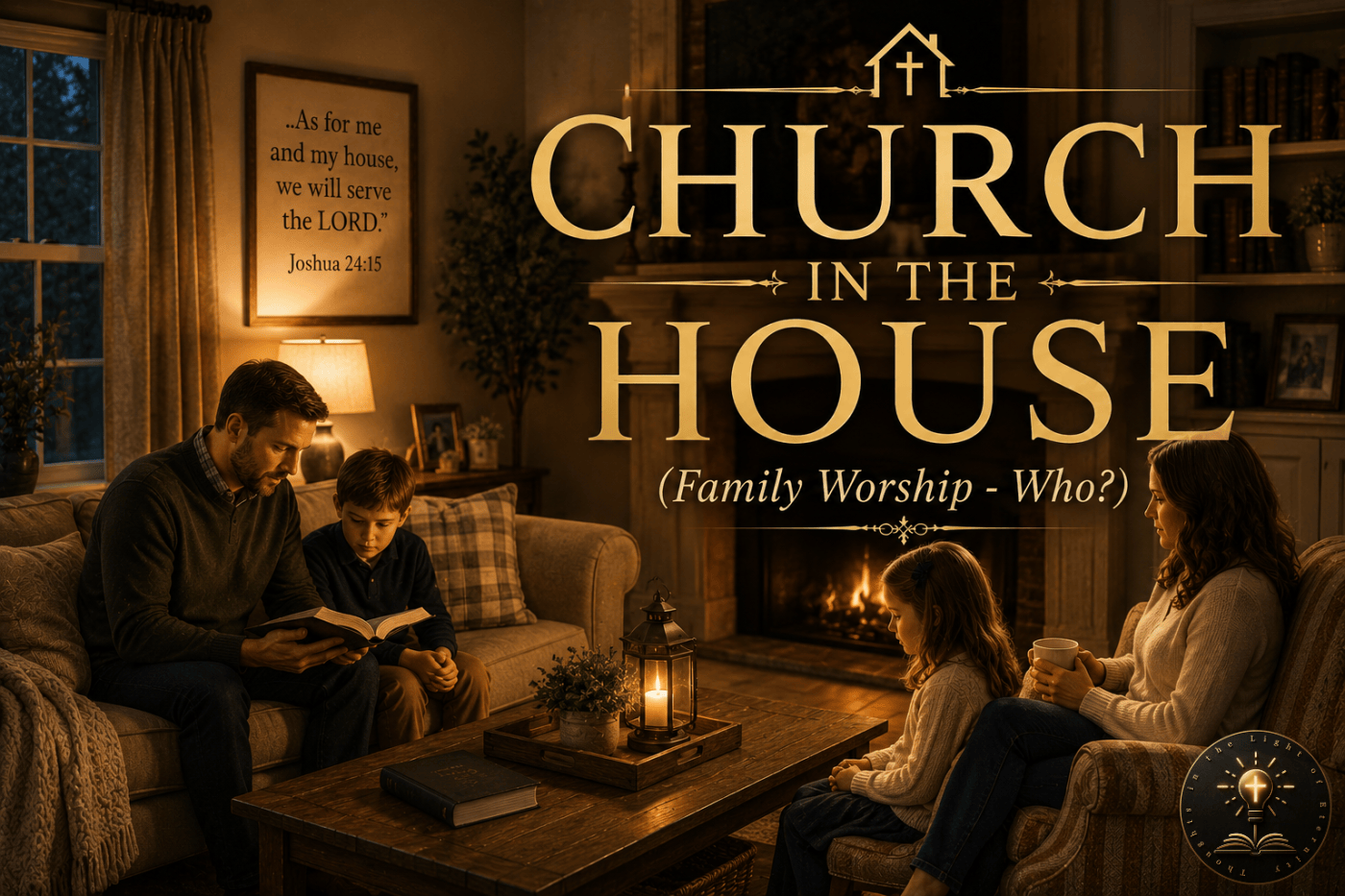
Once we have come to understand the duties and the need for family worship, we must next endeavor to answer the question of who it involves: who leads it and who partakes in it. What is asked of those who sit under it, and what is the role of the head in the giving and instructing of worship? Like all good things, we have structure and order based on the decreed design from God. We see the purpose of the church as very similar to that of the family in the sense of roles and responsibilities. In both, there are shepherds and flocks that those shepherds lead and care for. Let us dive into the “who” within Family Worship.
“A family is a little church, and the master of the family is as a priest in his own house.” – Thomas Watson
The Federal Head of The Home
“But if anyone does not provide for his relatives, and especially for members of his household, he has denied the faith and is worse than an unbeliever.” 1 Timothy 5:8
After understanding God’s design of marriage and the role to which He calls man, namely that the husband is the head of the family, we must then address the duties of the head. In this case, he operates as a prophet, priest, king, and provider. These are the main roles and duties that we see Christ modeling in how He cares for and leads His bride within the marriage of Christ and the body of Christ (the Church). Now, each of us, whether male or female, young or old, in some capacity should be exhibiting and exercising these duties according to the calling we have received from God. While the father of the family might have more responsibility regarding these roles, still each and every Christian is expected to model these based on being more like Christ in our daily duties. We will speak to each of these main three roles below and how they apply to the head of the family in the context of family worship.
Now, the most common expectation of a man, both culturally and biblically speaking, is that of being a provider. However, when this is brought up, it is mainly in the aspect of money and the lifestyle maintained by the husband and father. This is what, in the eyes of man, is considered most important. Yet, we never see God placing such importance merely on outward things; rather, we tend to see God caring more for the eternal care of our souls. Why would God prioritize our earthly comfort over the eternal comfort of belonging to Christ? Now, don’t get me wrong; God does care for His people in the sense of providing for their daily need of physical bread as well. But how could that compare to our vast need for God and the state of our depravity in the presence of a Holy God? We tend to jump to applying this to material and physical needs primarily, forgetting altogether the more important need of providing spiritually for ourselves and our families.
We have been tasked with the stewardship of that which we have been given, namely our families. We must seek to improve all that is under our care. How could we not apply this type of thinking and logic to the souls of those within our families? We have a high responsibility to raise up the next generation in the fear and admonition of the Lord (Eph 6:4). We must seek to be our families’ provider in all things spiritually. Thankfully, we are not alone in this task of caring for our family spiritually; God has seen fit to make a helper suitable for man in this role. When we are not around, our wives are tasked with acting as governors in the instruction and discipline of the children. They care for us dearly by praying for us and for our roles within the family. They may build upon the foundation of instruction throughout the day while we are away and provide careful assistance with us in the context of family worship each day. This can greatly ease the burden of the task of family worship and create a greater example of a healthy marriage model.
The 3 Offices
On to the three roles of Prophet, Priest, and King: the very examples Christ leaves us in his earthly ministry and the calling of men and women in Christ as Christians. Similar to that of the church, a father (or head of the household) is considered a “domestic minister,” who holds three distinct offices within the home: Prophet, Priest, and King. His duty is to instruct, devote, and govern the entire household in all things spiritually. The examples below will especially be addressed in the context of the role of the head of the house within family worship, though these three roles also generally apply to all Christians.
“In the familie a parent is all in all ouer his childe: a King, a Priest, and a Prophet.” “Therefore that which a Minister is to doe for matter of instruction in the Church, a parent must do at home.” – William Gouge, Of Domesticall Duties.
1. Prophet (Instruction)
In this capacity of prophet, we as the fathers are responsible for family doctrine and impressing it upon those under our care. Such duties include instructing the household in the knowledge of God’s Word and the will of God concerning our redemption and sanctification, which comes by the way of reading the Scriptures plainly to our children and guests so they may grow in divine truth and acknowledge the supreme Creator of all things. Also, the lost art of catechizing the children must be revived, so they may be grounded in the principles of Christianity, allowing such teachings to be hidden in their hearts and becoming a sure foundation for them to build upon in seasons to come. Not a day should go by that the things of God aren’t spoken of in our houses according to Deuteronomy 6.
“The governor of the family is to take care that God be worshipped in his family, and that his children and servants be instructed in the knowledge and fear of God.” – John Owen
2. Priest (Devotion)
In our priestly duties, the father acts as the family’s mouth to God. Such responsibilities include leading family prayer, offering up “spiritual sacrifices” of supplication and thanksgiving in the name of all under his roof. Think about the role Job played in his children’s lives as he offered up daily prayers for them, especially in times of hardship and sin. Interceding for his household, specifically pleading for the salvation and spiritual welfare of his wife, children, and guests, should be at the top of our priorities as priests of the living God. We should deeply care about the salvation of each and every person who is under our roof. Leading the family in praise, such as the singing of psalms or hymns, might be one of the toughest tasks for those who are not gifted in the area of singing; nevertheless, it is required of us and can be a great blessing to the family. Not to mention, all of these things also serve to better prepare our children for church services, especially that of worshiping in song.
“The master of the family is to be as a priest in his own house, to offer up the sacrifices of prayer and praise.” Thomas Manton
3. King (Govern)
In his kingly office, the Head is responsible for family discipline and provision. This role has been tasked with governing and directing the household in the fear of the Lord, ensuring that all members serve God and that the things of God are respected and highly valued among the family as a whole. Providing for both the temporal and spiritual needs of his domestics—ensuring they have sufficient food, clothing, and means of grace—is of utmost importance, with the latter being most critical. Maintaining order and discipline involves countenancing what is good and correcting what is evil or rebellious within the family. Like civil government, we as fathers must promote good and lead those in that direction, all while correcting that which goes against God’s word and instructions.
“a master of a family may authoritatively command the members of the family to pray, keep the Sabbath, etc., and may suitably correct for the neglect of those duties.” – James Durham
Heidelberg Catechism – Lord’s Day 12
31. Why is He called “Christ,” that is, “Anointed?”
Because He has been ordained by God the Father, and anointed with the Holy Spirit,1 to be our chief Prophet and Teacher,2 who has fully revealed to us the secret counsel and will of God concerning our redemption;3 our only High Priest,4 who by the one sacrifice of His body has redeemed us,5 and who ever lives to make intercession for us with the Father;6 and our eternal King,7 who governs us by His Word and Spirit, and defends and preserves us in the redemption obtained for us.
32. Why are you called a Christian?
Because by faith I am a member of Christ,1 and thus a partaker of His anointing;2 so that I also may confess His name;3 present myself a living sacrifice of thankfulness to Him;4 and with a free conscience fight against sin and the devil in this life,5 and hereafter, in eternity, reign with Him over all creatures.
Lambs of The Flock
Now, this family worship is meant for the entire household and all those under its roof. All Household Members are required to hold fast to the worship of God within the home regularly, including the wife, children, and any guests and visitors. Sojourners or visitors present in the home during this time are invited to join the family at the domestic altar. If the father is absent, deceased, or unfit, the duty devolves upon the mother or another capable family member approved by the church. Children are not merely an audience; they are disciples within the household—learning Scripture, answering questions, receiving catechesis, praying, singing, and growing in godliness. To reject any of this is seen as dishonor and rebellious behavior towards both the head of the house and God. This is to be the highest honor of the day and is to be treated as a necessity. Homework, sports, and friends can all take a backseat to the act of worshiping God. This takes commitment and requires saying no to other things that aren’t a priority compared to serving God in our homes. We must also keep in mind the best time to do our family worship, ensuring it is during a less busy time of day when all are present. In all of this, we must remember that it is the duty of the head to lead and the duty of all others to faithfully follow.
“The head of the family is to take care that none of the family withdraw himself from any part of family-worship.” – 1647 Directory for Family Worship
“All the whole family must join with the master of it, as wife, children, servants, sojourners; none should ordinarily be absent.” – Thomas Cobbet
Conclusion
“The authority, with which God has invested you as parents and governors of families, is a talent committed to your trust, and which you are bound to improve to your Master’s honor.” – George Whitefield, “The Great Duty of Family Religion”
As men, we must be willing to set the tone in our household with the example of Christ, first and foremost. This means leading in the area of prophet, giving instruction and teaching the will of God revealed throughout Scripture. Being a priest, offering daily praise and prayer to the Lord on behalf of our family, and leading them by example to do the same. Lastly, governing them as king, providing for them physically and spiritually while also raising them in God-honoring behavior and exercising correction (discipline) when needed to steer them away from evil.
All of these duties fall upon the head of the house to exercise. To state it plainly: “As for me and my house, we will serve the LORD” (Josh. 24:15) is a sentence only a father can utter. Deuteronomy 6 suggests that a father possesses singular authority to catechize his children in matters of religion, a power never explicitly delegated to the state, educational system, or the Church in the same capacity. May we honor God with our families and devote them wholly to His care.
“I have no greater joy than to hear that my children are walking in the truth.” – 3 John 1:4
This is Part 2 of a multi mini series on Family Worship more soon to come!


Leave a comment