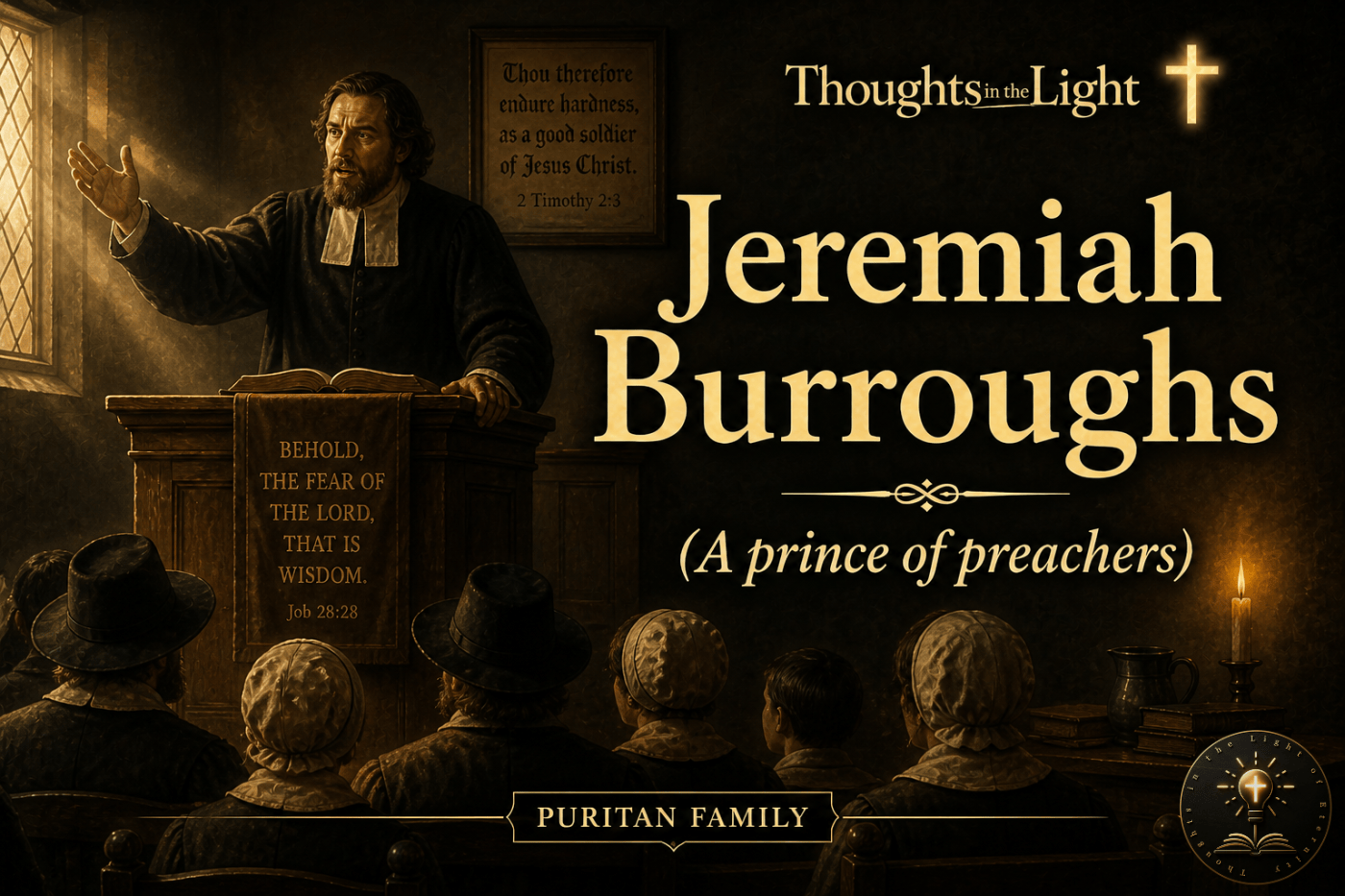
Jeremiah Burroughs (1599–1646) was one of the most distinguished and well-loved Puritan preachers of the seventeenth century. Burroughs was celebrated by his contemporaries for his profound theological insight, his superb gift for illustration, and, perhaps most uniquely, his conciliatory and peaceable spirit during a time of intense religious and political upheaval.
Early Life and Education
Jeremiah Burroughs was born around 1599 and was baptized in 1601. In 1617, he was admitted as a pensioner to Emmanuel College, Cambridge, which at the time was the primary training ground for Puritan ministers. During his time at Cambridge, he studied under the tutelage of Thomas Hooker, who would later become a founding father of New England. Burroughs graduated with a Bachelor of Arts in 1621 and a Master of Arts in 1624. However, his time at the university ended abruptly when he was forced to leave due to his non-conformist views, a prelude to the ecclesiastical conflicts that would define much of his professional life.
Ministry and Persecution in East Anglia
Burroughs’ early ministry was spent in East Anglia, a region where Puritan principles were particularly strong. From approximately 1627 to 1631, he served as an assistant to Edmund Calamy at Bury St. Edmunds in Suffolk. Both Burroughs and Calamy would later become members of the Westminster Assembly, and both were staunchly opposed to King James’s Book of Sports, refusing to read the royal proclamation that allowed for dancing and other recreations on the Lord’s Day.
In 1631, Burroughs was appointed rector of Tivetshall, Norfolk. Despite the support of his patron, his position was soon threatened by the rise of the Laudian regime. Bishop Matthew Wren of Norwich, a rigorous enforcer of conformity, suspended Burroughs in 1636 and deprived him of his living in 1637. The charges against him included his refusal to read the Book of Sports, his refusal to bow at the name of Jesus, and his insistence on speaking prayers extemporaneously rather than reading them from the Prayer Book.
Exile in the Netherlands
Like many other “godly ministers” under pressure from the bishops, Burroughs sought refuge on the Continent. From 1638 to 1640, he lived in the Netherlands, where he served as a “teacher” for a congregation of English Independents in Rotterdam. In the Independent tradition, the offices of “pastor” and “teacher” were viewed as distinct but complementary; while William Bridge served as the pastor, Burroughs fulfilled the role of teacher. This period of exile brought Burroughs together with other future “dissenting brethren,” including Bridge and Sidrach Simpson, solidifying his commitment to Congregationalism.
Return to London and the Westminster Assembly
With the ascendancy of the Long Parliament and the easing of Laudian restrictions, Burroughs was invited to return to England in 1641. He quickly became a popular and influential figure in London, serving as the pastor of two of the city’s largest congregations: Stepney and St. Giles, Cripplegate. His 7:00 a.m. sermons at Stepney were so well-attended that he became known as the “Morning Star of Stepney,” while his colleague William Greenhill was dubbed the “Evening Star”. Burroughs’s reputation was such that he was invited to preach before the House of Commons and the House of Lords on several occasions, with Thomas Brooks describing him as a “prince of preachers“.
As a member of the Westminster Assembly, Burroughs was one of the small but vocal minority of Independents. He was one of the “Five Dissenting Brethren” who presented the Apologeticall Narration to Parliament in 1644. This document defended Independency as a middle course between the “authoritarianism” of Presbyterianism and the “democracy” of Brownism. Despite these denominational differences, Burroughs remained exceptionally moderate in tone. His study door famously bore the motto: Opinionum varietas et opinantium unitas non sunt ασυστατα (“Variety of opinion and unity of opinion are not incompatible”). Richard Baxter, a contemporary Presbyterian, highly esteemed Burroughs, famously stating that if all Independents had been like him, the “breaches of the church would soon have been healed”.
Premature Death
Burroughs’s life and ministry were cut short at the age of forty-seven. In November 1646, he suffered a fall from his horse while returning from the Westminster Assembly and died from complications two weeks later. Many of his friends believed that his heart was broken by the growing divisions among the Puritan reformers, which contributed to his early death.
The Works of Jeremiah Burroughs
Though Burroughs was a prolific writer, nearly all of his books are compilations of his sermons published posthumously. His works are characterized by a deep grasp of doctrine, a comprehensive knowledge of Scripture, and an uncanny ability to apply the Word to the “recesses of the human heart”.
1. The Rare Jewel of Christian Contentment His most famous work, this classic explores the “mystery” of spiritual contentment. Burroughs defines contentment not as a change in outward circumstances, but as an inward, quiet, gracious frame of spirit that delights in God’s disposal. He argues that a Christian finds contentment not by adding to their possessions, but by subtracting from their desires to match their current condition.
2. Irenicum to the Lovers of Truth and Peace This volume contains his final sermons, pleading for unity among believers. In it, he argues that “every difference in religion is not a differing religion” and explores how pride, envy, and rigidity lead to “heart-divisions”. He advocates for a biblical striving for peace rather than a blanket tolerance of sin.
3. An Exposition of the Prophecy of Hosea Spurgeon called this mammoth commentary “masterly” and a “vast treasure-house of experimental exposition”. Burroughs died before finishing the work, and it was completed by his friends Thomas Hall and Edward Reynolds.
4. Other Notable Publications
- The Evil of Evils: A detailed study of the “exceeding sinfulness of sin”.
- Gospel Worship: A call to biblical propriety and sobriety in the worship of the Triune God.
- A Treatise of Earthly-Mindedness: A warning against worldliness and a guide to becoming “heavenly-minded”.
- Gospel Reconciliation: An exploration of the atoning work of Christ as the only way for sinners to be right with God.
- The Excellency of a Gracious Spirit: Based on the character of Caleb, this work explores what it means to follow God fully.
Jeremiah Burroughs’s legacy remains that of a zealous pastor who harmonized a fervent zeal for pure doctrine with a peaceable spirit that labored for Christian unity until his final breath.
Find more of our Puritan Family Series Here


Leave a comment